Performance Tracker 2026: NHS
Under Labour, NHS performance has stabilised. But the government's competing demands on the service mean it is unlikely to achieve any of its goals.
Introduction
In a speech defending his record after the 2026 local elections, Keir Starmer argued that he had “got the big political choices right”, using falling NHS waiting times as evidence.1 Starmer K, ‘Prime Minister and Leader of the Labour Party Keir Starmer’s speech in Central London (11 May)’, 11 May 2026, https://labour.org.uk/updates/stories/prime-minister-and-leader-of-the-labour-party-keir-starmers-speech-in-central-london-today-11-may/ He did have some success managing the NHS. The elective waiting list – people waiting for planned care, such as hip replacements or cataract removals – is slightly lower than it was at the 2024 general election and people are not waiting so long for that care.
There have been other areas of improvement. The NHS has achieved a large increase in the salaried GP workforce and steady improvement in patient satisfaction with general practice. Ambulance response times have dropped considerably since 2024.
That is only a partial picture of Starmer’s record on the NHS however. His government also spent considerable time, energy and political capital on its structural reforms – the abolition of NHS England (NHSE) and reorganisation of integrated care boards (ICBs) – and pursuit of 50% headcount cuts in those organisations. The Starmer government handled those reorganisations very poorly. The Burnham government has been marginally, though not much, better: both are still foundering due to a lack of clear political direction and foresight.
As health secretary, Wes Streeting also stressed the importance of the NHS returning to financial balance, breaking the cycle of financial deficits and emergency funding injections that has characterised its finances for the last few years. The NHS seems to have achieved that goal.2 Harvey-Rich O and Warner M, Is the era of annual NHS top-ups over?, Institute for Fiscal Studies, 28 August 2026, retrieved 14 October 2026, https://ifs.org.uk/articles/era-annual-nhs-top-ups-over But given the relatively modest (by historical standards) funding settlement for the NHS, reaching financial balance has required trusts to slow their activity growth and cut (particularly non-clinical) staff.
Moreover, a focus on elective performance, structural reorganisation and financial balance has prevented the NHS from making progress on other priorities. Away from electives, other areas of NHS performance – A&E waiting times, children’s community care and waiting times for diagnostic tests, among others – have seen little or no improvement.
Similarly, there is little evidence that the NHS is making significant progress on the “three shifts” (from hospitals to the community, from treating sickness to prevention and from analogue to digital) that the Starmer government outlined in its flagship strategy, Fit for the Future: 10 Year Health Plan for England (10YHP hereafter).
The Burnham government’s NHS inheritance is therefore mixed and he faces important decisions. The new prime minister has emphasised his commitment to a more devolved set of public services. But NHS reforms initiated under his predecessor are drawing power towards central government. If he wants to go ahead with those reforms, he needs to explain how they square with the “devolution by default” approach.
This chapter assesses NHS performance against the government’s stated goals for the service. It will first look at performance on elective care – so far the government’s primary focus – followed by other areas of NHS performance. It will then look at how the government has handled structural reorganisations and finally the progress made on each of the three shifts.
It draws on analysis of publicly available data and dozens of semi-structured interviews with policy experts and staff working in government, NHS England, trusts and in general practice.
The NHS: key messages
|
Recommendations in brief
- The government should reduce its 2029 elective target to 82%, the performance level on the eve of the pandemic. This is more realistic than current levels and is less likely to crowd out other NHS priorities between now and March 2029.
- Andy Burnham and his health secretary Yvette Cooper should clarify their other priorities for the NHS over the remainder of this parliament. For example, Cooper has repeatedly stated her commitment to improving maternity services, an area that receives little attention in the current NHS performance framework. This should include clarifying whether they intend to deliver the 10 Year Health Plan for England.
- Cooper and Burnham need to grip the NHSE abolition, provide clarity over the final structure of the service and – if it continues to centralise power – explain how this aligns with Burnham’s devolution ambitions.
- Cooper and Burnham should abandon the 50% headcount target for DHSC, NHSE and ICBs. Instead, they should determine the skills and capacity needed in those organisations and staff them accordingly, regardless of the size of the headcount cut.
- It is right for the government to pause ongoing ICB reorganisations to ensure the future borders align with police and strategic authority boundaries. After that process is completed, the government should abstain from future reorganisations as far as possible.
- If it intends to continue with the community shift, the government should outline future funding allocations which support its aim to increase the proportion of funding spent on primary and community over the rest of this parliament.
- The government’s prevention goals are laudable, but there is no clear framework to assess its progress on the prevention shift. The government should publish its “delivery indicators”.
- To make a success of its digital shift, the government must ensure it gets the basics right by addressing ongoing funding concerns, investing in working laptops and reliable WiFi, filling staff skill gaps, building public trust, making data collection more systematic and improve the approach to sharing best practice. It should also ensure it properly evaluates the use of AI tools that have been deployed.
Improving elective care was the Starmer government’s primary objective
From the start, the Starmer government made reducing elective waiting times its primary objective for the NHS. One of Starmer’s five ‘missions’ was an NHS mission. To demonstrate progress on that mission, he set a ‘milestone’ (a target) that 92% of patients would be treated within 18 weeks of a referral for elective care by March 2029.1
HM Government, Plan for change: Milestones for mission-led government, Gov.uk, 5 December 2024, p. 6,
https://assets.publishing.service.gov.uk/media/6751af4719e0c816d18d1df3/Plan_for_Change.pdf
This was not a new ambition. The New Labour government introduced the 92% target in the 2000s and it is now part of the NHS constitution, which outlines the right patients have to NHS care.2
Department of Health and Social Care, ‘Handbook to the NHS Constitution for England’, guidance, Gov.uk, 24 January 2025, retrieved 17 September 2026, www.gov.uk/government/publications/supplements-to-the-nhs-constitution-for-england/the-handbook-to-the-nhs-constitution-for-england
Performance against that target has long been poor. After elective performance improved under the 1997–2010 Labour governments, meaning the NHS reached that target, performance declined again under the coalition and then Conservative governments. The last time that the NHS hit the 92% target was in September 2015, when the waiting list stood at 3.5m cases.3
NHS England, ‘Consultant-led Referral to Treatment Waiting Times Data 2026-27’, England.NHS.uk, (no date),
retrieved 17 September 2026, www.england.nhs.uk/statistics/statistical-work-areas/rtt-waiting-times/rtt-data-2026-27/
Performance worsened substantially during the pandemic and was only at 58.9% in June 2024, just before Labour took power, with a waiting list of 7.6m cases.
Under Starmer, the Labour government set three targets for 18-week elective performance in this parliament:
- March 2026: 65%
- March 2027: 70%
- March 2029: 92%
The NHS hit its headline electives target for March 2026
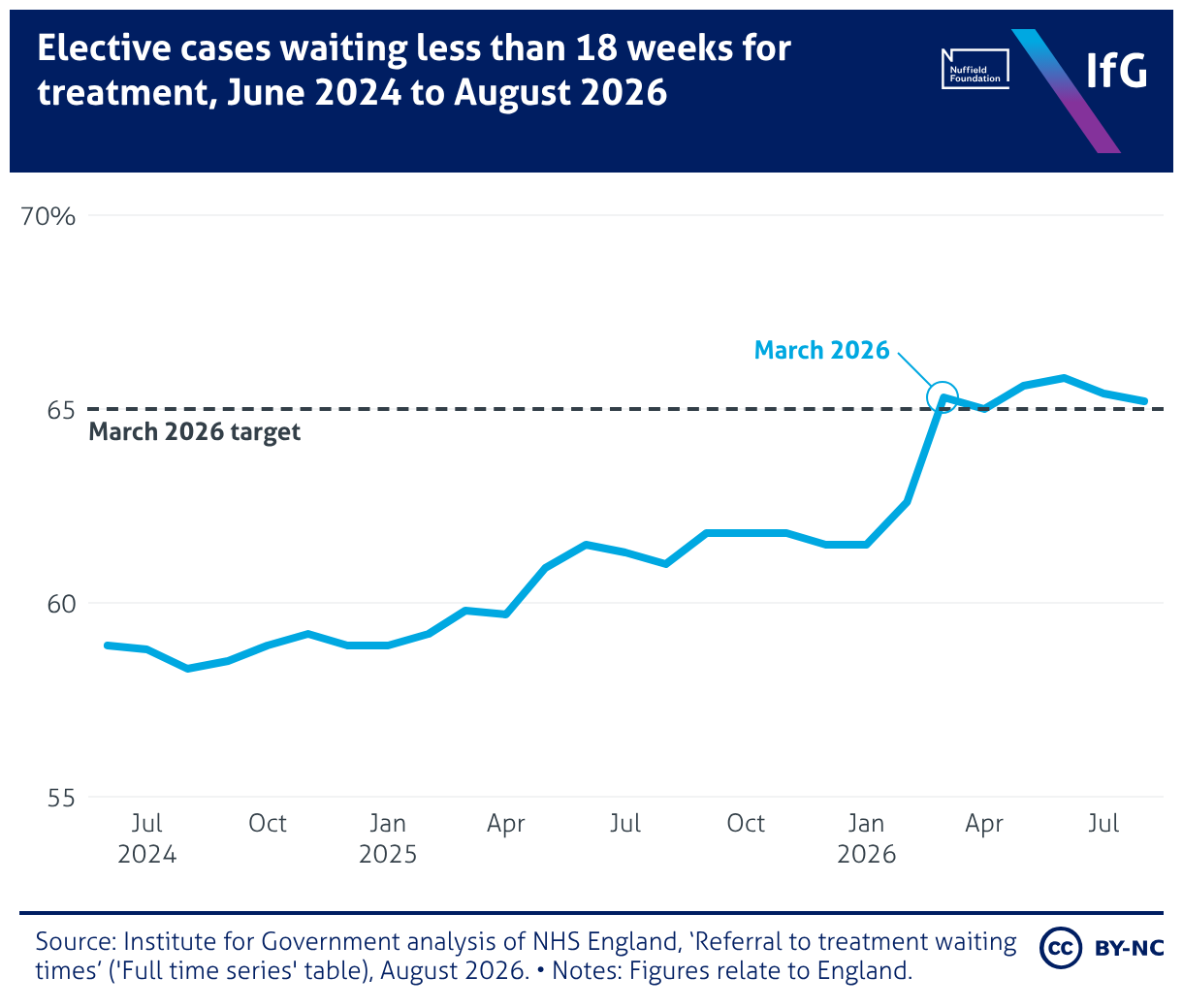
Between June 2024 and the end of 2025, the NHS made steady – though not dramatic – improvements in the elective waiting list. That improvement accelerated in the first months of 2026, meaning that in March 2026, there were 7.1 million cases waiting for care, a drop of 515,000 cases, or 6.8%, compared to June 2024. While an improvement, it is still historically very high: 2.5m cases (or 55.4%) higher than in February 2020, the eve of the Covid-19 pandemic.
That reduction in the waiting list led to improved performance on waiting times for elective care. In June 2024, just before the government took power, 58.9% of elective cases were waiting 18 weeks or less for care, far below the constitutional target of 92%. By March 2026, some 65.3% of cases had been waiting 18 weeks or less for care, a 6.4 percentage point increase from June 2024, meeting the first elective target.
Most of that improvement came between January and March 2026. At the end of January, 61.5% of cases had been waiting less than 18 weeks. The subsequent 3.8 percentage point (pp) improvement is the largest two-month gain on record (outside of the pandemic). As discussed in more depth below, trusts largely achieved this by delivering intensive operational activity, rather than more sustainable increases in activity, paid for with short-term, one-off funding.1 Institute for Government interview.
Since March 2026, however, progress has reversed. The waiting list grew by 264,000 cases between March and August 2026 and the proportion of cases waiting less than 18 weeks was marginally worse, at 65.2% in August.
Most trusts hit their targets for 2025/26
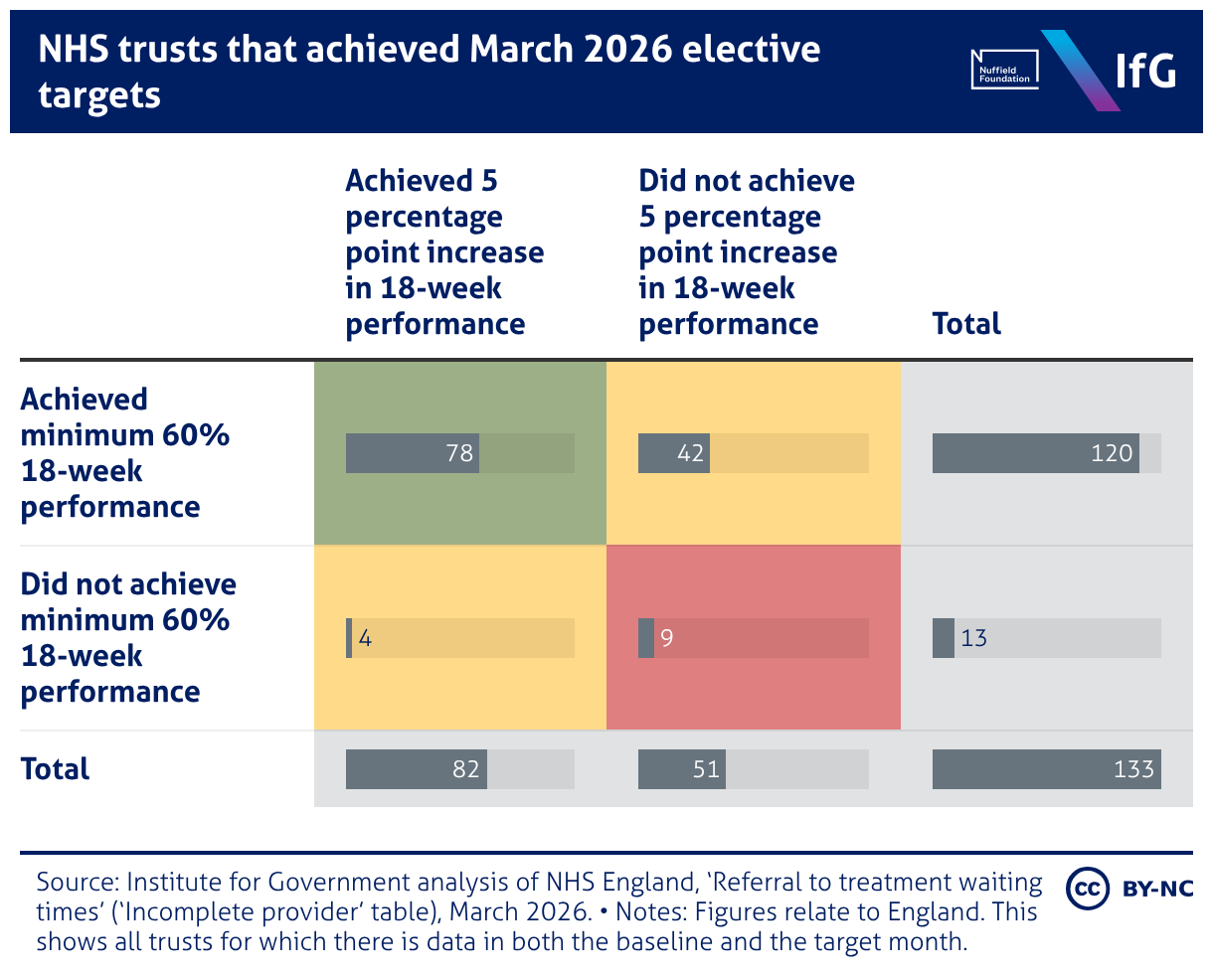
Alongside the national target, the NHS set a target for every trust to improve their elective performance by five percentage points by March 2026 (compared to a November 2024 baseline), with all trusts hitting a minimum of 60%.2
NHS England, ‘2025/26 priorities and operational planning guidance’, England.NHS.uk, 30 January 2025,
retrieved 17 September 2026, www.england.nhs.uk/publication/2025-26-priorities-and-operational-planning-guidance/
Of the 133 trusts for which there is consistent data between those two months, 58.6% hit both parts of their target while 6.8% hit neither part of their target. Of the remaining 46 trusts that hit one of the two targets, the vast majority (42) hit the minimum 60% target but not the 5pp increase.
Some trusts had exceptionally large increases in elective performance in that time, including 21 trusts that had a 10pp or greater improvement. The Princess Alexandra trust in Harlow, Essex had the largest increase: 22.4pp from 41.8% to 64.1%, through a combination of rigorous waiting list management, improved data quality from its new electronic patient record system, redesigning patient flow, optimising discharges and taking stronger operational grip on performance.1 Institute for Government interview.
Of those 21 trusts, 13 (61.9%) were in the bottom quartile of performance in November 2024. As a result, the range of performance among acute trusts has narrowed since Labour won the election, with particularly strong improvement among some of the worst performing trusts. In June 2024, there was a 44.7pp gap between the best and worst performing trusts and a 9.5pp gap between the trusts at the 25th and 75th percentiles. In August 2026, this narrowed to 33.3 and 6.8pp respectively.
The NHS missed its target for people waiting a long time
Alongside the 18-week target, the Labour government also gave the NHS the target to reduce the proportion of cases waiting more than 52 weeks to less than 1% by March 2026. This followed the NHS’s inability to eliminate them by March 2025, initially targeted by the Conservative government.1
Comptroller and Auditor General, Managing NHS backlogs and waiting times in England, Session 2022- 23,
HC 799, National Audit Office, 2022, p. 29, www.nao.org.uk/wp-content/uploads/2022/11/managing-NHS
backlogs-and-waiting-times-in-England-Report.pdf
There was improvement in that metric over the course of 2025/26: the proportion of cases fell from 2.4% in March 2025 to 1.3% in March 2026. This was still 0.3pp above the government’s target. Since then, it has increased slightly and in August 2026 sat at 1.5%.
Elective improvement was the result of a three-pronged approach
The elective waiting list shrank from September 2024 onwards because the NHS increased removals from the list by more than additions have increased. In 2025/26, the NHS removed* 21.8m cases from the waiting list (an increase of 3.5% compared to 2024/25), while only 21.5m were added (an increase of 2.6%). That has helped to bring the waiting list down, as described above.
*A removal can be because the NHS started treating that person, or because the NHS took the case off the waiting list for administrative reasons, such as if the person was uncontactable. Most removals are due to people completing treatment: 85.4% in 2026/26.
Interviewees gave three reasons for improved national figures: increased diversion of referrals, a greater focus on waiting list management and sprint funding in the final quarter of 2025/26.
As planned, the government diverted more referrals from the waiting list
The NHS adds a case to the elective waiting list following a referral from another part of the health system.* Before making a referral, professionals can use a mechanism called ‘specialist advice’ to consult with a specialist doctor in hospital. The specialist can recommend that they do not make the referral. This is known as a ‘diverted referral’.
Diverting referrals helps elective performance by lowering additions to the waiting list. Trusts can use the freed-up appointments to work through the cases already on the waiting list, reducing the time people wait for care.
It can also lead to better outcomes for the patient by providing a quicker route to expert input, rather than waiting months for care. The NHS says that diverted patients receive more appropriate and timely care elsewhere in the service, such as in general practice or community care. However, it is impossible to know if this is the case, as there is no public data that shows the outcomes of those who the NHS diverts.
Specialist advice is not a new tool and its use has grown gradually for years. In 2019, there were just over 600,000 requests for pre-referral specialist advice.** This rose to 2.6 million requests in 2023/24, the last full year the NHS was under Conservative control.
The Labour government rapidly identified this as a vital route to reducing waiting times for elective care. Therefore it further incentivised its use in 2025/26 by including a £20 payment for GPs for every request for advice they make, which the NHS said “will deliver up to 4 million advice requests from GPs in 2025/26”, up from 2.4 million in 2024/25.1
NHS England, ‘Reforming elective care for patients’, England.NHS.uk, 6 January 2025, retrieved 17 September
2026, www.england.nhs.uk/long-read/reforming-elective-care-for-patients
The number of requests did rise substantially that year, from 2.9 million to 3.6 million, a 23.7% increase.
* Most referrals come from general practice: roughly 62% in 2025/26. A referral from a secondary care consultant is the second most common source: 18%
** Technically, this was for Advice and Guidance, which is a type of pre-referral specialist advice, but for consistency and ease of reading, we will continue to refer to all of these as specialist advice.
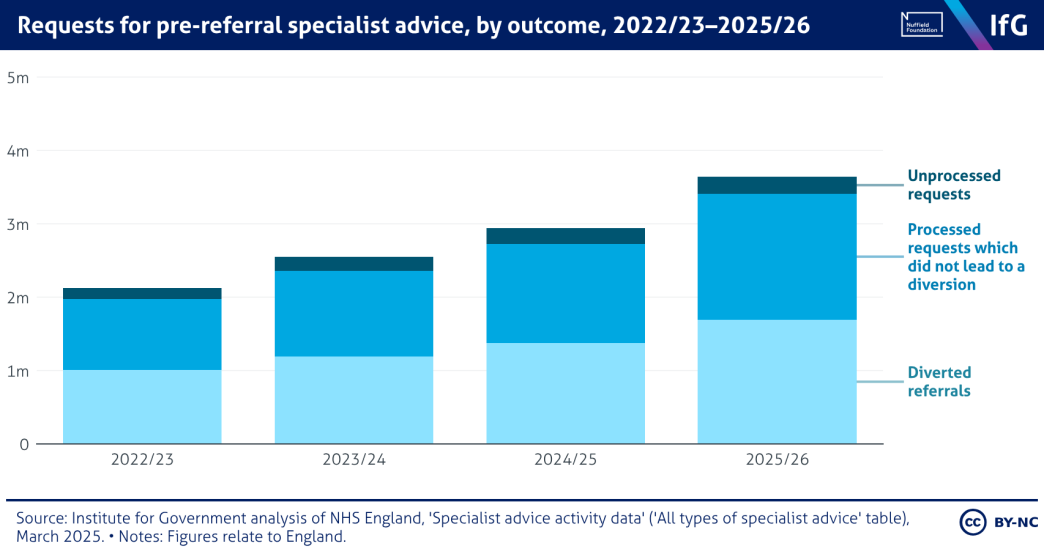
That resulted in 1.7m diverted referrals, a 23.1% increase compared to 2024/25 and meant that diversions rose from 6.6% of additions to the waiting list in 2024/25 to 7.9% in 2025/26.
Despite that increase in diverted referrals, interviewees told us that additions to the elective waiting list grew faster than expected in 2025/26, meaning that the waiting list fell by less than hoped, and making it harder for the NHS to meet the target for March 2026. Last year, 2025/26, was a record year for additions, reaching 21.5m, an increase of more than half a million (2.6%) compared to 2024/25. The government expected additions to grow by 2%,2 Institute for Government interview. meaning that there were just under 130,000 more additions than expected. That would have been higher if not for the growth in diverted referrals. If additions had been diverted at the same rate as 2024/25, there would have been 283,000 more additions, resulting in 4.0% growth, rather than 2.6%.*
Interviewees attributed that faster than expected increase at least in part to a rising number of GP appointments, the source of most referrals for the elective waiting list.
* And assuming that all diverted referrals would have resulted in an addition to the waiting list.
The number of GP appointments grew 2.4% between 2024/25 and 2025/26. That is the largest increase in GP appointments since the pandemic and above the average annual increase between 2019/20 and 2024/25 (1.7%). This is likely the result of the government successfully recruiting thousands more salaried GPs into the service (discussed in more depth below). That growth has accelerated further in the first five months of 2026/27. There were 5.6% more GP appointments in that time compared to the same period in 2025/26.
Additions to the waiting list that were the result of a referral from GPs grew even more quickly than the number of GP appointments between 2024/25, by 4.4%, meaning that a greater proportion of GP appointments resulted in an addition to the waiting list, despite more diverted referrals.*
* From publicly available data, it is very difficult to accurately calculate what proportion of GP appointments result in a referral.
There could be hidden costs to increased use of specialist advice
Interviewees expressed mixed views on the expanding use of specialist advice. One GP interviewee said that they have increasingly come to like it and called it a “common sense approach” which allows for better decision making.1 Institute for Government interview. Another interviewee argued that it makes more sense for some specialities – dermatology was the example they gave – than for others, where the condition might be more complex.2 Institute for Government interview.
But there was scepticism about its expanded use. An interviewee said that the NHS’s ambition to divert 25% of referrals by March 20273 Department of Health and Social Care, NHS England, ‘Neighbourhood health framework’, policy paper, Gov.uk, 17 March 2026, retrieved 17 September 2026, www.gov.uk/government/publications/neighbourhood-health-framework/neighbourhood-health-framework was “overambitious” and that they couldn’t “imagine it would be possible without a lot of additional resources in general practice to manage that [additional demand from patients not progressing to secondary care]”.4 Institute for Government interview.
The same interviewee pointed out that there still has not been a comprehensive evaluation of the effect of widespread use of specialist advice. For example, there is no understanding, or reporting, of what happens to a patient whose referral is diverted. They might return repeatedly to primary care or end up being referred to hospital later, when their condition has worsened.
A recently-published report by the Health Services Safety Investigations Body (HSSIB) redresses some of that evidence gap by providing an assessment of the impact of specialist advice on patient safety. That report found several concerns, including that some requests are delayed by months, that harm to patients had arisen due to delayed or missed diagnoses, and that there is substantial variation across the country in how areas implement specialist advice.5
Health Services Safety Investigations Body, Electronic patient record systems – electronic referrals for ongoing
care: advice and guidance, 18 August 2026, www.hssib.org.uk/patient-safety-investigations/electronic-patient-record-systems-electronic-referrals-for-ongoing-care/interim-report/
Specialist advice may also affect hospital doctors’ capacity. While it may reduce demand for outpatient care, it also takes time for clinicians to respond to requests for advice. An interviewee reported that currently this activity is not recognised within workforce planning and job plans.
The NHS is being more rigorous about waiting list management
The second factor which interviewees identified as supporting improved elective performance was the increased levels of validation. Validation is the process when a hospital regularly reviews patients on the waiting list to ensure they still require treatment. It could be that a decision has been made that alternative care is more appropriate, the patient has been treated elsewhere (for example, in the private sector) but has not alerted the NHS, or has died.
There is no data collected or published on the number of cases removed by validation. Many validation removals will show up in NHS data as ‘unreported removals’ from the elective waiting list. But that is still an imperfect proxy. This is because unreported removals also include patients who were removed for other reasons, such as if they received treatment that the NHS failed to report at the time.6 Illman J, ‘Exclusive: NHSE pays three trusts £1m each to remove patients from waiting lists’, HSJ, 9 June 2026, retrieved 17 September 2026, www.hsj.co.uk/quality-and-performance/exclusive-nhse-pays-three-trusts-1meach-to-remove-patients-from-waiting-lists/8023643.article Still, they are the best publicly available proxy about the extent of validation removals.
The government pushed for the NHS to undertake more extensive validation exercises in 2025/26 and paid trusts £33 for each validation removal.7Ibid. This payment was designed to cover the additional staff costs required to validate a higher proportion of the waiting list.
The NHS was successful: unreported removals increased from 2.9m in 2024/25 to 3.2m in 2025/26 (a rise of 7.9%), faster than the growth in completed cases due to treatment (2.3%).
The increase in unreported removals in 2025/26 led some commentators to argue that it is an unusual and illegitimate method of reducing the waiting list.1 Wright O, ‘Labour pays millions to make hospital stats more flattering’, The Times, 1 February 2026, retrieved 17 September 2026, www.thetimes.com/uk/politics/article/labour-nhs-waiting-lists-starmer-streeting-2cfxhm7c8 However, as a proportion of additions to the waiting list, unreported removals in 2025/26 remained below pre-pandemic levels. Unreported removals were 14.8% of additions in 2025/26 compared to 17.0% in 2016/17 (the first year for which there is data).
One interviewee argued that high staff turnover during and after the pandemic had led to a loss of expertise in waiting list management, reducing the quantity and quality of validation.2 Institute for Government interview. Another said that widespread pressure in the service during the pandemic diverted attention away from validation towards operational concerns. As a result, there was a higher number of errors in trusts’ waiting lists, such as duplicated cases, out of date records and patients that had received treatment elsewhere.
Validation is therefore an important component of effective waiting list management that cuts wasted administrative time in trusts and helps patients by reducing the amount of unnecessary contact from their hospital.
Last minute funding nudged the NHS over the line
The final factor which interviewees identified as driving improved performance was elective ‘sprint’ funding.3 Institute for Government interview. This is a pot of money worth £120m which the NHS gave to trusts between January and March 2026 to hit the 65% interim target.4 Illman J, ‘Exclusive: £120m ‘sprint’ will drive last-ditch attempt to hit elective target’, HSJ, 19 February 2026, retrieved 17 September 2026, www.hsj.co.uk/quality-and-performance/exclusive-120m-sprint-will-drive-last ditch-attempt-to-hit-elective-target/7041147.article
That money was allocated to short-term measures, such as increasing the number of first outpatient appointments (which is the stage at which most elective cases are closed), pushing even further on waiting list validation and targeting cases that had been waiting more than 18 weeks.5 Institute for Government interview.
The result was a record number of removals in March 2026: 2.1 million. The next highest month on record was October 2024 (1.9 million). It was also the highest number of unreported removals in a single month, at 352,000, with the next highest 332,000 in October 2018.
Sprint funding was also used to treat a record proportion of cases that had been waiting for more than 18 weeks in March 2026: 39.0% of all removed cases in that month. In comparison, only 33.2% of all cases treated in April to December 2025 (the 9 months of 2025/26 not covered by ‘sprint’ funding) had been waiting more than 18 weeks. The proportion then dropped back rapidly after March to 35.1% between April and August 2026.
There are questions about the efficacy of this funding. By its nature, trusts have targeted sprint funding at short-term initiatives to meet an immediate target. But that type of spending does nothing to address the structural drivers of demand, capacity constraints or pathway inefficiencies that contribute to waiting list growth.
One manager responsible for elective care in an acute trust told us that elective sprint money “is obviously welcome” but that it would have been better if the government had “spent the funding on care outside the hospital – in primary care and adult social care”1 Institute for Government interview. – as that would reduce demand for elective care in the long run. Instead, they were forced to spend the money on short-term initiatives.
The benefits of sprint funding are time constrained; there will be no real benefit for the service from that funding beyond the window that it was allocated, and indeed completed cases fell back after the funding finished and the waiting list grew again. One interviewee suggested that the more enduring benefit of elective policy in 2025/26 will be improved waiting list management, which will likely continue to lead to higher than otherwise validation removals.
The same interviewee said that building on those improvements will require the NHS to continue to focus on operational discipline and invest in the capability needed to carry out validation. That latter point could be problematic. As discussed in more detail below, financial pressure is leading trusts to cut non-clinical employees, potentially including those who would carry out validation. Additionally, there is probably an upper limit on the extent to which validation can improve elective performance – at a certain point trusts will run out of errors to find.
The NHS will not hit its elective target on current trajectory
The ambition to return to the 18-week target by March 2029 is incredibly stretching. It took the last Labour government more than a decade in power to make a large difference to elective waiting times2 Murray R, ‘Lessons from the 2000s: the ambition to reduce waits must be matched with patience and realism’, King’s Fund, 29 July 2021, retrieved 22 September 2026, www.kingsfund.org.uk/insight-and-analysis/long-reads/nhs-waiting-times and it did that alongside record increases in funding. Even then, the NHS only hit the 92% target in January 2012, two years after Labour left government.
At its core, hitting the 92% target requires the NHS to remove many more cases from the waiting list than it adds. But if the trend between April 2024 and April 2026 (removals growing at 3.2% and additions at 2.6% per year) continues until 2029, the NHS will miss its target. Under that central estimate, 78.7% of cases will be waiting less than 18 weeks by the end of March 2029 – more than 13pp lower than the target of 92%.*
* For more details about the modelling we used to calculate this figure, please see the Methodology.
While below the government’s target, this would be a substantial improvement on performance compared to June 2024, though would still be below the level of February 2020, the eve of the pandemic (82.9%).
However, there are a range of possible future trajectories of additions and removals from the waiting list.
Despite expanded use of specialist advice, additions to the waiting list grew at 2.6% per year between April 2024 and April 2026. That is higher than the 2.0% annual growth during the 2010s. If additions fell back to that level, performance would improve but would still be far short of the 92% target, all else being equal, at 82% (this is the “Additions slowdown scenario” in the table above).
Similarly, if the measures that the NHS is implementing to increase activity are successful (discussed below), and removals growth rises to 4.0% per year while additions growth remained constant, then this would lead to performance of roughly 82% in March 2029 (“Removals accelerate” scenario).
Even under our most optimistic scenario – in which additions slow to 2.0% and removals accelerate to 4.0% per year – the NHS would fall just short of the 92% target, at 88%.
Achieving either, let alone both, of those outcomes is extremely unlikely. Indeed, both trends have gone in the wrong direction in 2026/27: growth in removals has slowed while the rate of additions has accelerated. If those trends continue then performance would improve even more slowly, reaching just 72% by March 2029 (“Recent trends” scenario), before eventually falling again beyond the time horizon of this modelling.
The NHS is relying on several initiatives to accelerate performance
The NHS hopes that planned initiatives will further slow referral growth and increase activity. These include:
- Making it mandatory for GPs to seek specialist advice before most referrals, to achieve a “diversion rate of at least 25% by March 2027” in 10 of the areas of care with the highest volumes of referrals.1 Department of Health and Social Care, NHS England, ‘Neighbourhood health framework’, policy paper, Gov.uk, 17 March 2026, retrieved 30 September 2026, www.gov.uk/government/publications/neighbourhood-health-framework/neighbourhood-health-framework
- Deploying “crack teams” into trusts to improve performance.*
- Expanding the use of specialist hubs, which are parts of hospitals dedicated to elective activity,2 NHS England, ‘Surgical hubs’, Getting it right first time, (no date), retrieved 12 October 2026, https://gettingitrightfirsttime.co.uk/hvlc/surgical-hubs meaning that trusts cancel fewer elective appointments when there is high demand from other parts of the service.
- Continuing the roll out of community diagnostic centres (CDCs) – sites away from hospitals that provide diagnostic tests in more convenient locations for patients3 NHS England, ‘Community diagnostic centres’, NHS England, 29 July 2025, retrieved 12 October 2026, www.england.nhs.uk/longread/community-diagnostic-centres – to increase diagnostic capacity.
- Greater use of the private sector to expand capacity.
- Switching from a model of patients receiving a follow-up appointment by default, to having the appointment only if the patient wants it in “all clinically appropriate pathways”4 Department of Health and Social Care, Fit for the Future: 10 Year Health Plan for England, CP 1350, The Stationery Office, p. 39, https://assets.publishing.service.gov.uk/media/6888a0b1a11f859994409147/fit-for-the-future-10-year-health-plan-for-england.pdf , to free up more outpatient capacity. This is known as “patient-initiated follow-up”, or PIFU. Among other initiatives.5 NHS England, ‘Reforming elective care for patients’, 6 January 2025, retrieved 12 October 2025, www.england.nhs.uk/long-read/reforming-elective-care-for-patients/#reforming-delivery
Views on these initiatives are very mixed. While some GP interviewees were positive about specialist advice, they were far less supportive of mandating its use or having stretching targets that could distort care. Publicly, GP leaders claim that mandatory specialist advice takes away GPs’ right to refer and means they end up “rationing care”.6 Iacobucci G, ‘Patients at risk from new “advice and guidance” referral rules, GP leaders warn ‘, BMJ, 13 March 2026, retrieved 29 October 2026, https://www.bmj.com/content/392/bmj.s492
Specialist hubs, CDCs and use of the private sector have been successful in the past, particularly with certain specialties. But it is unclear how much additional capacity the NHS can wring from those sources.
Switching follow-up appointments has flatly failed in the past to reduce outpatient appointments and there is no explanation for why it will work this time.
The Health Foundation showed that the “crack teams” approach worked mostly by increasing unreported removals, rather than completed pathways, as touted by the NHS.7 Opie-Martin S and Tallack C, ‘Are “crack teams” reducing NHS waiting lists?’, blog, The Health Foundation, 15 April 2025, retrieved 9 November 2026, www.health.org.uk/features-and-opinion/blogs/are-crack-teams-reducing-nhs-waiting-lists As the experience from 2025/26 shows, this can help improve performance, but it is unclear how many additional removals this could create if scaled across the entire NHS.
Overall, there is evidence that some of these approaches improve elective performance. But it is very unclear if they will be sufficient to reach the 92% target by March 2029, particularly as many of these – specialist hubs, PIFU, use of the private sector and specialist advice – are by now relatively mature policies, where the easiest gains have been realised.
* This is called the “Further Faster 20” (FF20) programme.
There are also reasons to believe improvements may slow
Alongside those anticipated tailwinds for elective performance, there are some headwinds over the coming years.
One interviewee pointed out that national performance could improve more slowly as the best performing trusts reach high levels of performance.8 Institute for Government interview. They said that a small handful of trusts that have had elective performance in the region of 80% to 85% have pulled the national average up. But as those trusts approach or exceed the 92% target, the NHS will need worse performing trusts to make larger gains.
Another interviewee also said that performance is likely to become far more dependent on better diagnostic performance nearer the 92% target9 Institute for Government interview. – something the CEO of NHS England, Jim Mackey, has himself acknowledged.10 House of Commons Committee of Public Accounts, ‘Oral evidence: Reducing NHS waiting times for elective care’, HC 820, 11 September 2025, retrieved 9 November 2026, https://committees.parliament.uk/oralevidence/16463/html/ That is a problem as diagnostic performance is currently well below target level and has actually worsened throughout Labour’s time in power. Interviewees have suggested that is because it has been a low priority for trusts while they have been pursuing the elective target. It is welcome, therefore, that the government has prioritised this area with a target in 2027.
If faster growth of GP appointments is driving quicker-than-expected growth of additions to the waiting list, then the government faces somewhat of a tension between its ambition to expand access to primary care and its 18-week performance target. It has successfully increased the number of salaried GPs working in primary care, from 10,826 in June 2024 to 14,355 in August 2026, a 32.6% increase (though the number of GP partners continues to fall). The NHS hopes to accelerate the expansion of GP capacity in 2026/27.11 Opie-Martin S and Tallack C, ‘Are ‘crack teams’ reducing NHS waiting lists?’, The Health Foundation, 15 April 2025, retrieved 12 October 2026, www.health.org.uk/features-and-opinion/blogs/are-crack-teams-reducing-nhs-waiting-lists That seems to be bearing fruit: as already shown, GP appointments are growing much faster than in previous years. That is likely to mean that additions to the waiting list also grow more quickly than in recent years.
Finally, there could be further financial headwinds for the NHS. Since settlements were decided at the 2025 spending review, the inflation forecast has worsened, reducing the real terms generosity of the NHS’s allocation over the rest of this parliament. That situation could further worsen if Trump’s war with Iran results in yet more inflation.
As part of the 10YHP, the government also outlined its intention to shift funding away from acute hospitals. There is little evidence this has happened so far (as discussed further below), but if it does come to pass, then hospitals will struggle to increase activity.
Following a UK government agreement with the US government, the NHS will pay up to 25% more for branded pharmaceuticals in the future.1
Gainsbury S and Lomas J, ‘US-UK medicines partnership: the impact assessment of the costs and benefits must
be published’, Nuffield Trust, 13 May 2026, retrieved 12 October 2026, www.nuffieldtrust.org.uk/news-item/
us-uk-medicines-partnership-the-impact-assessment-of-its-costs-and-benefits-must-be-published
Analysis published in the British Medical Journal estimates that this will cost the NHS an additional £866m, £1.3bn, and £2.0bn in 2027, 2028, and 2029 respectively.2
Cross S, Claxton K and Hill A, ‘Health costs of the UK-US trade deal on pharmaceuticals’, BMJ, 1 July 2026, retrieved 29 October 2026, www.bmj.com/content/394/bmj-2026-340588?__cf_chl_f_ tk=KaCMbKw11ZC_u_1HqDMPElQBp8o6GN5.iwP9JVi6u3g-1783359340-1.0.1.1-IjKwiPVmOoFKwumtyTCZy8a vhFIni2sB2yKtn.1itHg
The government has not provided the NHS with further funding to cover that additional cost meaning that it will have to come from existing budgets.
With limited additional funding, the NHS may have to slow the growth in elective activity, putting its elective target further out of reach.
Away from elective care, performance in hospitals has improved less, if at all
Elective care is only one area where the government sets the NHS targets. There are many other metrics on which we should judge the government’s performance since 2024.
In 2025/26, the NHS missed hospital targets for cancer performance (receiving a diagnosis within 28 days of an urgent referral and starting treatment within 62 days of a referral), on ambulance response times (though this was a very near miss and followed substantial improvement) and on the proportion of people who wait more than 4 hours for care in accident and emergency (A&E) departments, though again this was a near miss, less than one percentage point below target.
The NHS hit its target for 12-hour waits despite minimal improvement
The other major target that the NHS hit was on long waits (12 hours or more) for care in A&E. But that was largely due to the target being incredibly unambitious, merely to improve on the previous year. Therefore, the NHS hit the target by reducing the proportion of people waiting 12 hours or more from 10.6% in 2024/25 to 10.0% in 2025/26.
Despite hitting the target, NHS performance is far from impressive on long waits. One in 10 attendees waited more than 12 hours for care in 2025/26. January 2026 was the second highest month for 12-hour waits on record, with 13.1% of attendees waiting more than 12 hours. The only month which was worse was December 2022, during the worst NHS winter crisis on record.
Waits of that long were virtually unheard of at the start of last decade. In 2011/12 (the first year for which there is data) only 0.6% of people attending A&E waited more than 12 hours. More people waited 12 hours or longer for care in 2025/26 than between April 2011 and August 2019.
The normalisation of 12-hour waits is worrying given their relationship with higher mortality rates.1 Jones S, Moulton C and others, ‘Association between delays to patient admission from the emergency department and all-cause 30 day mortality’, Emerg Med J, 2022, vol. 39, pp. 168–173, http://emj.bmj.com/content/emermed/39/3/168.full.pdf The Office for National Statistics (ONS) estimates that patients* who wait 12 hours in A&E were more than twice as likely to die in the following 30 days as those who waited two hours. The government and the NHS should not allow this extent of 12-hour waits to become normalised.2 ONS, ‘Association between time spent in emergency care and 30-day post-discharge mortality, England: March 2021 to April 2022’, ons.gov.uk, 17 January 2025, retrieved 12 October 2026, www.ons.gov.uk/peoplepopulationandcommunity/healthandsocialcare/healthcaresystem/bulletins/associationbetweentimespentinemergencycareand30daypostdisc…
Waits for community care are getting far worse for children
Away from acute hospitals, there are other areas where the NHS is not performing well.
The NHS has a target that 80% of cases waiting for community care – a wide range of support that the NHS provides to people outside of acute hospitals and primary care settings3 NHS England, ‘What are community health services?’, (no date), retrieved 12 October 2026, https://www.england.nhs.uk/community-health-services/what-are-community-health-services/ – should be seen within 18 weeks of a referral. It aims to hit that target in 2028/29, with an interim target of 78% by March 2027.
* Specifically, those requiring non-immediate care.
Since the general election, the NHS’s performance for all cases on the community waiting list has worsened slightly, from 76.0% in June 2024 to 75.8% in August 2026.
But there is a stark difference between children’s and adults’ services. Some 85.3% of adult cases were waiting less than 18 weeks in August 2026, up from 83.7% in June 2024, and already meeting the NHS’s target.
But performance on children’s services worsened considerably, falling from the already-poor 54.9% in June 2024 to 46.9% in August 2026, an eight-percentage point decline.
The story is worse still when looking at waits of more than 52 weeks. In January 2023, roughly one in 17 (5.9%) children on the list had waited more than a year. By August 2026, it was more than one in four (27.0%). That is a trend that started before Labour won the election, but the government has not been able to halt it since then.
One interviewee argued that the increase in long waits is due to higher demand from the special educational needs and disabilities (SEND) sector. They thought that higher demand for assessments for education, health and care plans (EHCPs), which is the most acute tier of provision, was putting more pressure on the community waiting list.1 Institute for Government interview. This would tally with the rising number of EHCPs that we describe in the schools chapter of this report.
The NHS has made little progress on its chosen metrics for general practice
In comparison to the acute hospital sector, the NHS sets primary care relatively few targets in the Medium-Term Planning Framework (MTPF). There are two targets for the sector. The first is that 90% of “clinically urgent appointments” happen on the same day they are booked. The NHS has set this target for every year between 2026/27 and 2028/29. The second is that patient experience of access to general practice improves year on year throughout that time.2 NHS England, ‘Medium Term Planning Framework – delivering change together 2026/27 to 2028/29’, (no date), p. 31, https://www.england.nhs.uk/wp-content/uploads/2025/10/medium-term-planning-framework-delivering-change-together-2026-27-to-2028-29.pdf
Unlike the metrics used for the acute hospital sector, both measures are relatively new. The NHS has never explicitly tracked or held general practice to account for the former. The latter comes from the Office for National Statistics’ (ONS’s) ‘Health Insight Survey’,3 ONS, ‘Health Insight Survey’, (no date), retrieved 12 October 2026, www.ons.gov.uk/surveys/informationforhouseholdsandindividuals/householdandindividualsurveys/healthinsightsurvey a dataset which the ONS has collected since only mid-2024.
Progress has been minimal on same-day urgent appointments
The MTPF does not offer a definition for an “urgent” appointment. In subsequent guidance, the NHS says that “It is for the GP practice to determine which patients are clinically urgent, in the same way they do now…based on the patient’s presenting complaint”.4 NHS England, ‘Recording same day appointments for all clinically urgent patients’, 16 March 2026, retrieved 12 October 2026, https://www.england.nhs.uk/long-read/recording-same-day-appointments-for-all-clinically urgent-patients
This metric changed little over the nearly first four years of available data. There was only a 1.3 percentage point increase (to 73.1%) from the year before the 2024 election to 2025/26, leaving the metric roughly 17 percentage points beneath the NHS’s target.*
Since the introduction of the target in April 2026, there may be some evidence, however, of a shift. The proportion of urgent appointments seen on the same day in August 2026 was 77.8% – 4.5 percentage points above the March 2026 level. This indicates that the NHS’s decision to track this from April 2026 has led to a rapid change in behaviour.
Forcing practice to prioritise urgent appointments may backfire
GP leaders have raised concerns about this target. The British Medical Association (BMA, the union that represents most doctors in England), argues that it puts more pressure on an already-overburdened general practice.1 Triggle N, ‘GPs told to guarantee same-day appointments for urgent cases’, BBC News, 24 February 2026, retrieved 12 October 2026, http://bbc.co.uk/news/articles/cm28vp0pkzro
One interviewee who works in general practice argued that the NHS’s decision to give practices discretion over what constitutes an urgent appointment was leading to “absolutely wild variation” in designating patients as urgent.2
Institute for Government interview.
This makes sense. If the government is holding practices to account for this metric, then there is a strong incentive for practices to only record the appointments they can see that day as urgent. If that is happening, then it severely undermines this metric’s usefulness.
* There is an issue with comparability here. This data shows the proportion of appointments in general practice that are recorded as “general consultation acute” that happen on the same day. This is the category of appointment that the NHS wants practices to use to record “urgent” appointments, starting from April 2026. That means the data recorded in practice systems between October 2022 and March 2026 may be different to the data recorded from April 2026 onwards, as practices change what they consider to be a “general
consultation acute” appointment. Still, this is the best approximation that is available against which to compare current performance.
There has been little change in patients’ views of general practice, according to the ONS
The NHS is targeting ‘year on year’ improvement in the ONS’s metric of patient experience of general practice. So far, the ONS has only collected two years’ worth of data from this survey. When comparing the two years, the NHS has achieved its target, but only just, with the number of patients reporting a good experience of general practice,* rising from 72.5% to 73.1%.
There are concerns about the quality of the data
A recent editorial in the British Journal of General Practice identified some limitations of the Health Insight Survey (HIS). These include the representativeness of the ONS surveys, smaller sample sizes at ICB level, and falling response rates over time.1 Routledge J, Opie-Martin S and Pettigrew L, ‘ONS Health Insight Survey in general practice: insight, not oversight’, British Journal of General Practice, 2026, vol. 76, no. 767, pp. 248–249, https://bjgp.org/content/76/767/248
The authors argue this makes it difficult to interpret change over time and raise concerns about the NHS’s ambition to use this to performance manage ICBs. It is also difficult to understand variation between practices, as the sample size is too small to draw conclusions about individual practices.2Ibid.
Instead, the authors urge the NHS to use this alongside the longer-standing annual General Practice Patient Survey (GPPS), which uses a larger sample size and allows for better comparison between practices and over time.3Ibid.
* The Health Insight Survey asks patients the question “Overall, how would you describe your experience of your GP practice?”
The annual patient survey shows satisfaction with general practice is gradually improving
The results of the 2026 GPPS show continued gradual improvements in the proportion of patients satisfied with general practice: rising from 75.4% in 2025 to 76.7% in 2026. It is not possible to compare 2026 performance with any result before 2024, but given the large drop in performance between 2018 and 2023, it is likely that satisfaction has not recovered to pre-pandemic levels.
There have been stumbling blocks to improved performance
Alongside the measures described in the electives section above, interviewees claimed that there were other factors which made it harder than expected for the NHS to improve performance.
Industrial action reduced activity
After resolving their dispute with the government soon after the 2024 general election, resident doctors* returned to picket lines in the summer of 2025. Throughout 2025/26, resident doctors walked out on three occasions: in July, November and December 2025 for a total of 15 days. That resulted in 127,036 cancelled or rescheduled elective appointments or operations.1 NHS England, ‘Data on the impact of the industrial action by resident doctors from the British Medical Association (BMA)’, 14 May 2026, retrieved 12 October 2026, http://england.nhs.uk/publication/preparedness for-potential-industrial-action-in-the-nhs/#heading-3
Not all those appointments would have resulted in a case leaving the elective waiting list. One interviewee told us that each round of strike action resulted in approximately 20,000 fewer removals from the waiting list.2 Institute for Government interview. If so, that means the waiting list was 60,000 cases (0.8%) higher by March 2026 than it would have been in the absence of industrial action.
In June 2026, the government and the BMA reached an agreement that brought the latest round of resident doctor strike action to a conclusion.3 Roberts M, ‘Resident doctors in England accept pay deal and end strikes’, BBC News, 29 June 2026, retrieved 12 October 2026, www.bbc.co.uk/news/articles/cwy01n5z48qo However, the NHS cannot rest easy. Consultants voted in favour of strike action in July 2026, and are due to walk out for 48 hours between 25 and 27 of November 2026.4 Tonkin T, ‘Consultants announce strike action ’, British Medical Association, 26 October 2026, retrieved 4 November 2026, www.bma.org.uk/news-and-opinion/consultants-announce-strike-action
Tight finances held back activity, particularly at the start of 2025/26
The 10YHP claims that the NHS “has developed an addiction to deficits” and that the government will “restore financial discipline”.5 Department of Health and Social Care, Fit for the Future: 10 Year Health Plan for England, CP 1350, The Stationery Office, p.133, https://assets.publishing.service.gov.uk/media/6888a0b1a11f859994409147/fit-for-the-future-10-year-health-plan-for-england.pdf NHS trusts ran deficits in every year between 2013/14 and 2024/25, except for 2020/21 and 2021/22 when there was additional funding to meet Covid pressures.6 The King’s Fund, ‘NHS funding deficits’, 12 March 2026, retrieved 12 October 2026, https://www.kingsfund.org.uk/insight-and-analysis/data-and-charts/nhs-trusts-deficit
The government made financial balance a strong focus of its agenda for the NHS in 2025/26. That seems to have worked. The Institute for Fiscal Studies (IFS) shows that the NHS largely stuck to its budget for 2025/26.7 Harvey-Rich O and Warner M, ‘Is the era of annual NHS top-ups over?’, IFS, 28 August 2026, retrieved 12 October 2026, https://ifs.org.uk/articles/era-annual-nhs-top-ups-over
Financial discipline comes at a cost, however: there is a direct trade-off between financial constraint and NHS activity.8
The NHS Alliance, ‘Targets and trade-offs: NHS finance and performance ambitions in 2026/27’, 18 May 2026, retrieved 12 October 2026, https://thenhsalliance.org/resources/targets-and-trade-offs-cost-of-nhs-finance-and-performance-ambitions
For example, interviewees told us that trusts did not undertake additional elective activity that would help reduce the elective waiting list, as doing so would incur further costs.9
Institute for Government interview.
At the Institute for Government conference in January 2026, then-health and social care secretary Wes Streeting acknowledged that aiming for financial balance was leading to lower elective activity: “some parts of the service… have over-steered and are therefore under-delivering on elective activity”.10
Tidman Z, ‘Streeting accuses trusts and ICBs of seeking to cut deficits too sharply’, HSJ, 13 January 2026, retrieved 12 October 2026, https://www.hsj.co.uk/finance-and-efficiency/streeting-accuses-trusts-and-icbs of-seeking-to-cut-deficits-too-sharply/7040794.article
* Previously known as junior doctors.
Some of the effect of the cost cutting drive is visible in staffing data. Between April 2019 and June 2024, the number of clinical and non-clinical staff* working in NHS trusts grew in lockstep, by 23%. Since then, growth rates have diverged. Between March 2025 and July 2026, clinical staff grew by 1.7% while non-clinical staff shrank by 1.6%. Interviewees working in trusts said that cutting non-clinical staff was one of their organisation’s first responses to tight financial pressure.
As our previous work has shown, cutting management, admin and back-office staff is often a false economy, resulting in worse productivity as vital work is shifted to clinical staff and effective decision-making capacity across systems is reduced.
* This includes managers, support staff for doctors, nurses and ambulance staff and those working in central functions such as HR.
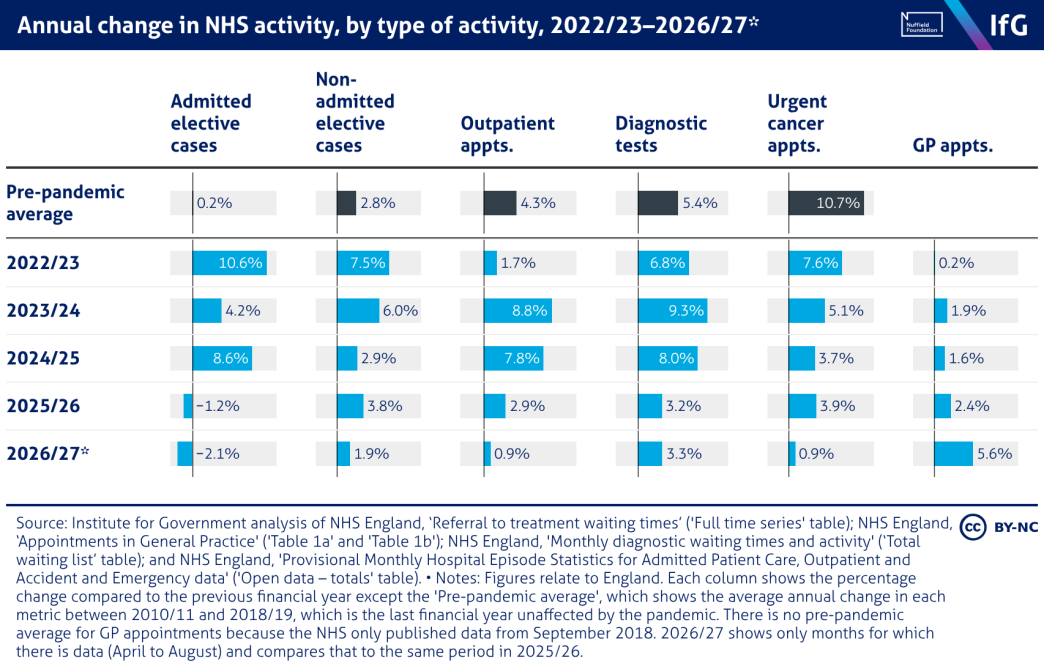
Similarly, there was a slowdown in the growth of NHS activity in 2025/26. The rate at which diagnostic tests, outpatient appointments, and urgent cancer appointments grew was lower compared to the previous year and was the slowest growth since 2023/24. In the case of admitted elective cases, there was a decline in activity. Growth in all those areas was well below pre-pandemic average annual growth rates.*
This general slowdown is almost certainly the result of tighter financial control, as trusts slowed activity to remain within their budgets. The exception is completed non-admitted elective cases, where the growth rate ticked up in 2025/26 compared to 2024/25 and was above pre-pandemic levels.
That pattern seems to have worsened in the first five months of 2026/27, with growth further slowing in elective care, outpatient and urgent cancer care. The exception is GP appointments, where activity has accelerated.
By choosing elective performance as the ‘milestone’ for the NHS mission, the government drove the NHS to focus more attention and resources on that area of care in 2025/26. When combined with tight financial control, the result is slow performance improvements in other parts of the system – A&E and diagnostic test waiting times, among others.
The early indication from the first few months of 2026/27 is that this pattern has continued, though even elective care no longer seems immune, with activity growth slowly considerably there too.
* The exception to this is general practice, where there is no comparable pre-pandemic data.
Cooper should adjust the elective target and clarify other performance priorities
As shown, the current target to treat 92% of elective cases within 18 weeks of a referral by March 2029 is almost certainly unachievable. That focus on electives also comes at the expense of other important areas of NHS performance and, as we show beneath, is making it harder for the government to achieve its wider goals for the system, such as moving care into the community.
There is little point, therefore, in pushing the service to hit an unachievable target while sacrificing other goals.
Cooper and Burnham should adjust the elective target. They should aim to return performance to 83%, the performance level on the eve of the pandemic. This lower level has a few benefits. It is stretching but achievable, as our analysis above shows, which is important to avoid demoralising staff. It will also allow for more flexibility of focus across systems, avoiding the distorting features of the current target. Finally, it still provides the government with a strong political story. Burnham and Cooper could legitimately argue that they had cleared the pandemic backlog.
They should also reassess their commitment to other NHS targets. The lesson from using electives as the milestone for the NHS mission is that the system responds strongly to political prioritisation. Cooper and Burnham should ensure that the targets the NHS is pursuing support their wider priorities. Where they do not, they should either pare them back or drop them entirely. This will require a wider assessment of whether they want to stick to the same priorities as Starmer and Streeting, particularly around the 10YHP.
NHS reorganisation
In March 2025, the Starmer government first announced the abolition of NHS England – the arm’s length body tasked with running the day-to-day operations of the NHS since 2013 – and its intention to bring some of its functions and staff into DHSC. It then announced a major cost cutting exercise in NHS integrated care boards (ICBs), the organisations established in 2022 to better integrate health and care services in a local area.
Progress on abolishing NHSE and merging it into the department has been slow
We have argued repeatedly that the government botched its March 2025 announcement of the abolition of NHSE. Chaotic early days do not necessarily condemn the rest of the process to failure. The government could have run the abolition and merger with DHSC more effectively. But that has not been the case.
There has been progress since the announcement. Some teams – such as the strategy teams – merged very quickly after the announcement. Other teams, such as policy, have followed. In January 2026, the Starmer government announced the ‘indicative timeline’ for the abolition to staff, which laid out milestones such as the publication of a ‘target operating model’ by the end of May 2026, and confirmation that the merger will be finalised by April 2027 (though headcount reduction may continue after that).1 Kituno N, ‘DHSC-NHSE merger timetable revealed’, HSJ, 27 January 2026, retrieved 12 October 2026, http://hsj.co.uk/workforce/dhsc-nhse-merger-timetable-revealed/7040985.article There has been slippage against that timeline: as of November 2026, the government still has not published the target operating model.
The government has also introduced the Health Bill to parliament which will abolish NHS England, alongside other changes, such as the introduction of the single patient record and the abolition of Healthwatch England. That bill is currently passing through parliament. Following uncertainty during Cooper’s first months in her role,2 Anderson H, ‘NHSE abolition on the cusp of being delayed’, HSJ, 15 October 2026, retrieved 23 October 2026, www.hsj.co.uk/policy-and-regulation/nhse-abolition-on-the-cusp-of-being-delayed/8124580.article she announced that the government will establish “a transitional Special Health Authority to host the NHS regions that is accountable to the Secretary of State through the NHS Group within the Department”.3 Cooper Y, Letter to Layla Moran, chair of the Health and Social Care select committee, ‘An update on DHSC NHSE transformation’, 4 November 2026, https://committees.parliament.uk/publications/55696/standard/pdf That brings slightly more clarity to the future structure, though still leaves key questions unanswered.
The targeted headcount cuts are extremely challenging
One of the most drastic parts of the March 2025 announcement was the ambition to cut 50% of staff working in DHSC and NHSE. At that point, there were 18,236 full-time equivalent (FTE) employees working across both organisations. A 50% reduction in staffing therefore implies a cut of 9,118 FTE staff.
In August 2026, there were 15,560 staff working in both organisations, a fall of 2,676 or 14.7% since March 2025.
Headcount reduction has so far been shared equally across NHSE and DHSC. The former has reduced its workforce by 14.6% and the latter by 14.9%. The government still needs to make extensive cuts to reach its target, a further 6,442 FTE staff.
The extent of the planned cut to the workforce is extreme. The government is right that there is some duplication of roles between DHSC and NHSE. But it is unlikely that half of staff across NHSE and DHSC are simply not needed, particularly as the government is also cutting staff in ICBs, as discussed below. Previous IfG and Nuffield Trust work showed that roughly 45% of staff working in NHSE and DHSC are operational staff, meaning that to achieve headcount cuts of 50% while protecting operational roles would require 9 in 10 policy roles to be cut.
Interviewees and Streeting himself clarified that the final headcount might differ from the 50% (by a few percentage points in either direction) following a more thorough assessment of the needs of the future department.1 Health and Social Care Committee, ‘Oral evidence: The work of NHS England’, House of Commons, HC 563, 8 April 2025, Q.214, https://committees.parliament.uk/oralevidence/15740/pdf But even with that flexibility, the commitment to deliver such extensive cuts may end up distorting final decisions about size and structure of the department, potentially leading to inefficiencies from an under-resourced centre.
There is also a risk that the government achieves its target headcount number, but then immediately starts growing the department again, to reach a sufficient level of staffing. That would be highly inefficient, and would result in many experienced staff leaving, only to be replaced by less experienced recruits.
The government has found integrating DHSC and NHSE more difficult than expected
While there has been some progress on integrating the two organisations, interviews reveal the process has not been smooth.
Some staff described problems of having a manager from the other organisation, making it hard to see them frequently. These issues will likely abate as the merger progresses.
More concerning are reports of a ‘culture clash’ between the two organisations. Some interviewees reported that NHSE staff tend to be more inward looking and defensive than DHSC colleagues. Others said that DHSC staff tend to be less expert in some policy areas than NHSE counterparts, particularly in operational areas.
Maybe more than anything else, pay has emerged as a sticking point. NHSE staff are on (often far) higher salaries than counterparts in DHSC. For example, the Health Services Journal (HSJ) reports that a grade 6 (the last civil service grade before the senior civil service) in DHSC is paid between £70,730 and £78,721, while equivalent staff in NHSE are paid between £79,504 and £108,814.2 Kituno N, ‘On call: the big NHSE-DHSC pay divide’, HSJ, 5 March 2026, retrieved 12 October 2026, www.hsj.co.uk/expert-briefings/on-call-the-big-nhse-dhsc-pay-divide/7041160.article However, civil servants receive better pension benefits than NHSE staff.
The government currently plans to keep NHSE staff on the same salaries when they enter the department. It has not yet clarified what will happen when staff subsequently move roles, leaving open the possibility that staff will then move onto the civil service pay scale, effectively taking a pay cut at that point. If this comes to pass, it could disincentivise staff from moving into new roles and brings a real risk that staff with operational expertise – many of whom currently work in NHS regions – will leave the service rather than accept civil service pay and conditions.
As a result of this uncertainty, interviewees and public reports3 Collins A and West D, ‘NHSE staff could be kept out of DHSC’, HSJ, 3 September 2026, retrieved 12 October 2026, http://hsj.co.uk/policy-and-regulation/nhse-staff-could-be-kept-out-of-dhsc/8124229.article indicated that the government may create a new organisation outside of the department to house certain functions and staff to reduce the risk that they leave. These reports seem to have been proved right with the government’s announcement about the establishment of the Special Health Authority (SHA) to host the NHS regions. This may allow the NHS to pay staff more than they would receive in DHSC, thus retaining them when they may otherwise leave.
Another option that one interviewee suggested was to give NHSE staff who move into DHSC an additional specialist pay allowance on top of their base pay. The civil service already uses this uplift to recruit and retain staff with specialist skills, for example in digital and data.4 Government Digital Service, ‘What we do at GDS’, Civil Service Careers, (no date), retrieved 12 October 2026, www.civil-service-careers.gov.uk/gds-what-we-do-at-gds Another interviewee with experience of another departmental merger said that departments can end up classifying many staff as specialists due to lack of clear definition.
A lack of political direction means the process is drifting, disrupting the rest of the agenda
Interviewees report that the root cause of much of this uncertainty – over the target operating model, the status of NHSE staff and even whether there will be an organisation that replaces NHSE outside the department – stems from Streeting’s failure to provide sufficient political direction for the process.
In the absence of political direction, senior leaders in DHSC and NHSE have been left to fight for their own versions of a future NHS. Unsurprisingly, NHSE leaders want to maintain some kind of operational independence from government, to avoid what they see as undue political interference, while DHSC wants to bring more power into the department. The stories emerging in the press are a symptom of this, with each side briefing journalists about their preferred outcome.
That has created immense uncertainty for staff. Many do not know if they will have jobs – or even what organisation they will be working in – come April 2027. One interviewee described the process as “utter chaos”.5 Institute for Government interview. Other interviewees expressed similar intense unhappiness with the communication and progress of the merger.
That sentiment is supported by data. Of all the departments in Whitehall, DHSC had the largest drop in its civil service ‘engagement score’* in 2025 compared to 2024: 5.7 percentage points (albeit after a 5-percentage point increase in 2024 compared to 2023).
When asked whether they believe that their organisation’s senior leaders have a clear vision for the future of the department, the change was even more dramatic: an 18.8 percentage point drop in 2025 compared to 2024. The next largest decline was 9.5 percentage points, in the Department for Science, Innovation and Technology (DSIT).
* Essentially the morale of a department in any given year
While those survey results are a snapshot of sentiment in DHSC in September and October 2025,1 Intellectual Property Office, ‘People survey results’, Gov.uk, 27 February 2026, retrieved 12 October 2026, www.gov.uk/government/publications/people-survey-results-2025 interviewees conveyed similar sentiments in the summer and autumn of 2026.
The reorganisation has wider implications for performance in the NHS. Embroiled in the unresolved debate about the future of DHSC, interviewees tell us that leaders in both organisations have less time to spend working out how to implement the 10 Year Health Plan for England, or drive performance improvement.
Yvette Cooper needs to grip the NHSE abolition
The new secretary of state needs to quickly provide the political direction her predecessor did not. It should not have taken more than 18 months since the abolition announcement for the decision on the SHA to be made, but it makes sense for the future of NHS regions to be decided as part of wider discussions on how to ‘rewire the state’ and for there to be a transitional arrangement in the meantime.
She should further clarify the future organisational structure of the department and the NHS, including whether the SHA is intended to be a permanent organisation or only temporary, and which functions or teams she expects will sit within NHS regions. That should include considerations over how to retain sufficient NHSE staff with the expertise needed to run the future organisation.
Cooper should ignore the arbitrary headcount target set by her predecessor. She should assess the capacity and capability that the future structure needs and staff it accordingly. If she deems that the 50% cut would result in poor performance and inefficiencies, then she should abandon it. Any reduction in savings from smaller cuts will be more than offset by more effective running of the largest public service in the country.
The government’s reorganisation of ICBs has been equally chaotic
In March 2025, the government also announced that ICBs would need to cut their operating costs by 50% by October of that year.2 Digital Health, ‘Model Integrated Care Board – Blueprint v1.0’, (no date), p. 18, https://www.digitalhealth.net/wp-content/uploads/2025/05/Model-Integrated-Care-Board-%E2%80%93-Blueprint-v1.0.pdf As a result, many ICBs started the process of merging or clustering with neighbours.
The government has handled the ICB reorganisation abysmally. The announcement came out of the blue, catching leaders unaware, and was the second time that ICBs had been forced to reorganise since their establishment in only 2022. The government then repeatedly set unrealistic timelines for the reorganisation, before having to push them back. The initial October 2025 deadline for cost cutting was pushed back to December 2025. That too proved impossible, when it transpired that ICBs did not have sufficient funding to pay for mandated redundancies,3 Campbell D and Bawden A, ‘Labour’s NHS job cuts plan in chaos amid row over £1bn costs’, The Guardian, 20 September 2025, retrieved 9 November 2026, www.theguardian.com/society/2025/sep/20/nhs-integrated care-boards-england-job-cuts-row triggering a months-long negotiation between DHSC and the Treasury.4 Lovell T, ‘Wes Streeting gives the go ahead for ICB and NHS job cuts’, Digital Health, 12 November 2025, retrieved 9 November 2026, https://www.digitalhealth.net/2025/11/wes-streeting-gives-the-go-ahead-for-icb-and-nhs-job-cuts/
In interviews with the Health Foundation, one ICB leader described the decision-making process as more “on the hoof” than previous reorganisations.5 Arnold-Forster A, Dunn P and others, ‘Integrated care systems in England: where next?’, health.org.uk, 2026, p. 28, www.health.org.uk/sites/default/files/upload/publications/2026/ICS%20report_Final.pdf Other leaders were less polite, calling the process “disgraceful”, “unprofessional”, and “an absolute shitshow”.6Ibid. That is echoed by our own interviews. One interviewee described the government’s handling of the process as “a shambles”.7 Institute for Government interview.
While painful for staff, Burnham is right to align ICB boundaries with mayoral authorities
To add further to the uncertainty of this reorganisation, the Burnham government announced that ICBs would now be required to align their boundaries with strategic authority (SA) boundaries.8 Cabinet Office, ‘Rewiring the State – Cabinet Statement’, policy paper, gov.uk, 31 July 2026, retrieved 17 July 2026, https://www.gov.uk/government/publications/rewiring-the-state-cabinet-statement/rewiring-the-state-cabinet-statement-html This is in contrast to the approach taken under Streeting when the NHS was allowed to design ICB boundaries in line with its own priorities.9 Anderson H, ‘ICBs told to redraw boundaries again’, HSJ, 31 July 2026, retrieved 12 October 2026, https://www.hsj.co.uk/policy-and-regulation/icbs-told-to-redraw-boundaries-again/8123939.article
That will mean a further round of reorganisation, including for ICBs that have just finished their restructure. In October 2026, the government confirmed that it has paused the reorganisation of 20 ICBs that were due to merge in April 2027 until “at least 2028” while it considers how to fulfil the prime minister’s goal of aligning services’ boundaries.10 Launder M, ‘ICB mergers suspended due to ‘devolution discussions’’, HSJ, 7 October 2026, retrieved 12 October 2026, www.hsj.co.uk/policy-and-regulation/icb-mergers-suspended-due-to-devolution discussions/8124509.article
That decision will extend uncertainty for staff and further slow delivery of the government’s goals, an incredibly frustrating outcome for the staff working in ICBs. The 2025 NHS staff survey showed that all 20 of the ICBs that had results in both 2024 and 2025 reported declines in morale and staff engagement. All but one reported a decline in staff motivation (the one ICB that improved did so by only 0.01 out of 10). Nineteen out of the 20 had a decline in morale that was larger than the NHS-wide result. The average decline in morale among ICB staff was 0.44 (on a scale from 1 to 10) compared to 0.06 across the entire NHS.
That low morale holds back the government’s reform agenda, much of which relies on ICB staff to implement strategy. Launching another reorganisation likely means that low morale will continue throughout this parliament.
Despite that, the government is right to ensure that ICB boundaries align with SA boundaries. Aligned boundaries support better integration of services and, in a world where mayors set more of the NHS’s priorities, allow for greater accountability of local NHS leaders, as we’ve argued before.
To support Burnham’s devolution agenda, the government should therefore align ICB and SA boundaries on a one-to-one basis, so that a single mayor can hold local NHS leaders to account.
Given that some Mayoral Strategic Authority (MSA) footprints are smaller than current ICB footprints, some argue that it should be possible for a single ICB to contain multiple MSAs. We argue that having multiple MSAs within a single ICB hugely dilutes that vital accountability by making it impossible for ICB leaders to choose between the priorities of mayors that may come from different parties or simply have different objectives.
Constant disruption to ICBs is undoubtedly poor for morale and for the government’s wider objectives for the NHS. But aligned boundaries are a necessary bedrock of any government’s desire to further devolve responsibility for services. Ideally, the Starmer government would have taken more time to consider the entire landscape of services’ boundaries before launching ICBs into a disruptive reorganisation, and his government rather than Burnham’s deserves blame for ongoing disruption. The goal now should be to create a coherent set of organisations across all public services and then refrain from further reorganisations.
The government has been consistently unclear about the purpose of the reorganisation
The government has provided multiple rationales for the reorganisation. When Jim Mackey first briefed system leaders about the cuts, he framed them as part of the NHS’s attempt to erase its deficit.1 West D, Anderson H and Kituno N, ‘ICBs ordered to cut costs by 50%’, HSJ, 12 March 2025, retrieved 12 October 2026, www.hsj.co.uk/policy-and-regulation/icbs-ordered-to-cut-costs-by-50/7038846.article
Subsequently, the government has pushed the idea of ICBs as “strategic commissioners”, in other words pursuing improved population health outcomes through effective purchasing of services.2
Integrated Care Systems Network, ‘Strategic commissioning’, NHS Alliance, 2025, https://nhs-alliance.uksouth01.umbraco.io/media/xvvjqrny/pioneers-of-reform-summary.pdf
That is a worthy, if not novel, aim.3
Smith S, ‘Same cycle – different bike?’, The King’s Fund, 22 July 2025, retrieved 12 October 2026, https://www.kingsfund.org.uk/insight-and-analysis/blogs/same-cycle-different-bike-strategic-commissioning-population-health
To achieve that, the government is giving ICBs more power over commissioning, including over primary care services, which currently sits in NHSE.4
Department of Health and Social Care, ‘Health Bill: ICBs as strategic commissioners – fact sheet’, Gov.uk, 9 September 2026, retrieved 12 October 2026, https://www.gov.uk/government/publications/health-bill-icbs-as-strategic-commissioners-fact-sheet/health-bill-icbs-as-strategic-commissioners-fact-sh…
Crucially, though, being able to effectively fulfil the role of strategic commissioning requires slimming down ICBs’ other responsibilities.5
Gault B, ‘Strategic commissioning: how it will shift the role of ICBs’, Healthcare Leader News, 29 July 2026, retrieved 12 October 2026, https://healthcareleadernews.com/integrated-care-boards/strategic-commissioning-how-it-will-shift-the-role-of-icbs/
Following the publication of the “model ICB blueprint”, it looked like the government was going to follow through on that goal by substantially cutting the functions that ICBs are responsible for. Since then, however, the government has flip-flopped. One interviewee reported that of the 18 functions or activities that the NHS initially classed as under “review for transfer” out of ICBs,6
Digital Health, ‘Model Integrated Care Board – Blueprint v1.0’, (no date), p. 13, https://www.digitalhealth.net/wp-content/uploads/2025/05/Model-Integrated-Care-Board-%E2%80%93-Blueprint-v1.0.pdf
it has decided to keep 14 within ICBs, raising questions about how effectively ICB staff will be able to focus on strategic commissioning, especially following cuts of 50%.
Worse, having been told they would no longer have responsibility for those 14 functions, many ICBs made the staff delivering them redundant.7 Institute for Government interview.
The scale and speed of cuts mean the NHS could lose key capabilities
The combination of deep cuts, an unclear vision for the system and a pressing timeline will make it very difficult for DHSC and ICBs to retain key staff.
For example, previous IfG work shows that confusion over whether ICBs would be responsible for special educational needs and disability (SEND) services led to ICBs heavily cutting those staff, despite DHSC eventually deciding that they would continue to fulfil that function.
Another example is medicines optimisation in ICBs.*,8 NHS England, ‘Regional arrangements for medicines optimisation in the NHS in England’, 31 July 2023, retrieved 12 October 2026, www.england.nhs.uk/long-read/regional-arrangements-for-medicines-optimisation-in-the-nhs-in-england Interviewees spoke positively about the cost savings that arose from effectively staffing that function but said that it was an area that had been subjected to heavy cuts, as ICBs no longer have a statutory duty to fulfil this function.9 Institute for Government interview.
Interviewees also said that ICBs face a trade-off over whether to invest in strategic commissioning skills and the staff needed to deliver the statutory functions which remain the responsibility of ICBs.
The same story holds in the centre of the NHS. So far, exits from DHSC have been managed mostly through voluntary exit or voluntary redundancy schemes. The IfG has argued previously that these schemes are generally poor ways of retaining high performing staff. As pressure mounts on the department to hit its headcount target, it may fall back on cutting staff based on ease rather than on an assessment of their necessity to the future DHSC operating model. The NHS itself sees this as a risk: in its June 2026 board meetings, NHSE updated its operational risk register to include “Loss of workforce talent and critical capability during pre-integration with DHSC”.10 NHS England, ‘Agenda and papers for the NHS England Board meeting – 4 June 2026’, 3 June 2026, retrieved 12 October 2026, www.england.nhs.uk/publication/agenda-papers-nhs-england-board-meeting-4-june-2026
From a broader perspective, the 50% headcount cuts in NHSE, DHSC and ICBs, as well as the reduction of non-clinical staff working in trusts and partners working in general practice, is a substantial loss of management capacity across the NHS. That is capacity the service can ill afford to lose. As previous IfG work has repeatedly shown, the NHS is undermanaged, with persistently low productivity since the pandemic at least partly the result of too little management capacity, rather than a surfeit.
* Medicines optimisation is a function which ensures that patients receive the correct medicines at the correct time, and reduces wasteful spending.
The ‘three shifts’
At the heart of the 10YHP are three shifts that it wants the NHS to achieve. These are shifts from:
- Hospital to the community
- Sickness to prevention
- Analogue to digital.
We have written in support of all three. Achieving any would represent a significant step-change in the way the NHS operates.
Unlike the performance metrics described above, however, it is much harder to assess the NHS’s performance against these shifts.* In what follows, we have set out what we consider to be the most appropriate metrics by which to judge whether the NHS is progressing towards these shifts.
These shifts come from the Starmer government’s 10 Year Health Plan for England. Since coming to office, Burnham and Cooper have not explicitly endorsed the Plan. In her speech to the Labour conference, Cooper made one short reference to the 10YHP and spent more time explaining her priorities on maternity care, Sure Start and reducing violence against women and girls.11 Cooper Y, ‘Read Health Secretary Yvette Cooper’s conference speech in full’, Labour List, 30 September 2026, retrieved 12 October 2026, https://labourlist.org/2026/09/yvette-cooper-labour-party-conference-2026 Despite the lack of clarity over this government’s commitment to them, it is worth assessing the progress of the three shifts which underpinned Starmer’s and Streeting’s approach to the NHS as the current administration has said that the 10YHP still stands and systems are still using it as a framework for their work.
* Where there are clearer ambitions – for example around improving air quality – there are still no specific targets for how the government intends to measure progress, or what it would deem to be a success after 10 years
Community shift
The NHS (much like health systems in other countries) has been attempting to shift care into the community for more than 50 years.12 Baird B, Fenney D and others, ‘Making care closer to home a reality’, The King’s Fund, 2024, p. 6, https://assets.kingsfund.org.uk/f/256914/x/ab65341d7a/making_care_closer_home_reality_report_2024.pdf There are three broad aims of this shift:
- To improve population health outcomes
- To improve access to health services by bringing them into patients’ communities
- To make the NHS more financially sustainable, by reducing demand for more
expensive acute hospital care.
At the core of this shift is the government’s proposed transition towards “neighbourhood health”, partly through the establishment of the neighbourhood health service (referred to here as NbH). To support the NbH, the government plans to build 250 neighbourhood health centres,13 NHS England, ‘Neighbourhood health centre guidance for regions and integrated care boards’, 16 April 2026, retrieved 12 October 2026, www.england.nhs.uk/long-read/neighbourhood-health-centre-guidance-for regions-and-integrated-care-boards “colocat[ing] NHS, local authority and voluntary sector services, to help create an offer that meets population need holistically”.14 Department of Health and Social Care, Fit for the Future: 10 Year Health Plan for England, CP 1350, The Stationery Office, p. 36, https://assets.publishing.service.gov.uk/media/6888a0b1a11f859994409147/fit-for-the-future-10-year-health-plan-for-england.pdf
It is not clear yet that the NHS is rebalancing funding towards community services
Key to any proposed transition to a neighbourhood health model is how the NHS chooses to allocate funding between different parts of the health system. To support its vision of shifting care away from hospitals, the 10YHP says that:
“Over the course of this Plan, the share of expenditure on hospital care will fall, with proportionally greater investment in out of hospital care. This is not just a long-term ambition. We will also deliver this shift in investment over the next 3 to 4 years.”
We will, therefore, use this as a yardstick of the government’s progress on the community shift.
The NHS spends far more on the acute hospital sector than on any other area of health and care. In 2022/23,* spending on acute trusts was £109.5bn (in 2026/27 prices). That is more than six times higher than spending on general practice and 23 times higher than spending on community trusts.
* The most recent year for which there is outturn data across all these sectors.
Public Services Performance Tracker 2026
The most comprehensive stocktake of the Labour government’s progress on public services since the 2024 general election.
Read our report
Rebalancing that funding is vital to shifting resources into the community. Therefore, we should look at how spending on various sectors has changed over time as an indicator of whether the government is committed to transitioning care into the community.
Between 2016/17* and 2024/25, the Conservative government set NHS funding allocations. In that time, the NHS increased spending on acute, ambulance and specialist NHS trusts at a greater rate than for general practice and community trusts. Between 2016/17 and 2024/25, spending on acute trusts rose by 36.8% in real terms, while spending on general practice and community trusts rose by 26.4% and 14.8% respectively,** further growing the proportion of spending going on acute trusts in that time.
In the first year that the Labour government had complete discretion over NHS funding allocations, 2025/26, there was a mixed picture on the balance of spending increases. Spending on acute trusts grew by 1.6% in real terms compared to 2024/25. Positively for the community shift, funding for general practice grew by 3.7% in real terms, the largest increase across all the sectors that we look at here. However, spending on community trusts fell in 2025/26, by 6.3% in real terms.
The scale of that spending cut on community trusts means that, when taken together, spending on community and general practice grew by the same amount in real terms (1.6%) as spending on acute trusts. This hardly signals a large shift in funding towards the community.
* And likely earlier, though there is no data before that year.
** For general practice, this is an estimate in the final two years, as there is no outturn data for general practice spending after 2022/23. The projection uses the percentage increases outlined in the GP contract. See the Methodology for more details.
The government has not created financial mechanisms to divert funding
One interviewee argued that, in the absence of a plan to move funding into the community, they would want to see the government implement a mechanism which automatically diverted funding towards primary care and community care, echoing a recommendation made by Dr Ara Darzi in his 2024 review of the NHS.1 Institute for Government interview. ,2 Lord Darzi, Department of Health and Social Care, ‘Summary letter from Lord Darzi to the Secretary of State for Health and Social Care’, 15 May 2026, retrieved 12 October 2026, https://www.gov.uk/government/publications/independent-investigation-of-the-nhs-in-england/summary-letter-from-lord-darzi-to-the-secretary-of-state-f… This could be something like the Mental Health Investment Standard (which required ICBs to increase spending on mental health services by at least in line with the growth in their overall budget3 Centre for Mental Health, ‘Mental health at risk of missing out on funding after government changes’, 26 November 2025, retrieved 12 October 2026, https://www.centreformentalhealth.org.uk/news/item/mental-health-at-risk-of-missing-out-on-funding-after-government-changes/ ) or an annual ratchet in the proportion of spending on primary and community care. But the NHS has not outlined any mechanisms for that to happen.
The NHS might argue that integrated health organisations (IHOs) will deliver this shift. IHOs are intended to have control over the entire population health budget in a local area, “creat[ing] incentives to invest in community-based preventative care”, as the IHO will benefit from supposed subsequent savings.4 NHS England, ‘Fit for the future: towards population health delivery models’, 17 March 2026, retrieved 12 October 2026, www.england.nhs.uk/long-read/fit-for-the-future-towards-population-health-delivery-models That is certainly a possibility. But it would represent a real departure from the usual NHS practice of diverting money towards the highly visible and vocal acute sector and would likely require making wider changes to NHS funding arrangements, for example shifting away from payment by activity for elective care, which incentivises spending more in hospitals. In any case, the government still seems to be a long way from establishing IHOs.
Labour has expanded the salaried GP workforce, but not meaningfully rebalanced staffing away from the acute sector
Another indicator of whether the NHS is shifting resources into the community would be if the NHS is hiring more staff to work in those settings.
The above chart shows the relative change in various staff groups, indexed to June 2024, the month before Labour won the 2024 general election.
Since June 2024, the longstanding trend of rising numbers of clinical staff (hospital nurses, doctors and ambulance staff) working in the acute hospital sector has continued, though the growth rate of nurses has slowed considerably compared to pre-2024 levels.
In primary care, the government has done nothing to arrest the long-term decline in GP partners (5.9% lower in August 2026 than in June 2024) and the number of GP nurses remains relatively flat.
The trend has shifted for direct patient care staff (DPC) – including physiotherapists, pharmacists and care co-ordinators – as well as salaried GPs. The former has seen a relative flattening out in numbers, after a dramatic increase between 2019 and 2024. The opposite is true for salaried GPs, where the number working in primary care has rapidly accelerated since June 2024.
These phenomena are related. The Labour government loosened restrictions on a funding pot that was previously ringfenced for hiring DPC staff,* to allow practices to use it to hire salaried GPs. That has proved very effective at expanding the numbers of salaried GPs working in the service, but is a direct trade-off with other staff working in primary care.
In the community sector, there was a 7.3% decline in district nurses between June 2024 and August 2026, meaning there are now fewer district nurses than at any point since records began. The Labour government has done nothing to increase the number of health visitors, which has remained largely flat since 2024. The number of other community nurses has continued to grow, albeit at a slower rate than before the general election.
* This is the additional roles reimbursement scheme (ARRS), which the Conservative government introduced in 2019.
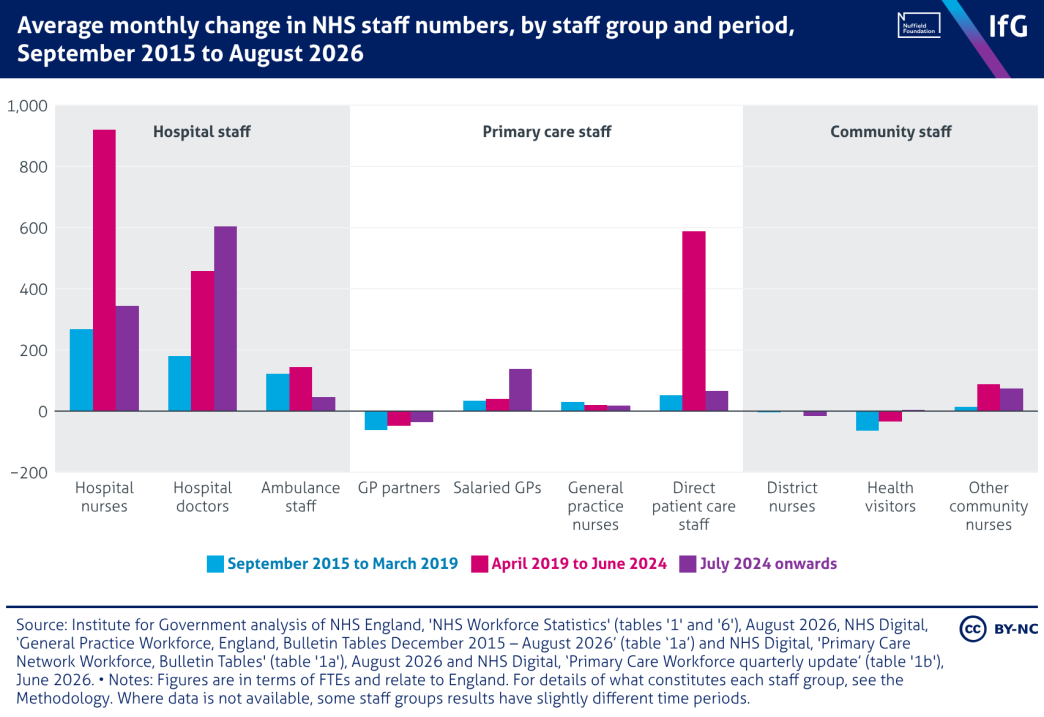
Looking at the absolute change in the number of staff is also important when identifying shifts in capacity across the entire NHS. On that basis, hospitals have again won out: there were 25,546 more doctors, nurses and ambulance staff working in hospitals in August 2026 compared to June 2024. In comparison, there were 6,168 more clinical primary care staff and 1,516 more nurses and health visitors working in the community sector.
As a result, two years into Labour’s parliamentary term, there has been no shift in clinical capacity towards community settings. If anything, there has been the opposite. In June 2024, 75.5% of clinical staff were working in the hospital sector. In June 2026, the proportion was the 75.7%. The government intends to publish an updated workforce plan during the autumn of 2026. Cooper should ensure that that document outlines how the NHS will make the shift of staff into the community to support its ambitions on that shift.
More salaried GPs may better support the government’s aims
While the government has not yet shifted resources away from secondary care towards primary care, the government is, arguably, doing a better job allocating funding within primary care.
As previously argued, the expansion of the salaried GP workforce has been funded through reduced funding for DPC staff. If the government’s goal is to increase access and patient satisfaction with the service, that makes sense. Previous IfG work shows that an additional salaried GP is associated with a statistically significant increase in patient satisfaction, while an additional DPC staff member is not. An additional salaried GP is also associated with more appointments than DPC staff, though this is likely because not all DPC staff activity is captured by appointment data.
The government has done nothing to address the crisis in the partnership model
Despite its progress on salaried GPs, the NHS has done nothing to stop the decline in the GP partner workforce. That is a major concern. GP partners hold contracts with the NHS to provide general practice services in their local area. Without them fulfilling that function, the current partnership model of general practice would not work. Given that the NHS’s neighbourhood framework says that “general practice is the bedrock of neighbourhood health”,1 Department of Health and Social Care and NHS England, ‘Neighbourhood health framework’, 17 March 2026, retrieved 12 October 2026, https://www.gov.uk/government/publications/neighbourhood-health-framework/neighbourhood-health-framework it looks like GP partners will be a key component of the government’s future neighbourhood health service. Partners are also the staff that are associated with the largest increases in patient satisfaction with the service and a greater number of additional appointments compared to other GPs.
Despite that, the government has not made it clear how it intends to address the continued crisis of falling GP partner numbers. In the 10YHP, the NHS says that it wants to “create an alternative for GPs” and will “encourage GPs to work over larger geographies by leading new neighbourhood providers”.2 Department of Health and Social Care, Fit for the Future: 10 Year Health Plan for England, CP 1350, The Stationery Office, 2025, p. 30, https://assets.publishing.service.gov.uk/media/6888a0b1a11f859994409147/fit-for-the-future-10-year-health-plan-for-england.pdf What that means for existing partners, or for the future of the partnership model, is very unclear.
Progress has been slow towards establishing a neighbourhood health service
Underpinning the community shift is the government’s Neighbourhood Health Service (NbH). The government has four aims for the NbH:
- To improve health outcomes
- To join-up care around patients’ lives
- To reduce pressure on the acute sector
- To help the NHS deliver against core targets
- To cut waste and duplication.3 Department of Health and Social Care and NHS England, ‘Neighbourhood health framework’, 17 March 2026, retrieved 12 October 2026, https://www.gov.uk/government/publications/neighbourhood-health-framework/neighbourhood-health-framework
In practice, the government envisages shifting responsibility and accountability for those goals to a more local level through the creation of two new contracts: the single- and multi-neighbourhood provider (SNP and MNP) contracts. These will create organisations to co-ordinate primary and community care activity across populations of 50,000 and 250,000 people, respectively.
There is a precedent for these contracts. In 2019, the Conservative government created primary care networks (PCNs). These are GP-led organisations which co-ordinate primary, community, mental health, pharmacy and other services across population sizes of roughly 50,000 (the same as SNPs).4 NHS England, ‘Primary care networks’, (no date), retrieved 12 October 2026, www.england.nhs.uk/primary-care/primary-care-networks
So far, the NHS has established very few of these new organisations. Since September 2025, the NHS has supported 43 sites as part of the National Neighbourhood Health Implementation Programme.5 Department of Health and Social Care and NHS England, ‘Millions of people to benefit from healthcare on their doorstep’, press release, 9 September 2025, retrieved 12 October 2026, https://www.gov.uk/government/news/millions-of-people-to-benefit-from-healthcare-on-their-doorstep A group of GP practices in Kent have also agreed a change in their contracts to deliver some neighbourhood services.6 Kent and Medway NHS Integrated Care Board, ‘Investing in neighbourhoods - Kent and Medway launches new PCN DES Local Variation contract offer to deliver Neighbourhood Health’, press release, 4 June 2026, retrieved 26 October 2026, https://www.kentandmedway.icb.nhs.uk/news/investing-in-neighbourhoods-kent-and-medway-launches-new-pcn-des-local-variation-contract-offer-to-deliver-… But there is still no clear timeline for when the NHS intends to implement these models across all of England.
Interviewees working in primary care expressed concern that the SNP, in particular, will merely reinvent the existing primary care network (PCN) model that the Conservative government created in 2019, albeit it with a different name and potentially different people or organisations holding the contract. This would be a mistake. PCNs have spent years building relationships, new pathways and developing staff. The experience and relationships they have accumulated are valuable. Tearing those up to establish organisations that seem nearly identical, but with politically preferable branding, would reset all that progress. The government should aim for evolution of the PCN model rather than undertake what would essentially be a structural reorganisation to create almost identical organisations.
The NHS lacks ambition on neighbourhood health centres
The government aims to build 120 neighbourhood health centres (NHCs) by 2030 and a total of 250 by 2035, through a combination of new builds and “upgrades” to existing buildings.7 NHS England, ‘Neighbourhood health centre guidance for regions and integrated care boards’, 16 April 2026, retrieved 12 October 2026, www.england.nhs.uk/long-read/neighbourhood-health-centre-guidance-for-regions-and-integrated-care-boards It will use those buildings to co-locate general practice, community, social care and local authority staff in one place, to make it easier for patients to access a range of services.8Ibid.The NHS has launched the first wave of investment, with an ambition to open the first 27 NHCs in 2027.9 Department of Health and Social Care and NHS England, ‘Communities to benefit from health centres on their doorstep’, press release, 26 March 2026, retrieved 12 October 2026, https://www.gov.uk/government/news/communities-to-benefit-from-health-centres-on-their-doorstep
As with so much of the Plan, NHCs are not new. They are very similar to the “polyclinics” that Dr Ara Darzi proposed in 2007.10
Darzi A, Healthcare for London: A framework for action, 2nd edition, Nuffield Trust, 2007, p. 90, www.nuffieldtrust.org.uk/sites/default/files/2019-11/1575037889_darzilondon.pdf
A contemporary review of the evidence found that co-locating staff was not sufficient for realising benefits and that it required changes in commissioning behaviour and strong leadership to make the most of the investment.
From a practical perspective, it is wise to look to the existing public sector estate as a source of buildings for NHCs. It is not uncommon for the public estate to be underused.
But the scale of the ambition seems small. Compared to the 8,911 premises in general practice,*,11Ibid., p. 3.250 centres is a relatively small number. Given the inadequacy of the current general practice estate, it is unclear that a change of this size would make a real difference to the primary care estate.
* As of 2022, which is the most recent stocktake.
Recommendations
First, Cooper should clarify her priorities for the neighbourhood shift. Slow progress on establishing the NbH and the wider community shift may be because the NHS is still unclear what it is trying to achieve. The four priorities outlined above are incredibly broad and could point the NHS towards different policy prescriptions. For example, if the primary goal is to provide more proactive, preventative care aimed at improving health outcomes then the NHS may want to target an increase in continuity of care in general practice. But if the goal is to shift care out of hospitals, policy makers may instead want to expand diagnostic capacity in the community, or grow virtual ward beds. These policy aims are not mutually exclusive. But within a limited funding envelope, it will be hard for the NHS to achieve everything.
The government needs a more considered plan for how to make the shift towards the community. As this section has shown, there has been no clear shift in resources – in terms of either spending or staffing – since 2024. The NHS should use the upcoming workforce plan to lay out how the government intends to expand capacity in the primary and community sectors. The government should also clarify how it will fund that shift in resources. The government should break away from the current cycle of single-year contracts for general practice and set a multi-year settlement which shows a real shift in resources towards the sector and provides the financial certainty necessary for planning a longer-term shift. Finally, it should set clearer long-term funding plans for the community sector. There is currently no publicly-available funding projection for that sector, making it impossible to see how the NHS intends to shift funding.
Given the importance of that workforce, the government should make it clear what future it envisages for GP partners. It should either explain how it intends to reverse the long-term trend of declining numbers or else – if it is willing to accept the continued shrinkage of that workforce – its alternative model for providing general practice services.
To make a success of its neighbourhood health service, the NHS should evolve the PCNs into SNPs, rather than tearing up a system that is increasingly working well.
Without additional funding for the entire NHS, there will likely also be a trade-off between faster increases for primary and community care and the acute hospital sector. If Cooper wants to make the community shift a reality, she should clarify which priorities in the acute hospital sector she is willing to deprioritise.
Prevention shift
The 10YHP recognises that services are often delivered too late, waiting until someone has reached an acute health crisis before providing support. Instead, the document lays out a vision where the NHS aims to intervene earlier, to prevent ill health from arising at all. As with the community shift, many governments have aimed to make the NHS more preventative. Largely that has failed, with the proportion of NHS spending that goes on the acute hospital sector increasing, while spending on other preventative services outside the NHS – adult social care, housing, early years services such as Sure Start – fell during the first half of the 2010s as local authorities worked out how to deal with lower, austerity-era budgets.
The 10YHP says that “Prevention will be how we restore the means to lead a healthy life in places – like Blackpool – where it has become most difficult” and outlines an ambition to “halve the gap in healthy life expectancy between the richest and poorest regions, while increasing it for everyone, and to raise the healthiest generation of children ever”. 12 Department of Health and Social Care, Fit for the Future: 10 Year Health Plan for England, CP 1350, The Stationery Office, p.58, https://assets.publishing.service.gov.uk/media/6888a0b1a11f859994409147/fit-for-the-future-10-year-health-plan-for-england.pdf
To do this, the 10YHP lays out a few high-level ambitions/areas of focus:
- Creating a smoke-free generation
- Ending the obesity epidemic
- Tackling harmful alcohol consumption
- Cleaning up our air
- Employment and good work
- Thriving young lives.13Ibid., p. 70.
Away from that incredibly high-level goal (halving the gap in healthy life expectancy), other measurable targets are scarcer. For example, there is no target level for obesity, or around alcohol consumption that would give an indication of what the government thinks is necessary to narrow the healthy life expectancy gap and which would make it possible to assess whether the government is on track to deliver that long-term, high-level outcome. The 10YHP commits to working with the Office for National Statistics “and other experts” to “develop a new suite of delivery indicators”.14Ibid., p. 63.From publicly available information, the NHS does not seem to have made any progress towards those indicators.
There are overlaps with the community shift. The NHS intends the NbH to deliver more preventative care, for example the 10YHP says the NHS “will test new delivery models for secondary prevention through the Neighbourhood Health Service” in relation to diabetes and cardiovascular care.15Ibid., p. 72.Similarly, a general practice service that has more time to spend with patients would be able to take a more preventative approach to healthcare.16 Ellenby R, Mandla A, Stewart M and Tzortziou Brown V, ‘Prevention: The general practice role in evidence based and equitable prevention’, Royal College of General Practitioners, September 2026, https://www.rcgp.org.uk/representing-you/policy-areas/prevention-report
Public health grant allocations are still lower in real terms than in 2016
The community shift section above has already assessed the extent to which funding is likely to flow towards primary and community care over the course of this parliament – both important sectors if the NHS is serious about shifting towards more preventative care. Spending on public health is another area which would demonstrate intent on this front.
Public health services, commissioned by local authorities, are intended to reduce the likelihood of disease, improve the population’s health and redress health inequalities – all aims that fall squarely within the prevention shift.17 Faculty of Public Health, ‘What is public health?’, (no date), retrieved 12 October 2026, www.fph.org.uk/what-is-public-health They include services such as children’s 0-5 public health services, alcohol and drug misuse services, and smoking cessation services.
The government’s primary method of funding public health services is the public health grant, a ringfenced pot of money that it provides to local authorities.
As shown above, the government spends relatively little on public health compared to the acute hospital sector: almost 25 times less in 2022/23.
The public health grant will be 12.9% higher in real terms in 2028/29 than in 2024/25. However, all of the increase comes in the first two years and is due, at least in part, to the new inclusion of drug and alcohol, and smoking cessation funding in the grant from 2026/27 onwards. It is not possible to tell from published data how much the core public health grant increased over this period.18 Department of Health and Social Care, ‘Public health ring-fenced grant financial year 2026 to 2027: local authority circular’, 9 February 2026, retrieved 12 October 2026, https://www.gov.uk/government/publications/public-health-grants-to-local-authorities-2026-to-2027/public-health-ring-fenced-grant-financial-year-2026… A fairer comparison may therefore be 2026/27 to 2028/29, when funding is due to fall by 0.5% in real terms.
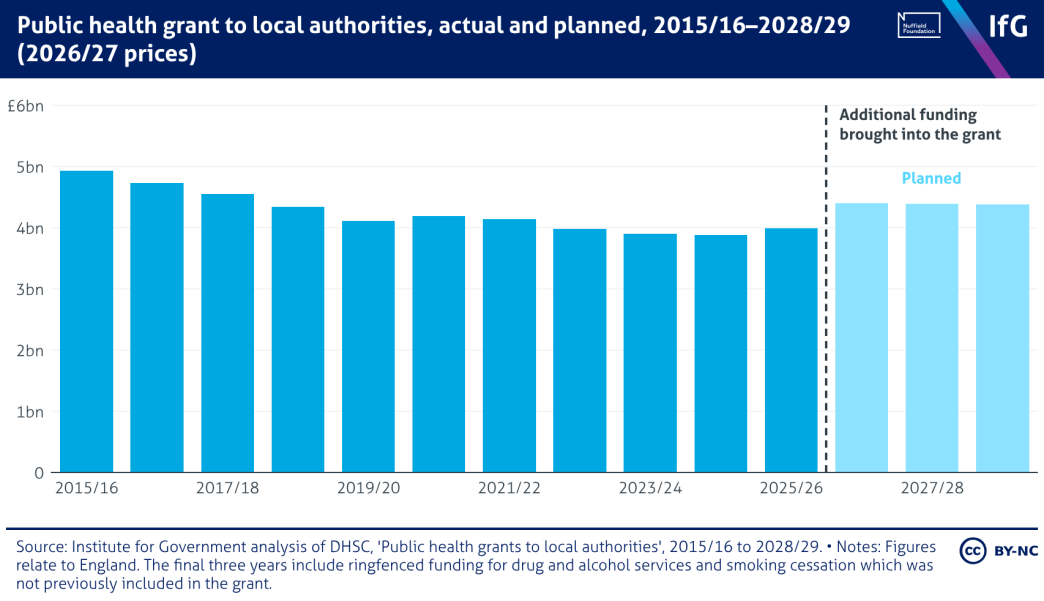
Even with the additional funding, the value of the grant in 2028/29 will still be more than a tenth (11.2%) lower in real terms than it was in 2015/16. Considered alongside the lack of shift in funding towards primary and community care, the slow growth in the public health grant makes it difficult to argue that the government has significantly prioritised funding for preventative health services.
The introduction of PDEL could help drive focus and resources towards preventative spending
At the 2026 autumn budget the chancellor, John Healey, announced that the government would “introduce a new category of ringfenced spending at the spending review in 2027” which it would call ‘preventative DEL (PDEL)’.19 HM Treasury, Budget 2026, HC 726, The Stationery Office, October 2026, p. 34, https://assets.publishing.service.gov.uk/media/6ae20b85460c1346f7be784e/E03668986_HMT_Budget_2026_ELAY__2_.pdf
This is a welcome step and one that the IfG has argued for since 2024. Identifying and protecting preventative spending should create an incentive for services to better protect that spending and will impose a political cost on any politician or service that raids those budgets to fund more acute pressures.
It is still unclear how this will work in practice or what it will mean for services, but this is a welcome step towards a greater focus on prevention in services.
The Tobacco and Vapes Act is a bold step forward for prevention
Legislation and taxation are also important public health levers, and the Tobacco and Vapes Act represents a major preventative intervention. The process towards this legislation started under the Sunak government in 202420 Department of Health and Social Care, ‘Smokefree generation one step closer as bill introduced’, press release, 20 March 2024, retrieved 26 October 2026, https://www.gov.uk/government/news/smokefree-generation-one-step-closer-as-bill-introduced and the Starmer government finished the process in 2026.21 Department of Health and Social Care, ‘Tobacco and Vapes Bill becomes law’, press release, 29 April 2026, retrieved 26 October 2026, https://www.gov.uk/government/news/tobacco-and-vapes-bill-becomes-law It aims to create a smoke-free generation, in turn reducing future incidence of cancer, cardiovascular and respiratory disease, tackling health inequalities and reducing NHS pressures.
The government’s own analysis attributes 1 in 4 cancer deaths in the UK to smoking and suggests that one person every minute in England is admitted to hospital because of smoking.22 Department of Health and Social Care, ‘Tobacco and vapes: evidence to support legislation’, call for evidence, 8 October 2025, retrieved 12 October 2026, https://www.gov.uk/government/calls-for-evidence/tobacco-and-vapes-evidence-to-support-legislation/tobacco-and-vapes-evidence-to-support-legislation This represents a significant time and financial cost to the NHS (£1.8bn a year) and to the wider economy (£18.6bn in productivity losses).23 Action on Smoking and Health, ‘ASH Ready Reckoner’, May 2026, retrieved 12 October 2026, https://ash.org.uk/resources/view/ash-ready-reckoner
Much like the 2006 ban on smoking in enclosed public spaces – a clear policy success, which “has stuck, is widely complied with and now largely accepted with no real risk of reversal” – the 2026 Act will likely reduce smoking-related hospital admissions and illness. The government’s impact assessment estimates that the Act will reduce smoking prevalence for those aged 14 and over from 11.3% in 2023 to 1.5% in 2056.24 Department of Health and Social Care, Tobacco and Vapes Bill: Impact assessment, 2024, https://assets.publishing.service.gov.uk/media/6985eeb7cfe7ccf77efbc74e/tobacco-and-vapes-bill-impact-assessment.pdf
As a bonus, regulation of this kind is low-cost to deliver for the government, with lost future revenues for the exchequer from cigarette and vape duties far less than the estimated combined cost to the NHS and economy (duties were £8.8bn in 2023/24),25 Woolnough S, ‘The Tobacco and Vapes Act – a landmark win for health’, blog, The King’s Fund, 22 April 2026, retrieved 12 October 2026, www.kingsfund.org.uk/insight-and-analysis/blogs/tobacco-and-vapes-act-landmark-win-health and is also popular with the public.26 Action on Smoking and Health, ‘Majority of public support smokefree generation as new polling shows overwhelming public backing for tougher action on tobacco’, press release, 30 May 2025, retrieved 12 October 2026, https://ash.org.uk/media-centre/news/press-releases/majority-of-public-support-smokefree-generation-as-new-polling-shows-overwhelming-public-backing-…
The NHS has rapidly increased prescriptions of GLP-1s since 2024
The 10YHP also claims it wants to “end the obesity epidemic”.27 Department of Health and Social Care, Fit for the Future: 10 Year Health Plan for England, CP 1350, The Stationery Office, 2025, p.61, https://assets.publishing.service.gov.uk/media/6888a0b1a11f859994409147/fit-for-the-future-10-year-health-plan-for-england.pdf Obesity prevalence in England has risen from 22.6% in 2015/16 to 26.6% in 2024/25.28 Department of Health and Social Care, ‘Fingertips public health profiles: Obesity prevalence in adults, (using adjusted self-reported height and weight) (18+ yrs)’, [no date], retrieved 12 October 2026, https://fingertips.phe.org.uk/obesity-physical-activity-nutrition#gid/1938133368/ati/6 This costs the NHS an estimated £9.3bn (around 5% of NHS England’s budget in 2025/2629 HM Treasury, Spending Review 2025, CP 1336, The Stationery Office, 2025, p. 122, https://assets.publishing.service.gov.uk/media/686270a608bf2f53761219fc/E03349913_HMT_Spending_Review_June_2025_TEXT_PRINT_CS.pdf ) and society as a whole £107bn per year.30 Frontier Economics, The Economic and Productivity Costs of Obesity and Overweight in the UK, Nesta, 2025, https://media.nesta.org.uk/documents/The_economic_and_productivity_costs_of_obesity_and_overweight_in_the_UK_.pdf
The group of drugs known as GLP-1s, or weight loss jabs, which include brand names such as Wegovy, and Mounjaro, are a key tool to reduce obesity.
The NHS has taken a staggered approach to rolling out GLP-1s, targeting patients with the greatest clinical need first, before expanding eligibility over the remainder of this parliament.31 NHS England, ‘Interim commissioning guidance: implementation of the NICE technology appraisal TA1026 and the NICE funding variation for tirzepatide (Mounjaro) for the management of obesity’, 2 April 2026, retrieved 12 October 2026, www.england.nhs.uk/long-read/interim-commissioning-guidance-nice-ta1026-tirzepatide
That has resulted in a sustained and rapid expansion in the number of jabs that the NHS prescribes. In August 2026, the NHS prescribed 487,000 tirzepatide (brand name Mounjaro) and semaglutide (brand name Ozempic/Wegovy) jabs to patients, up from 172,872 in June 2024 (a 182% increase), though this covers drug usage for both diabetes treatment and management of obesity.
Despite that rise, private use of GLP-1s dwarfs NHS prescribing rates. In July 2025, there were 2.4m private prescriptions of these jabs in the UK, compared to just under 380,000 prescribed by the NHS (though NHS figures are just for England, not the entire UK).1 IQVIA, written evidence to the House of Commons Health and Social Care Committee inquiry on food and weight management (FWM0029), 19 November 2025, https://committees.parliament.uk/writtenevidence/146947/pdf/#:~:text=Meanwhile%2C%20IQVIA%20data%20suggests%20that,Figure%20 1
NHS spending on these drugs is rising rapidly. The NHS’s prescribing cost for Tirzepatide (Mounjaro) roughly doubled on 1 September 2025 when the manufacturer, Eli Lilly, increased prices from £90 to £180 for 5mg and £122 to £330 for 15mg pens.1 OpenPrescribing.net, ‘Tirzepatide (BNF code 0601023AZ)’, Bennett Institute for Applied Data Science, University of Oxford, 2026, retrieved 12 October 2026, https://openprescribing.net/ analyse/#org=CCG&numIds=0601023AZ&denom=nothing&selectedTab=chart Greater demand plus higher prices mean that NHS England spends around £80m a month (before discounts are applied) on GLP-1 prescribing costs.*
It is still too early to tell the effect this rapid increase in prescribing will have on obesity rates. The most recent data is still for 2024/25, before more widespread uptake of these drugs. In theory, increased GLP-1 usage could have a rapid effect. One meta-review of academic literature of GLP-1s found that users had an average weight loss of 17.3% after 68 weeks.2 Shah MY, Mohammad A, Samejo RBA and others, ‘Weight Loss That Lasts: Reviewing the Long-Term Impact of GLP-1 Receptor Agonists’, Cureus, 2025, vol. 17 no. 7, https://pmc.ncbi.nlm.nih.gov/articles/PMC12361690/ That implies that higher prescription rates could reduce obesity rates within this parliament.
Multiple studies have shown, though, that ceasing treatment often results in users regaining lost weight.3Ibid.,4 West S, Scragg J, Aveyard P and others, ‘Weight regain after cessation of medication for weight management: systematic review and meta-analysis’, BMJ, 2026, vol. 392, www.bmj.com/content/392/bmj-2025-085304 That implies that the NHS will have to continue to prescribe these drugs to maintain the benefit.
* See note in chart above for caveat on these figures.
Vaccination coverage has continued to decline under Labour
High vaccination uptake is one of the most effective preventative interventions a government can implement.5 NHS England, ‘NHS England Vaccination Strategy’, ENGLAND.NHS.UK, [no date], retrieved 5 November 2026, www.england.nhs.uk/south/wp-content/uploads/sites/6/2023/12/20231207-NHSE-Vaccination-Strategy-Explainer-v1.0.pdf Despite that, vaccination coverage for most major types of vaccine have declined in recent years, some dramatically, and starting under the Conservative government. In 2024/25, only 71.7% of girls aged 12 or 13 had received the human papillomavirus (HPV, a virus which increases the risk of a range of cancers, particularly cervical cancer) vaccine compared to 91.1% in 2013/14 (the earliest year for which there is data), compared to a target of 90% coverage.
Labour has not stopped that trend. For all the vaccines that have data, coverage was lower in 2025/26 than it was in 2023/24, though in some cases (MenB first dose and Rotavirus) the decline was minimal.*
* For HPV (where the most recent year is 2024/25) coverage was also lower than in 2023/24, though Labour are less responsible for this performance as they took power after the year had started.
Declining rates are related to a range of issues. The Royal College of Paediatrics and Child Health (RCPCH) stress that while vaccine hesitancy has likely increased since the pandemic, in their view parents’ inability to access vaccination services far outweighs that uptick.1 Royal College of Paediatrics and Child Health, Vaccination in the UK: Access, uptake and equity, 2025, p. 17, https://www.rcpch.ac.uk/sites/default/files/2025-06/Vaccination-in-UK-access-uptake-equity_policy-report-2025.pdf
Access problems can be caused by a lack of staff, difficulties booking appointments with providers, or inadequate travel routes for parents to take children to receive vaccinations.2 Royal College of Paediatrics and Child Health, Vaccination in the UK: Access, uptake and equity, 2025, www.rcpch.ac.uk/sites/default/files/2025-06/Vaccination-in-UK-access-uptake-equity_policy-report-2025.pdf
Health visitors feel the quality of their work has declined
Health visitors are among the first agents of the state to interact with children and their families. Their unique access to the home environment and ability to track the early indicators of development means they have a powerful role to play in a preventative shift among children.
In England, the health visiting service conducted 85.5% of New Birth Visits within 14 days of a child’s birth in 2025/26.3 Office for Health Improvement and Disparities, ‘Health visitor service delivery: data for 2024 to 2025’, 21 January 2025, retrieved 12 October 2026, https://www.gov.uk/government/statistics/health-visitor-service-delivery-data-for-2024-to-2025 That has remained relatively stable over time, with 87.7% of new health visits completed within 14 days in 2017/18.4 Office for Health Improvement and Disparities, ‘Child and Maternal Health: Proportion of New Birth Visits (NBVs) completed within 14 days’, Fingertips, (no date), retrieved 12 October 2026, https://fingertips.phe.org.uk/profile/child-health-profiles/data#page/4/gid/1938133223/pat/159/par/K02000001/ati/15/are/ E92000001/iid/93469/age/284/sex/4/cat/-1/ctp/-1/yrr/1/cid/4/tbm/1
Despite relatively consistent visiting rates, the health visiting workforce is operating under enormous pressure. Health visiting numbers have declined by 45% since September 2015 and there is low morale across the workforce.*,1 Institute of Health Visiting, ‘Health visitor survey finds that more babies and young children are missing out on the government’s promise of the “best start in life”’, press release, 18 January 2023, https://ihv.org.uk/news-and-views/news/health-visitor-survey-finds-that-more-babies-and-young-children-are-missing-out-on-the-governments-promise-of-…; Survey results, p. 5, https://ihv.org.uk/media/h3wfffh3/71119_health_visiting_in_england_vision_final_version.pdf As such, while health visiting rates have been broadly stable in the last ten years (excluding the pandemic period), these rates have been maintained with a smaller headcount. Thus, even though the number of children requiring a health visit fell by 14.8% between 2017/18 and 2025/26, the workload on each health visitor increased by more than a quarter (29.2%).2 UCL, ‘Number of health visitors in England falls by a fifth over five years’, 26 March 2026, retrieved 12 October 2026, www.ucl.ac.uk/news/2026/mar/number-health-visitors-england-falls-fifth-over-five-years
Consequently, only 37% of health visitors in England now feel they provide “a good or outstanding service that can adequately safeguard children”.3 Institute of Health Visiting, State of Health Visiting, UK Survey Report: A vital safety net under pressure, 2023, p.6, https://ihv.org.uk/media/h3wfffh3/71119_health_visiting_in_england_vision_final_version.pdf
As previously discussed, Labour has not made a meaningful improvement to the health visitor workforce, with numbers hovering around the same level as when Labour won the election.
* Indeed, at the end of 2024, some 40% of health visitors surveyed by iHV said they intended to leave the profession in the next five years. https://www.nursinginpractice.com/clinical/paediatrics/health-visiting-workforce-cut-beyond-the-bone-in-too-many-areas/
Recommendations
Alongside the shift in resources to the community and primary care sectors, the government should make it clear how it intends to shift funding towards public health services delivered by local authorities. This should be part of a wider government effort to shift resources towards prevention.
There are insufficient clear targets in the 10YHP that would demonstrate progress towards its prevention goal. The government should publish the “delivery indicators” described in the 10YHP. Where those are very long-term, it should provide interim targets that demonstrate progress.
Vaccination is one of the most important preventative health interventions, but coverage has declined in recent years. That trend has continued under Labour. The government should ensure that improving vaccination uptake is a key part of any future preventative agenda.
Digital shift
“We [will] create the most digitally accessible health system in the world” - 10 Year Health Plan
The government has set great store in a digital transformation of the NHS, arguing that moving from “bricks to clicks” is an existential necessity for the service. In doing so, it aims to improve access and convenience for patients; free up capacity to respond to complex need in physical services; and provide financial savings to guarantee its future financial sustainability.
There are three clear “retail” policies that, if successfully rolled out, will change patients’ experience of the NHS most visibly:
- The single patient record (SPR)
- Expansion of the NHS app
- Widespread adoption of artificial intelligence (AI) tools.
There are other programmes which are designed to sit alongside those technologies. The Federated Data Platform (FDP), a product that technology company Palantir is currently contracted to deliver, is the highest profile. It is also the most controversial because of public concerns around the use of personal data and whether it is delivering the improvements the programme set out to, given the level of investment and the NHS’ scale of ambition.4 Booth R, ‘More than 44,000 file legal objections to Palantir NHS platform handling their data’, The Guardian, 30 September 2026, retrieved 26 October 2026, www.theguardian.com/technology/2026/sep/30/legal-objections-palantir-nhs-platform-handling-data ,5 Medact, Briefing: Concerns regarding Palantir Technologies and NHS data systems, 12 March 2026, www.medact.org/2026/resources/briefings/briefing-palantir-fdp ,6 Health and Social Care Committee, ‘Drop Palantir’s Federated Data Platform and look for alternative, MPs tell Health Minister’, UK Parliament, 9 July 2026, retrieved 26 October 2026, https://committees.parliament.uk/ committee/81/health-and-social-care-committee/news/214760/drop-palantirs-federated-data-platform-and-look-for-alternative-mps-tell-health-minister/ ,7 Borrett A and Hughes L, ‘UK raises cost projections for Palantir’s NHS data platform’, Financial Times, 10 August 2026, retrieved 26 October 2026, www.ft.com/content/da888f06-b9bc-4d83-8020-e82f5d5fa609 The 10YHP also sets out bold ambitions on the use of wearables across the NHS. The goal to increase patients’ usage of wearables would undoubtedly change user experience. However, there is little indication that there has been tangible progress (or even aims set) in this area.
As with previous digital health plans, there is still little detail on the ‘plumbing’ that will turn ideas in the 10YHP into reality. As one interviewee put it, across governments “there has been consistent direction-setting, but delivery has long been a challenge”.
Progress is even harder to assess in this shift than the others. There are no good proxy metrics – such as spending or staffing data – for progress. There is also no data about the rate at which different parts of the NHS are adopting tools or, more importantly, how they are using them and to what effect.
There has been slow, steady progress on the Single Patient record
The Single Patient Record (SPR) is the centrepiece of the Labour government’s digital strategy. Currently, a combination of electronic records (held by trusts) and some shared patient records8 Steere A, ‘Long read: The Single Patient Record: what the legislation does – and what it will take to deliver it’, Understanding Patient Data, (no date), retrieved 12 October 2026, https://www.understandingpatientdata.org.uk/long-read-single-patient-record-what-legislation-does-and-what-it-will-take-deliver-it (across small geographies and built on ad hoc data sharing arrangements) capture patient data. There is, however, no consistent, unified system for sharing information across the country or across different services.
An SPR would resolve many issues around data fragmentation and, if complemented by extensions to the NHS App, provide patients with easy access to all their health information. It would also allow staff working across primary, secondary, community and social care in every ICB to access the same up-to-date patient records.9 Purbrick-Thompson K, ‘The single patient record explained: what could it mean for patients and the health and care system’, The King’s Fund, 4 August 2026, retrieved 12 October 2026, https://www.kingsfund.org.uk/insight-and-analysis/long-reads/the-single-patient-record-explained-what-could-it-mean-for-patients-and-the-health-and-c…
DHSC has committed to improving clinician access to data by 2027 by improving connections between existing shared care records and aims to give all patients access to their core health data through the NHS App from 2028, with full access by 2030.10 NHS England, ‘Single Patient Record – your health at your fingertips’, (no date), retrieved 12 October 2026, www.england.nhs.uk/digitaltechnology/the-single-patient-record
The government has made slow progress in bringing an SPR to life. Since the then-secretary of state Wes Streeting announced plans for an SPR in October 2024, the NHS has launched public deliberations and engagement with stakeholders.
Over the next few years, DHSC plans to work with NHS staff, the public and suppliers to “develop and test prototypes for real-life scenarios in priority areas such as maternity care”, through a phased approach.11Ibid.
DHSC has also introduced the 2026 Health Bill which, if passed, will mandate that data flows across all health and social care providers and IT system providers.
However, suppliers are still uncertain what the NHS will require of them. For example, the Bill compels IT suppliers to share data in a timely manner and says that there will be financial penalties for non-compliance. But the bill does not define “timeliness”, which information standards will be enforced, or a mechanism for penalisation.
Further, with the merger of NHSE into DHSC, alongside cuts to ICB headcounts, it is difficult to discern who will ‘hold the ring’ and ensure delivery on data standards, accountability and liability and how data will flow from different NHS organisations in and out of the SPR. It is even less clear how this data might then be utilised to improve population health management and predictive care.
Increased use of artificial intelligence underpins many of the government’s anticipated productivity improvements for the NHS
The 10YHP also sets out how Artificial Intelligence (AI) might be used to free up staff time, contributing to improved NHS productivity. Key commitments include:
- Greater use of ambient AI voice capturing technology which, in a London-wide study, was found to reduce time spent on paperwork by 51.7%.
- A new platform for all NHS provider organisations, enabling remote patient monitoring, with generative AI producing the first draft of care plans.
- The roll out of Microsoft Copilot, which has been delivered to 500,000 NHS staff so far, with trials suggesting savings of two days per month on administrative tasks.12 NHS England, ‘NHS accelerates artificial intelligence rollout to cut waiting times and improve care for millions’, 4 July 2026, retrieved 12 October 2026, www.england.nhs.uk/2026/07/nhs-accelerates-artificial-intelligence rollout-to-cut-waiting-times-and-improve-care-for-millions
The 10YHP also pledged to develop and implement an “NHS AI strategic roadmap”, providing ethical and governance frameworks, alongside AI upskilling programmes and the use of validated AI diagnostic and administrative tools.13 Department of Health and Social Care, Fit for the Future: 10 Year Health Plan for England, CP 1350, The Stationery Office, 2025, p.118, https://assets.publishing.service.gov.uk/media/6888a0b1a11f859994409147/fit-for-the-future-10-year-health-plan-for-england.pdf The 10YHP also promises to better harness data for new clinical, decision-support and admin-reduction tools through the new Health Data Research Service.
However, while AI use in the NHS has undoubtedly grown since the 2024 election, it is unclear by how much. There has been mass-adoption of Ambient Voice Technology, with many areas now procuring the technology at scale, though some concern has been raised about the pace of change.14 HTN Health Tech News, ‘Investigation launches into use of ambient voice technology in hospitals’, 6 August 2026, retrieved 9 November 2026, https://htn.co.uk/2026/08/06/investigation-launches-into-use-of-ambient-voice-technology-in-hospitals/ ,15 Concordance, ‘Digital scribes: the first AI tool the NHS actually adopted’, 14 March 2026, retrieved 9 November 2026, http://concordance.uk/insights/nhs-digital-scribes ,16 Burns C, ‘NHS urges sector to take advantage of AI scribes’, The Pharmaceutical Journal, 16 January 2026, retrieved 9 November 2026, https://pharmaceutical-journal.com/article/news/nhs-urges-sector-to-take-advantage-of-ai-scribes ,17 NHS England, ‘Midlands leads the way on ambient voice technology’, 15 July 2026, retrieved 9 November 2026, www.england.nhs.uk/midlands/2026/07/15/midlands-leads-the-way-on-ambient-voice-technology ,18 Lovell T, ‘London NHS trusts to roll out AI scribing to 20,000 clinicians’, Digital Health, 8 April 2026, retrieved 9 November 2026, www.digitalhealth.net/2026/04/london-nhs-trusts-to-roll-out-ai-scribing-to-20000-clinicians ,19 Lovell T, ‘Hertfordshire Community NHS Trust to roll out AI-scribing’, Digital Health, 1 April 2026, retrieved 9 November 2026, www.digitalhealth.net/2026/04/hertfordshire-community-nhs-trust-to-roll-out-ai-scribing Similarly, in stroke care, AI brain-scan software is now in use across all 107 NHS stroke centres, with impressive preliminary results, though this rollout began under the previous government in 2023.20 NR Times, ‘NHS AI tool will help 50% of stroke patients recover’, 2 September 2025, retrieved 9 November 2026, https://nrtimes.co.uk/nhs-ai-tool-will-help-50-of-stroke-patients-recover-lpc25 ,21 Department of Health and Social Care, The Rt Hon Steve Barclay MP and Chloe Smith, ‘£21 million to roll out artificial intelligence across the NHS’, press release, 23 June 2023, retrieved 9 November 2026, https://www.gov.uk/government/news/21-million-to-roll-out-artificial-intelligence-across-the-nhs However, more broadly, the speed at which AI has developed, means that we have very little data (including in surveys) about NHS staff’s use of AI before 2024, and it is difficult to assess Labour’s progress in this area. Likewise, it is also hard to distinguish between simple AI ‘adoption’ (where trusts and services have bought services) versus true embrace and regular use of these technologies by NHS staff.
Perhaps most importantly, the piecemeal and often bottom-up adoption of AI in different parts of the NHS, and limited reporting/evaluation of these technologies, makes any assessment of their benefits (beyond specific clinical use cases) challenging. It is also unwise to assume straightforward efficiency gains through AI adoption. There is little existing literature considering how freed-up time, resulting from time-saving technologies, is actually repurposed.22 Moulds A and Horton T, ‘How would clinicians use time freed up by technology?’, The Health Foundation, May 2024, retrieved 12 October 2026, www.health.org.uk/reports-and-analysis/briefings/how-would-clinicians-use-time-freed-up-by-technology Staff time might be used for more activity, but it also might be used to spend more time with each patient (improving patient experience but not driving up productivity, per se), conducting training (which has knock-on productivity benefits that aren’t immediately clear), or completing administrative tasks that might otherwise be done during work breaks or during overtime. All these are worthwhile uses of time, but they don’t automatically equal greater productivity or more patients treated.
Labour has made consistent progress on the NHS App
Building on the anticipated rollout of the SPR, the Starmer government promised that an improved NHS App will create convenience for patients and save resource for the NHS.23 Department of Health and Social Care and NHS England, ‘Managing healthcare easy as online banking with revamped NHS App’, press release, 3 July 2025, retrieved 12 October 2026, www.gov.uk/government/news/managing-healthcare-easy-as-online-banking-with-revamped-nhs-app The App will be complemented by a raft of other AI-enhanced ‘My X’ services, like the My NHS GP tool (available 24/7, for non-urgent cases), and the My Choices tool.* For service users, the NHS App will be the most visible sign of a digital shift in the way the NHS manages care.
NHS England’s online NHS App roadmap24 NHS England, ‘NHS App roadmap’, 5 November 2026, retrieved 9 November 2026, https://digital.nhs.uk/services/nhs-app/roadmap tracks completed, current and future projects aimed at improving patient access and experience. Release notes25 NHS England, ‘NHS App release notes’, 25 March 2026, retrieved 9 November 2026, www.nhs.uk/nhs-app/about/nhs-app-release-notes indicate that there have been small (bug fixes) as well as large improvements (introduction of new services, such as the integration of online consultation and Patient Care Aggregator services) to the NHS App at a near fortnightly rate since Labour took office. Clearly, work is being done.
And, use of the App is growing. There have been over 40 million NHS App account registrations, with app login sessions in June 2026 79.9% higher than in the same period in June 2024.26 NHS England, ‘NHS App management information – June 2026’, 24 July 2026, retrieved 12 October 2026, https://digital.nhs.uk/data-and-information/publications/statistical/nhs-app-statistics/june-2026 The government set a target for 85% of hospitals to make appointment information available through the app by March 2025. This was met, with 87% of trusts hitting the target in March 2025, up from 68% in July 2024.27 Department of Health and Social Care, ‘Major NHS App expansion cuts waiting times’, press release, 28 April 2025, retrieved 12 October 2026, www.gov.uk/government/news/major-nhs-app-expansion-cuts-waiting-times
As with many areas of digital innovation, greater uptake of technologies alone does not equal success and focusing solely on uptake or expansion of online services risks obscuring whether these changes are adding value for service users. But patients are broadly positive about the App; a Healthwatch survey, conducted in the summer of 2025, found that 57% of participants agreed that the NHS App helped manage their health.**,***
There remain risks in an ‘App-first’ approach. Those with lower digital literacy skills are most obviously at risk of marginalisation28 Pilot L, Offline and Overlooked: Digital exclusion and its impact on older people, Age UK, 2024, www.ageuk.org.uk/siteassets/documents/reports-and-publications/reports-and-briefings/offline-and-overlooked-report.pdf ,29 Healthwatch Derby, ‘NHS app: awareness and experiences report 2024’, 8 August 2024, retrieved 12 October 2026, https://nds.healthwatch.co.uk/reports-library/nhs-app-awareness-and-experiences-report-2024 ,30 Lloyds Banking Group, 2025 Consumer Digital Index: The generative AI edition, 2025, www.lloydsbankinggroup.com/assets/pdfs/media/consumer-digital-index/2025/2025-consumer-digital-index.pdf ,31 The King’s Fund, ‘Connection lost: people’s experiences of using digital technology in health and care’, 2023, retrieved 12 October 2026, https://features.kingsfund.org.uk/connection-lost/index.html?_ga=2.182180519.1637327810.1727786389-964730683.1724858879 but many beyond this group feel ‘forced’ into using the App and frustrated by imperfect services and inaccurate records, even if they valued the App’s ease of use and convenience, overall.32 Healthwatch Oxfordshire, ‘Digital health care and the NHS App, Voices from Oxfordshire’, 2025, https://nds.healthwatch.co.uk/sites/default/files/reports_library/NHS%20App%20final%20final%20Nov%202025.pdf Digital change of this kind will also require physical service redesign and standardisation across the country in order to avoid confusion across services, repetition or errors.33 Devereux E, ‘NHS App breaking cancer diagnoses before clinicians’, HSJ, 18 November 2025, retrieved 12 October 2026, www.hsj.co.uk/technology-and-innovation/nhs-app-breaking-cancer-diagnoses-before-clinicians/7040409.article; quoted in Mistry P, ‘Is the NHS ready for the AI-powered patient?’, The King’s Fund, 26 May 2026, retrieved 12 October 2026, www.kingsfund.org.uk/insight-and-analysis/long-reads/nhs-ready-for-ai-powered-patient
* Other services promise convenience and personalisation for patients, including greater ability for self-referral, remote consultation, self-management of medication and vaccine regimens as well as managing their own care as well as that of their children.
**Creating a ‘one stop shop’ for care would go some way to improve the digital experience of even those who are very digitally confident, many of whom use multiple apps, websites and login details to access care. http://kingsfund.org.uk/insight-and-analysis/long-reads/the-reality-of-and-potential-for-digitally-enabled-care-in-the-community
***The most common use of the App in one survey was to order repeat prescriptions (76%), followed by viewing GP health records (70%). Indeed, app users view their GP health record over 35 million times each month, with 12 million views of test results. https://nds.healthwatch.co.uk/sites/default/files/reports_library/NHS%20App%20final%20final%20Nov%202025.pdf;http://digital.nhs.uk/services/nhs-app/roadmap
Recommendations
For the government to make a success of its digital shift, it first needs to get the basics right, address ongoing funding concerns, fill staff skill gaps, build public trust and implement more systematic approaches to data collection and data sharing.
It should also prioritise investment in IT basics that would definitely improve productivity before investment in more speculative technologies such as AI, where the benefits are far more uncertain. These are well-established priority areas where trade associations, think tanks and charities have called for improvements for many years.34 Nuffield Trust, written evidence to the House of Commons Health and Social Care Committee inquiry on digital transformation in the NHS (DTN0051), 5 July 2022, retrieved 12 October 2026, https://committees.parliament.uk/writtenevidence/109146/html ,35 Keck L and Godec S, ‘Trust and confidence in technology-enabled care’, The Health Foundation, November 2024, retrieved 12 October 2026, www.health.org.uk/reports-and-analysis/briefings/trust-and-confidence-in-technology-enabled-care ,36 techUK, ‘Driving digital transformation: techUK’s recommendations for health and social care’, 21 November 2024, retrieved 12 October 2026, www.techuk.org/resource/driving-digital-transformation-techuk-s-recommendations-for-health-social-care.html ,37 The NHS Alliance, ‘Digital transformation in the NHS: a reference guide’, 11 December 2025, retrieved 12 October 2026, https://thenhsalliance.org/resources/digital-transformation-in-the-nhs-a-reference-guide ,38 House of Commons Health and Social Care Committee, Digital Transformation in the NHS: Eighth report of session 2022–23 (HC 223), The Stationery Office, 2023, retrieved 12 October 2026, https://publications.parliament.uk/pa/cm5803/cmselect/cmhealth/223/report.html Those enabling factors are vital before ministers get too carried away with the “white heat” of AI, genomics and wearables technology.
The government should also ensure it makes a strong case to the public for the need for change. Previous attempts at digital reform – such as the ‘care.data’ scheme and the General Practice Data for Planning and Research (GPDPR) programme – were slowed or failed due to a lack of public support.
The current approach of ad hoc adoption of AI technologies across the NHS does create a useful laboratory for innovation, reducing risk by keeping technologies localised to small geographies or service areas with the option to scale those that have proven benefits. However, without proper evaluation of these technologies (probably led by central government) and frameworks for adoption, patient trust, safety and efficiency could be undermined. The NHS should build upon the recommendations of the National Commission into the Regulation of AI in Healthcare to rapidly build a regulatory framework for AI use in the NHS.39 Medicines and Healthcare products Regulatory Agency, National Commission into the Regulation of AI in Healthcare: Recommendations for a future regulatory framework, 10 September 2026, retrieved 9 November 2026, www.gov.uk/government/publications/national-commission-into-the-regulation-of-ai-in-healthcare-recommendations-for-a-future-regulatory-framework The Commission notes that current frameworks are designed for products that are “more static and easier to reliably assess at a single point in time”. AI-enabled products “may iterate rapidly, perform differently in different settings and depend on the data, workflows, people and organisations around them”.40Ibid. Without greater clarity, the NHS runs the risk that trusts and services within the NHS deploy AI (at significant cost) without clear evaluations, use cases or the proper technical architecture and staff training needed to enable success.*
Following decades of work,41 Robertson A, Bates DW and Sheikh A, ‘The rise and fall of England’s National Programme for IT’, Journal of the Royal Society of Medicine, 2011, vol. 104, no. 11, pp. 434–35, https://pmc.ncbi.nlm.nih.gov/articles/PMC3206716/ the NHS has finally achieved near-full coverage of EPRs.42 NHS England, ‘Digitising the frontline’, (no date), retrieved 12 October 2026, www.england.nhs.uk/digitaltechnology/digitising-the-frontline But there are still problems with how the service uses EPRs. Many staff still report issues sharing or accessing data across different parts of the service.43 Moulds A and Horton T, ‘Which technologies offer the biggest opportunities to save time in the NHS?’, The Health Foundation, April 2024, retrieved 12 October 2026, www.health.org.uk/reports-and-analysis/briefings/which-technologies-offer-the-biggest-opportunities-to-save-time-in , 44 NHS England, ‘Interoperability’, 15 May 2023, retrieved 12 October 2026, www.england.nhs.uk/long-read/interoperability It is positive that the government has made it a priority over the course of 2026 to optimise EPR “functionality, efficiency and usability”, conduct digital maturity assessments and provide support (including through a tiger team service) to trusts as they embed EPRs. As part of this, the NHS should implement more consistent approaches to data collection and coding standards which hamper interoperability and formalise data sharing agreements between places to maximise the benefits of EPRs.
There are considerable digital skills gaps across the NHS. The service struggles to hire digital specialist roles because of less competitive pay and work conditions relative to the private sector.45 Dawood S, ‘The NHS’s digital problem: how old infrastructure is slowing down healthcare services’, The New Statesman, 23 August 2024, retrieved 12 October 2026, www.newstatesman.com/spotlight/healthcare/nhs/2024/08/nhs-digital-transformation-infrastructure-technology-patient-records-artificial-intelligence-wa… There is also a history of high turnover of digital and data workforce, affecting institutional memory and delivery.46 Mistry P, ‘Infrastructure for innovation: getting the NHS and social care ready for AI’, The King’s Fund, 25 June 2025, retrieved 12 October 2026, www.kingsfund.org.uk/insight-and-analysis/long-reads/infrastructure-nhs-social-care-ai#%E2%80%8B%E2%80%8Borganisational-and-system-capabilities- The cutting of non-clinical staff in trusts alongside headcount reductions in NHSE, DHSC and ICBs risks the loss of digital capabilities, institutional memory and programme delivery capacity at a vital time. The government should ensure that it has sufficient data and digital capacity to deliver its digital ambitions.
* Early evidence indicates that this has been the case in many trusts that have adopted Palantir’s Federated Data Platform. https://www.ft.com/content/a3e94197-87a8-4ba5-8a6d-4b7193993af9?syn-25a6b1a6=1; https://www.ft.com/content/cc1f2e28-117f-41bb-96b9-030746cf9530?syn-25a6b1a6=1; https://www.ft.com/content/63bfdeb2-efb1-4e3a-8c89-a884eb5bd618?syn-25a6b1a6=1; https://www.ft.com/content/da888f06-b9bc-4d83-8020-e82f5d5fa609?syn-25a6b1a6=1; https://www.lrb.co.uk/the-paper/v48/n13/peter-geoghegan-and-lucas-amin/this-looks-absolutely-rubbish
- Supporting document
- Public Services Performance Tracker 2026: NHS - Methodology (PDF, 136.79 KB)
- Topic
- Public services
- Keywords
- NHS Health Public spending Public sector
- Political party
- Labour
- Position
- Health and social care secretary
- Administration
- Starmer government Burnham government
- Department
- Department of Health and Social Care
- Public figures
- Yvette Cooper
- Tracker
- Performance Tracker
- Publisher
- Institute for Government