Working to make government more effective

Comment

Six things we learned from Andy Burnham’s government formation

What do Andy Burnham’s cabinet choices reveal about the priorities and direction of his new government?

Andy Burnham
Andy Burnham at his first Cabinet meeting

Andy Burnham became the UK's 59th prime minister last Monday, and his first week in office saw a flurry of appointments as he assembled his new government. Alongside announcing his cabinet, Burnham unveiled an extensive reshuffle, with a sweeping round of ministerial appointments and dismissals. By the end of the week, some 82 ministers had taken up new roles, including 24 entering government for the very first time.

So, who are the new faces around the cabinet table, and what do Burnham's choices tell us about how he wants to run his government? IfG experts share their key takeaways from last week's reshuffle.

The changes saw key Starmer allies out

While it was expected that Burnham would use his first reshuffle to put his own stamp on government, the scale of the changes – both among the cabinet and junior ministers – look to be greater than some had anticipated. At least some of the churn is due to Burnham bringing back some allies who had previously quit Starmer’s government.

The departure of several of Keir Starmer's closest allies – not least Rachel Reeves and Darren Jones – signalled a decisive break with the previous administration, while a number of other senior ministers were sacked or moved into new portfolios. There were some high-profile returns too: Louise Haigh, Lucy Powell, Wes Streeting and John Healey are all back in government.

In total, 13 of the 22 full cabinet members are now serving in new roles, with seven joining for the first time. Beyond the cabinet, Burnham also brought back some ministers who had either been dismissed by Starmer or resigned after losing confidence in his leadership, including Jim McMahon and Vicky Foxcroft. 
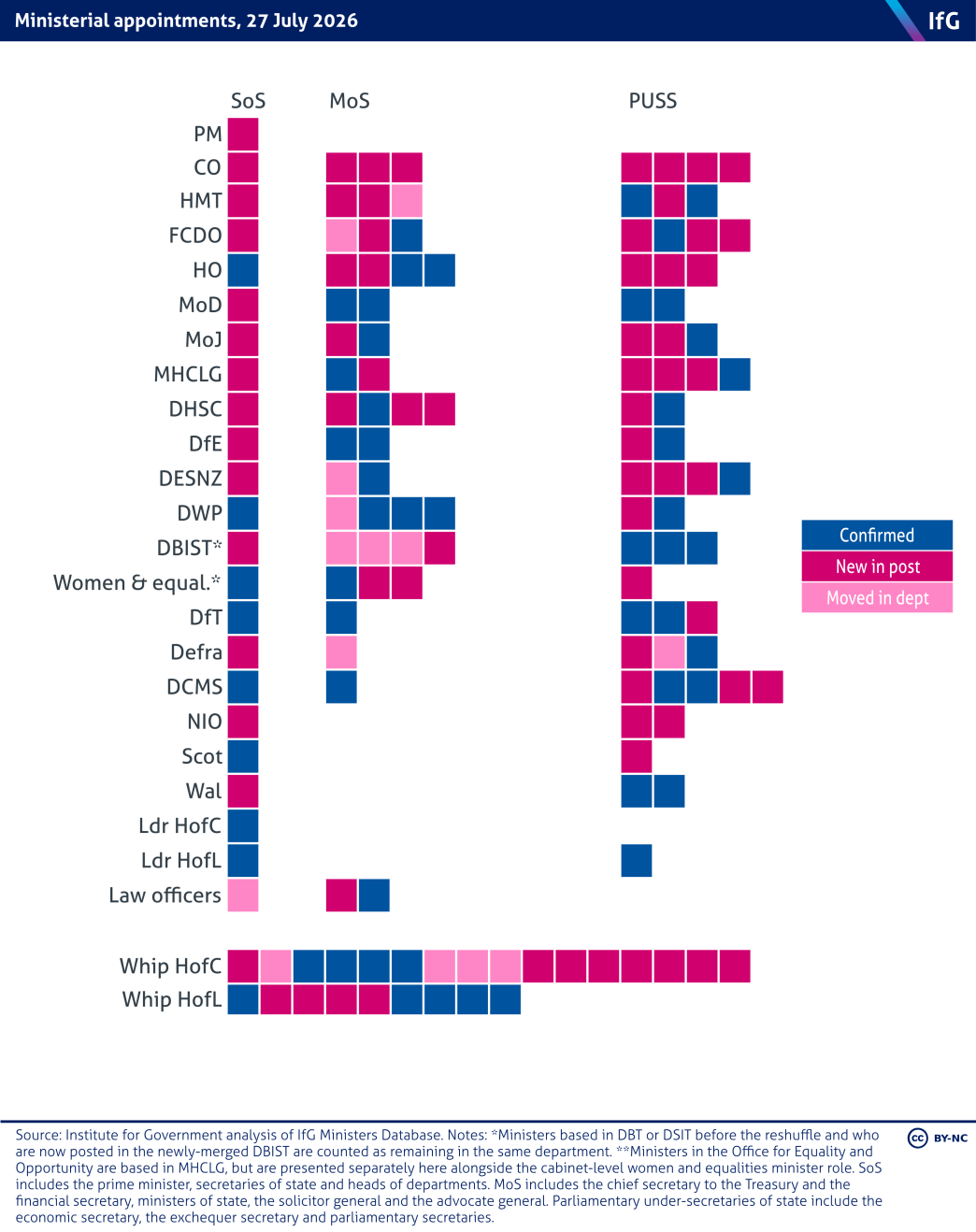
Ministerial appointments

We warned previously that Burnham should resist sweeping changes of junior ministers. While he inevitably wanted to refresh his top team, junior ministers already in post are his best chance of getting things done and delivering on things already in train.

Overall, the make-up of Burnham’s new government reflects a mixed picture with some departments experiencing more turnover than others. The Northern Ireland Office has seen a wholesale change in leadership, with Chris Bryant appointed secretary of state alongside two new junior ministers. The eight ministers in the Cabinet Office have also been replaced entirely, but as the department closest to the prime minister, it was expected that there would be significant change here. Even then, Dan Jarvis is a returning figure to the Cabinet Office having previously served there as a joint minister between September 2025 and June 2026.

Other departments including the Home Office, MHCLG, DHSC and MoJ have seen sweeping changes among junior ministers; in 11 departments at least half of the junior ministers have come from elsewhere or are new to government. Although some of these appointments are simply resetting the clock, back to before some ministers resigned from Starmer’s government.

Elsewhere, the picture is of greater continuity. Although the Ministry of Defence has a new secretary of state, its team of junior ministers remains unchanged. Similarly, the Department for Work and Pensions has retained six of its seven ministers, and the Department for Education only has one new minister, suggesting Burnham was keen to balance renewal with stability in some departments where major reforms are already under way.

Andy Burnham has signalled some early priorities in his cabinet picks

Every prime minister uses appointments to communicate priorities. Who gets a seat at the cabinet table, who is elevated, and which roles are created or strengthened are among the clearest signals a new administration can send. Andy Burnham’s appointments reveal some key signals.

The first, as covered above, is where Burnham has chosen continuity over change for example by keeping Pat McFadden as secretary of state at DWP to continue his work on welfare. Second, early changes point to a serious and well trailed attempt to shift power away from Whitehall, with Manchester at the centre of that project. Louise Haigh has been appointed to lead the new “No.10 North” in Manchester while also serving as chancellor of the Duchy of Lancaster and head of the Cabinet Office. Haigh has also been given the title of first secretary of state, a political designation often used to mark out a minister as senior to other secretaries of state and, in practice, as one of the prime minister’s closest deputies. Burnham has repeatedly argued as mayor that the UK is too centralised; elevating Haigh and placing her in charge of No.10 North turns that argument into an institutional commitment with decentralisation being embedded into the machinery of government.

Third, Burnham has signalled that housing will be treated as a core government priority. Matthew Pennycook, the junior minister of housing and planning, has been invited to attend cabinet. His brief covers housing supply and delivery as well as social housing and is one of the junior ministers to survive the reshuffle in their original post. We have repeatedly pointed out the high turnover of the minister of housing since 2010 as being one of the worst examples of ministerial churn.

Burnham has appointed a record number of PPSs to support his ‘cultural reset’ of Westminster

Attention in a reshuffle naturally falls on secretaries of state, but Burnham’s appointments were also notable for the number of Parliamentary Private Secretaries (PPSs) brought in: 61 in total. These are unpaid parliamentary aides to government ministers drawn from the party’s backbenchers, and is a role that has long been seen as the first rung on the ministerial ladder. In practice the job can range from the mundane - handing documents between civil servants and ministers when they’re speaking in the chamber – to sounding out colleagues, defending government policy among the backbenchers and sometimes representing ministers on their behalf.

Burnham’s 61 PPSs is the largest cohort of this position ever, surpassing Starmer’s 55 appointed in November last year. Large numbers of PPS appointments are a way to boost the ‘payroll’ vote (the number of MPs a government can expect to vote for their policies by virtue of their role, which includes PPSs as unpaid ministers).

But that strategy is not without risks. A large PPS cohort only strengthens government if those MPs feel valued and have a meaningful role, if they are being used well and, crucially, still agree with government policy. Starmer discovered the downside earlier this year in May when several PPSs, including Melanie Ward and Sally Jameson, resigned from their posts in opposition to Starmer. (Both were brought back by Burnham this week.)

As well as the political dark arts, however, Burnham’s team say they are trying something different – to use the PPS role as part of a ‘cultural reset’. That ambition is reflected in a letter from chief whip Anneliese Midgley to the incoming PPSs, in which she promises to “strengthen and elevate” the role by giving them greater opportunities to represent the government in parliament and the media, working within agreed policy and alongside departmental communication teams.

If Burnham and Midgley really mean this, it is promising. If used effectively PPSs can be a much needed bridge between ministers and the parliamentary Labour Party (PLP), and give a wider cohort of MPs an insight into the realities of working in government. Last week we argued that Burnham's pledge to rebuild relations with Labour MPs would require more than structural reforms – it would demand a cultural shift in how government engages with its own parliamentary party. Midgley’s letter is a positive early sign.

Andy Burnham: The new prime minister

Explore our work on Andy Burnham's first decisions as the new prime minister and his preparations for power.

Find out more
Andy Burnham speech

Breaking up DSIT is a big change but most ministers stayed in their jobs

In forming his government, Burnham decided to break up the Department for Science Innovation and Technology (DSIT) and split its functions three ways across the newly named Department for Business, Innovation, Science and Trade (DBIST), a strengthened Department for Digital, Culture, Media and Sport, and the new Office for the Prime Minister and Cabinet.

We have argued that a machinery of government change on this scale causes a lot of uncertainty for civil servants working on this policy area, and for businesses and scientific institutions that built relationships with DSIT.

However, on a ministerial level, there’s a good amount of continuity with many familiar faces that have been working on AI, tech, and digital being kept in government. Nearly all of the ministers in DBIST (aside from Anas Sarwar who was newly appointed as a Lords minister) have come from DBT or DSIT. Among them is Kanishka Naryan, the new minister for AI now jointly in the Cabinet Office and DBIST.

The attendance of Naryan at cabinet meetings suggests that artificial intelligence is being treated as a strategic priority – even if this runs somewhat counter to the abolition of DSIT. Rather than creating a standalone technology power centre, Burnham seems to be pulling key elements of AI policy closer to the heart of government. That would align with the cabinet secretary Antonia Romeo’s wider plans for civil service reform by using the Cabinet Office to drive cross-government capability rather than relying on a separate department.

Jonathan Reynolds is also a familiar face. He was business and trade secretary from July 2024 until Starmer’s reshuffle in September 2025. And Ian Murray has been kept as minister of state in DCMS.

But the exact split of responsibilities between these ministers is unclear and it will be challenging to find ways of co-operating and working together across the different departments. As an added layer of complexity, Burnham has also appointed former DSIT minister Lord Vallance to chair an AI Taskforce.

While the overall continuity at the ministerial level is welcome, there is a lot of churn and change at official level with such changes, and we have argued that Burnham should provide more clarity of responsibilities, or risk confusion and a loss of focus in this area.

There are more women, and more Manchester MPs, in the room where it happens

Keir Starmer’s appointments in September 2025 meant that for the first time three of the great offices of state were held by women: Yvette Cooper at the Foreign Office, Shabana Mahmood at the Home Office and Rachel Reeves as chancellor. Mahmood remains in post but Cooper has moved to Health and Reeves has left government.

However, among those who attend cabinet there is gender parity for the first time in history. This includes secretaries of state alongside others who attend cabinet such as Emma Reynolds as chief secretary to the Treasury and Ellie Reeves as attorney general.

Across the whole government, Burnham’s team of ministers is made up of the highest percentage of women ever at 52.8%. This is an increase on the percentage of women in Starmer’s government which at its highest reached 51.7%, but decreased slightly to 49.2% by the time of his resignation.

The new prime minister’s much touted ‘Manchesterism’ is also well evidenced in his appointments. As well as the creation of No10 North in Manchester, MPs representing constituencies in Greater Manchester have done especially well from this government formation. Of the 92 MPs in the new government, 11 represent constituencies in Greater Manchester meaning over a third of the area’s MPs are now in government. There are 16 ministers in total who represent seats in the north west, equalling the number from London and Yorkshire and the Humber.

Besides Burnham, those holding Greater Manchester seats include communities secretary Angela Rayner, education secretary Lucy Powell, culture secretary Lisa Nandy and business secretary Jonathan Reynolds – making the city region well represented at cabinet level.

Burnham inherits an ambitious legislative programme but will want to leave space to make his own mark too

Andy Burnham has made clear that he does not intend to call an early general election, instead committing to governing on the basis of Labour's existing manifesto.

The last King's Speech set out an ambitious programme of legislation. While several bills have already been introduced – and a small number have completed their passage through parliament – many remain at earlier stages. However, while the legislative programme inherited from Starmer provides a starting point, the new prime minister will inevitably want to reshape some things to reflect his own priorities. Burnham’s new government will need to decide what to prioritise, amend and, in some cases, abandon altogether.

One casualty will be the Digital Access to Services Bill, which was intended to establish the legislative framework for the government's Digital ID programme scrapped by Burnham on his first day. With further devolution proposals expected in the coming days, additional legislation may also be required to deliver those commitments.

The machinery of government changes announced alongside the reshuffle will also have implications for the legislative programme. Significant departmental restructuring means responsibility for a number of bills is held by departments with a new secretary of state, and some with almost entirely new ministerial teams even where policy development is already well advanced. Others have shifted departments – notably DBIST, after the merger of DBT and some DSIT functions, which will likely be responsible for six bills previously in those departments.

MHCLG also has a substantial legislative workload, with five bills in the King’s Speech, two of which are progressing through parliament. Some of these policies including the Commonhold and Leasehold Reform Bill, were initiated under Angela Rayner before she left government and were explicit commitments in Labour's manifesto so this change is unlikely to be as impactful.
Elsewhere, the newly appointed Northern Ireland Office ministerial team, led by Chris Bryant along with Sarah Owen and Baroness Anderson, inherits the politically sensitive Northern Ireland Troubles Bill, while Yvette Cooper takes responsibility for a wide-ranging programme of health reforms alongside the NHS Reform Bill.

The new prime minister will have enjoyed his first weeks in office: he has his top team in place, brought in a large number of fellow travellers and, perhaps most gratifying of all, seen Labour’s popularity surge in recent polling. But now is the time to get down to business. It could be a busy summer.

Related content