Working to make government more effective

Comment

Brexit at 10: The economy

Whatever the rhetoric, exiting a large trading bloc was always going to hurt the economy.

The Bank of England, Royal Exchange

For the conventional, free-market economist, leaving the EU was a straightforward act of anti-economics folly, one that overvalued ‘more control’ over an important timeless truth: that it is always better to be in a larger market than a smaller one. Whatever the political arguments, the economic case was, and is, unarguable, says Giles Wilkes

Ten years on, that timeless truth abides. The UK’s growth rate has been poor, living standards have sputtered and productivity faltered. Careful economic studies give a chunk of the blame to Brexit. Despite a savage post-referendum drop in the pound, goods trade has lagged. Business investment, a longstanding shortcoming, remains weak: calculations here and elsewhere suggest it fell short of where it might be by over 10%. 10 Business investment” www.instituteforgovernment.org.uk/sites/default/files/publications/business-investment.pdf page 15  Corporate Britain, never an admirer of Brexit as an idea, have failed to warm to it as a reality. 

The conventional view remains mine, but the pro-EU side must admit to the story being somewhat less clear than expected. Brexit is far from the only or even the biggest shock of the last 10 years. The hyper-vigilant might have noted a once-a-century pandemic, two energy crises, and a fairly unprecedented assault on free-trading norms emanating from the US. Through all of this, the UK has generally managed to keep growing, by around 13%, or 1.2% per year, over the whole period (albeit, the figures per hour worked are considerably worse). It still lags the US, but it may well have outpaced Germany, and kept up with the G7.
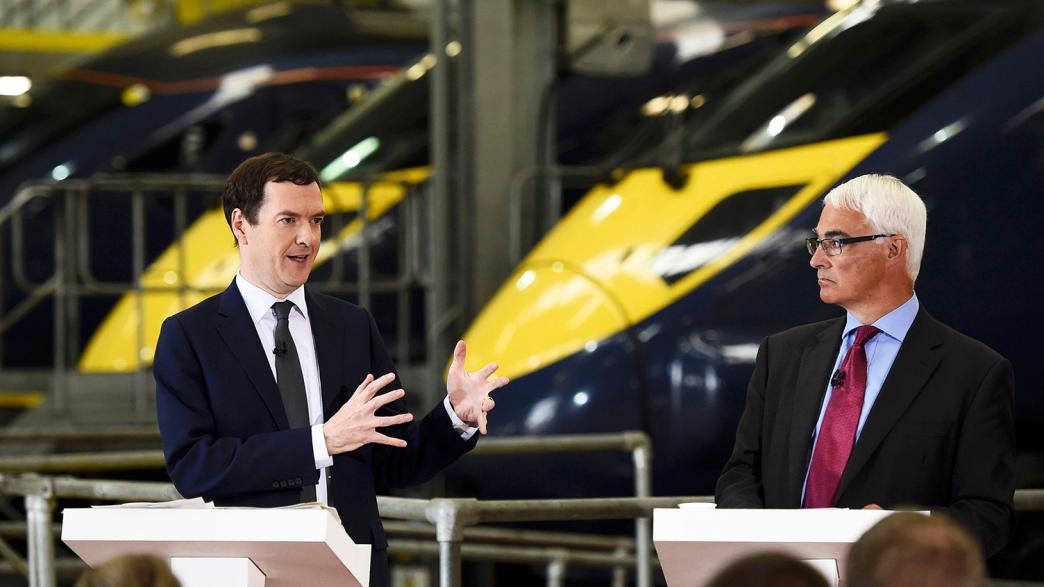
Former chancellors George Osborne (left) and Alistair Darling at a pro-Remain event at the Hitachi Rail Europe plant in Ashford, Kent, in 2016.

The phoney war

The immediate aftermath of the vote saw none of the panic or despair warned of in editorials – such as the Economist’s, which warned of “grave and lasting harms” that would leave the UK “poorer, less open and less innovative.” 13 The Economist, “Divided we fall”, 18th June 2016, www.economist.com/leaders/2016/06/18/divided-we-fall  Yes, the pound was weak, but this played a vital stabilising role. There was no recession – in fact, unemployment fell below 4% in 2019.

Rather than the “punishment budget” George Osborne had threatened as necessary to right the public finances after the referendum, (subsequent) chancellors felt able to expand investment and support projects to “level up” the country. There has been no exodus from the City – indeed, some of the bankers who decamped to Frankfurt or Paris may have returned. 14 The Economist, Has the City of London finally got its mojo back?, 30th April 2026, www.economist.com/britain/2026/04/30/has-the-city-of-london-finally-got-its-mojo-back

An aerial view of the City of London financial district.

Brexit did not bankrupt Britain – but then, it never could

The problem is that when economies fail, they tend not to do so like a business. There is no literal bankruptcy, no parade of staff with cardboard boxes, no stock-ticker making a right-angled swoop to zero. Economic mistakes as broad and long-lasting as Brexit manifest through the gradual accumulation of numberless, seemingly unrelated disappointments. It is hard to spot investments that don’t get made, or the loss of anything as ethereal as competitive vigour, or know which entrepreneurs opted for Paris, Dallas or Warsaw instead of London or Birmingham.

This is a grander version of the problem that makes good economic policy so hard to push through everywhere and all the time 16 Wilkes G, The UK needs a robust growth strategy and a stronger No.10 to deliver it, Institute for Government, 26 January 2026, www.instituteforgovernment.org.uk/comment/growth-policy-strategy-centre : the benefits are long-term, diffuse and hard to pin down, the inconvenience and effort are in the here and now. 

So while both sides are right, the conventional view is right-er. Matching G7 average growth is not terrible, and better than the doomier Remainers might have feared. But some estimates put the growth foregone at 8%, and even half of that – the official estimate of the OBR – amounts to a failure that over a decade adds up to over a trillion pounds of lost opportunity.
Bank of England at nighttime.

Where has this left UK economic policy making?

What matters is where this leaves UK economic policy making. One area where I find surprising agreement with the pro-Brexit camp is that it has been clarifying for the UK to understand that its fate can no longer be blamed on Brussels. 

The vote to leave the EU ushered in a series of governments keen to make something of the slogan, “Take Back Control”. Unfortunately, what the act of Brexit also revealed is that, unshackled from Europe, UK governments are perfectly capable of prioritising the wrong things or just making the wrong call. And for all the talk of agency, we learned that even without the supposed constraints of EU membership, a fully sovereign government can still fail to make choices, act short-term and make promises it really should not.

Brexit cannot be blamed for a multi-decade failure to update Council Tax, never-ending fuel-duty freezes, or the constant permutations that skills, regional and industrial policies have endured. Neither our membership in nor exit from the EU explain low levels of housebuilding, or why successive prime ministers push the reform of social care into the distant future. 

Housing development in Essex, one of the areas on the Devolution Priority Programme

Neither our membership in nor exit from the EU explain low levels of housebuilding.

Where do we go next?

So what does this mean for the future? As you might expect, my personal view is that becoming a closer part of the gigantic single market should be a key part of any growth agenda. This is not a simple, one-dimensional judgement – there will political choices to make, such as how much more adventurous the UK might want to be with new technology like artificial intelligence. But bigger markets are still better, geographical proximity remains as salient as ever, and Britain is better off cooperating with countries that share its respect for institutions and following the rules.

However, we cannot let fixation on the EU mask proper attention to the problems that Brexit helped to reveal, and also to exacerbate. Remainers like me baulk at the very phrase “opportunities of Brexit”. I still do, but will concede that it is fair to characterise the last decade as a time of missed opportunities. Wasting so much time either hoping to reverse the vote, or chasing the mirage of a post-EU trading system made up of dozens of tiny trade deals, Britain has spent a decade failing to make progress on domestic reforms.  

Our system of government gives its leaders impressive powers. Whoever leads Britain could embark on a decade of tax reform, devolution, energy system investment and public sector renewal, if they choose it. Regulatory alignment with Brussels should be a part of this. But, for goodness sake, let us not allow it to distract us from everything else. 

Related content

01 JUN 2026 Explainer

Public financial institutions

Public financial institutions (PuFins) can invest public funds and “crowd in” private investment. But who are they?

21 MAY 2026 Podcast

Burnham Issues

Sam White, Keir Starmer's former chief-of-staff, joins the team to explore what the PM can do as Andy Burnham inches closer to Westminster.