Public financial institutions
Public financial institutions (PuFins) can invest public funds and “crowd in” private investment. But who are they?

The government wants to boost investment in the UK as part of its strategy for growth. It sees an important role for what the chancellor has called an “active and strategic state” 38 Reeves R, ‘Mais Lecture 2026’, speech at the Bayes Business School, 17 March 2026 and that involves a significant role for public financial institutions (PuFins) which can invest public funds and “crowd in” private investment. The government plans to increase the capacity of the UK’s PuFins by nearly 40% in this parliament to £137bn. 39 HM Treasury, ‘An introduction to the UK public investment landscape’, 21 October 2025, www.gov.uk/government/publications/an-introduction-to-the-uk-public-investment-landscape
Who are the UK PuFins?
HM Treasury currently designates five PuFins in the UK to use financial transactions such as loans, equity investments and guarantees to deliver government objectives. 40 HM Treasury, ‘Financial transaction control framework’, updated 1 April 2025, www.gov.uk/government/publications/financial-transaction-control-framework
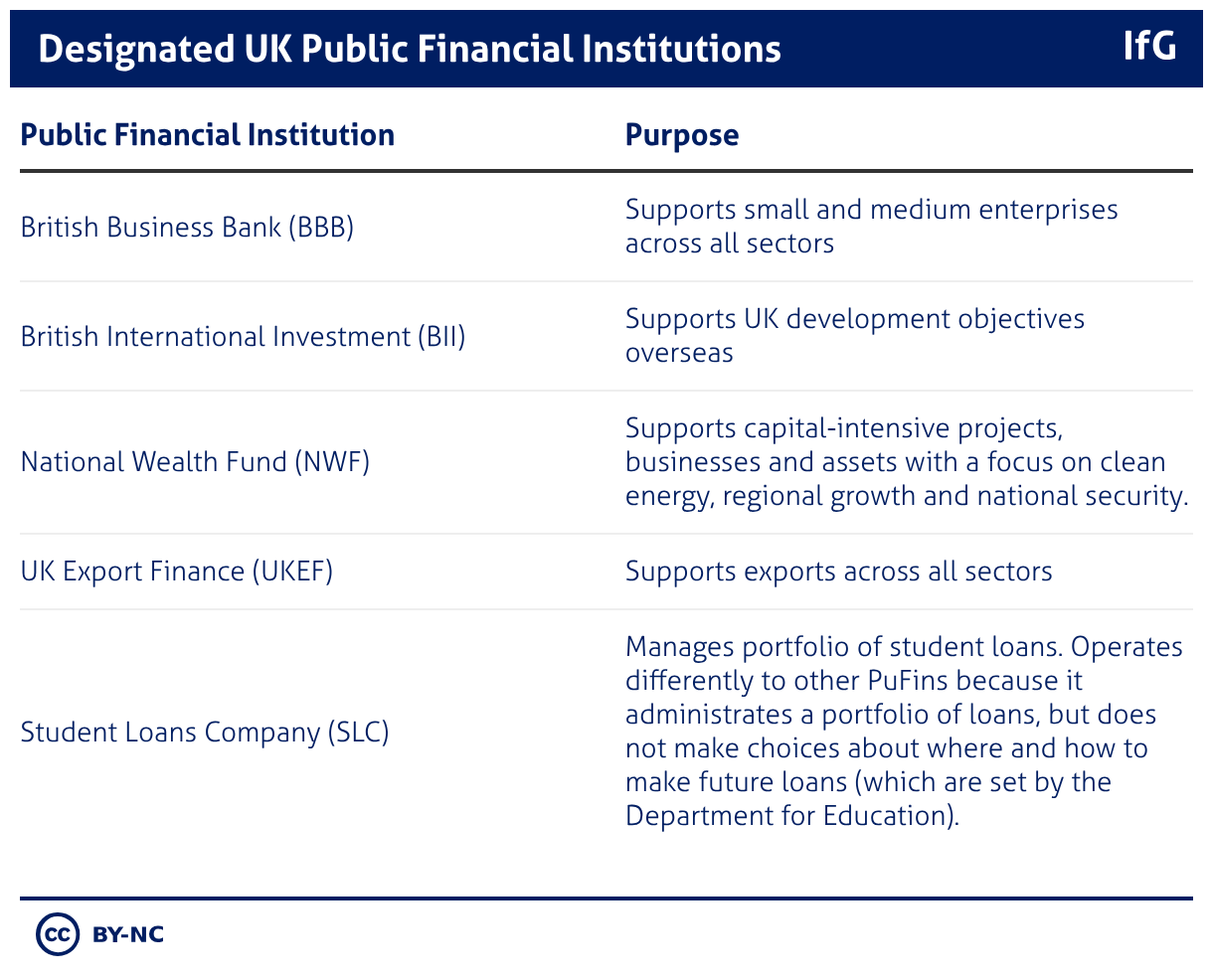
In addition, the recently established National Housing Bank 48 National Housing Bank and Homes England, ‘Homes England marks National Housing Bank launch as part of a once-in-a-generation investment offer to accelerate delivery of new homes and mixed-use schemes’, press release, 31 March 2026, www.gov.uk/government/news/homes-england-marks-national-housing-bank-launch-as-part-of-a-once-in-a-generation-investment-offer-to-accelerate-delivery… will focus on supporting the delivery of housing, while GB Energy may be designated as a public financial institution in the future as the government intends for it to invest in green energy projects. Devolved governments have also established their own institutions which use financial transactions to deliver policy. 49 The Scottish National Investment Bank, the Development Bank of Wales and Invest Northern Ireland.
The landscape of PuFins in the UK has changed a lot in recent years and is increasingly complex. For instance, the government established the Green Investment Bank in 2012 and then sold it into the private sector in 2017. The British Business Bank (BBB) was established in 2014. Before the UK left the EU, the UK could access the European Investment Bank (EIB). Partly in response to this, the UK Infrastructure Bank was launched in 2021 and then it was expanded and reformed as the National Wealth Fund in 2024. 50 Institute for Government, ‘National Wealth Fund’, 12 February 2025, www.instituteforgovernment.org.uk/explainer/national-wealth-fund Great British Energy and the National Housing Bank are new organisations. One risk is that the UK may end up with “a proliferation of subscale public finance institutions all facing similar organisational challenges”. 51 House of Commons Treasury Committee, National Wealth Fund – Oral Evidence, 1 July 2025, https://committees.parliament.uk/oralevidence/16224/pdf/
Some other countries have access to more established, larger institutions with wide remits, such as KfW in Germany and the EIB. KfW has a portfolio of over €500bn of assets and makes investments with a value of roughly 1% of German GDP per year, 52 King A and Jameson D, ‘Designing a UK fiscal framework fit for the climate challenge’, Centre for Economic Transition Expertise, 11 July 2024, https://cetex.org/publications/designing-a-uk-fiscal-framework-fit-for-the-climate-challenge/ while Bpifrance has over €100bn in assets, and invested €60bn into the French economy in 2024. 53 Bpifrance, ‘2024 Financial Results’, press release, 19 March 2025 It may take time for UK PuFins to develop similar scale, networks and track records, but these international comparators can inform the design and strategy of the UK’s PuFins.
The UK also contributes to financial institutions that support projects globally, such as the European Bank for Reconstruction and Development. Some have suggested that the UK could participate in a new financial institution to fund increased defence spending across NATO countries. The idea for a Defence, Security and Resilience Bank (DSRB) has been supported by the Canadian prime minister Mark Carney but the institution has not yet been formed. 54 Webber E, ‘Britain sidelined in talks on Carney-backed defense bank’, Politico, 20 April 2026, www.politico.eu/article/keir-starmer-mark-carney-uk-canada-sidelined-talks-defense-bank/
What do public financial institutions do?
PuFins provide finance through loans, equity investments and guarantees to support policy priorities where the government believes investment is currently insufficient. This could be because the government is better able to take some kinds of risk, because it has a different time horizon to the private sector, or where there are wider social benefits that private investors may weigh less heavily than the government.
In some cases, that means working with a particular group of companies. For instance, the British Business Bank (BBB) offers support to smaller businesses to expand through programmes such as loans for new entrepreneurs and direct investments in small businesses. It can also mean supporting specific projects such as the National Wealth Fund’s (NWF) loan of £36.6bn for the construction of the Sizewell C nuclear power station. PuFins will often also aim to bring in more private sector investment alongside their own support. For instance, the government has set a target for the NWF to mobilise £3 of private investment for every £1 that it invests. 57 HM Treasury, ‘Statement of Strategic Priorities to the National Wealth Fund’, 19 March 2025, www.gov.uk/government/publications/statement-of-strategic-priorities-to-the-national-wealth-fund
As well as making their own investments, PuFins can play an important role as centres of expertise in the public sector. Their commercial and financial expertise can help other parts of the public sector to structure project pipelines and access the right kind of finance for their projects. For instance, the NWF provides support to local government with project development.
How are they funded?
PuFins use public funds to deliver their work, but they operate differently from government departments and so their budgets are set differently. 58 HM Treasury, ‘Financial transaction control framework’, updated 1 April 2025, www.gov.uk/government/publications/financial-transaction-control-framework The government will typically give a PuFin a multi-year capital allocation. This is the total amount that the organisation can have invested at any one time. This may be supplemented by an annual limit on the quantity of new investments they can make in a given year. If a loan is paid back, or a stake in a company is sold, the PuFin can then use that money to give new loans or invest in companies.
Finally, most PuFins will have a target for the level of returns they are expected to achieve from their investments. This target is typically not expected to be achieved in every year as returns can vary, but helps guide the kind of projects which PuFins invest in and the kind of returns that they should make across their whole portfolio.
How do PuFins impact the government’s performance against its fiscal rules?
The way in which financial transactions (FTs) are reflected in the fiscal rules changed in 2024. The government’s investment rule states that net debt should fall as a share of the economy in the medium term. 61 Institute for Government, ‘Current UK fiscal rules’, updated 19 November 2024, www.instituteforgovernment.org.uk/explainer/current-fiscal-rules In 2024, the measure of debt changed from Public Sector Net Debt (PSND) to Public Sector Net Financial Liabilities (PSNFL). 62 Institute for Government, ‘What are the different ways to measure public debt?’, 24 September 2024, www.instituteforgovernment.org.uk/explainer/measure-public-debt Under PSNFL, if the government borrows money to make a loan that it expects to be paid back, then the borrowing counts as a government liability, as under PSND, but under PSNFL the loan is now counted as an asset on the government’s balance sheet too. As a result, the government can now spend more on FTs without affecting its performance against its fiscal rules.

FTs are also typically classed as capital spending, which means they do not contribute to performance against the other fiscal rule – that the current budget is in balance in the medium term.
The change to the fiscal rules increases the incentive for the government to use FTs to achieve its objectives. But this also increases the risk that the government will turn to FTs when they are not the most appropriate tool. This is why the government released a new Financial Transaction Control Framework 64 HM Treasury, ‘Financial transaction control framework’, updated 1 April 2025, www.gov.uk/government/publications/financial-transaction-control-framework to manage their use across government. This argues that PuFins should be the standard way of delivering FTs that are large, complex or high risk as they have the expertise and operational independence to identify suitable opportunities, and design and deliver FTs in response.
Could PuFins lose money?
Since PuFins are making or guaranteeing loans and buying stakes in companies, there is an inherent risk that they could lose money on these transactions. Indeed, the government wants PuFins to take risks to achieve their goals. For instance, the National Wealth Fund has a higher financial risk appetite than a typical private sector capital provider. 67 National Wealth Fund, ‘Unlocking the UK’s Future: our Five-Year Strategic Plan to 2030/31’, 2026, www.nationalwealthfund.org.uk/about-us/our-strategy/ If individual transactions lose money this would not prevent the PuFin from achieving its objectives if other parts of its portfolio are more successful.
However, risk still needs to be managed through controls within PuFins and through risk limits set by the government. These limits use the same kind of modelling as a private sector bank to classify the riskiness of a portfolio of investments and ensure that this is aligned with the government’s risk appetite.
Sometimes, the government might want to make investments even though it expects to make a loss. In this case, the transaction is treated differently in the public finances. For instance, the government does not expect that all student loans will be paid back in full. The total value of student loans is therefore split into an asset – the part of the loan that is expected to be paid back – and a transfer. 68 Institute for Government, ‘Student finance’, 27 February 2026, https://www.instituteforgovernment.org.uk/explainer/student-finance The transfer is treated as normal government spending and not a financial transaction from the perspective of the public finances and the fiscal rules.
- Topic
- Public finances
- Keywords
- Economy Business Public spending
- Position
- Chancellor of the exchequer
- Department
- HM Treasury
- Public figures
- Rachel Reeves
- Publisher
- Institute for Government