Performance Tracker 2026: Prisons and probation
Recent policy changes have put prisons back at risk of running out of spaces, while probation is struggling to manage offenders in the community.

In July 2024, when the Starmer government came into office, the prison system in England and Wales was facing disaster. Prisons were almost out of space, with occupancy levels hitting 99%; existing early release schemes were highly chaotic and had largely reached their limits. Violence was very high, protests and self-harm were both at record levels and all were rising rapidly. Purposeful activity for prisoners – education, employment and training – was very poor, 191 HM Chief Inspectorate of Prisons for England and Wales, Annual Report 2023-24, 2024, retrieved 21 September 2026, https://hmiprisons.justiceinspectorates.gov.uk/hmipris_reports/annual-report and prisons were struggling with inexperienced staff and high leaving rates.
The state of the probation service was not much better. The Sunak government’s ad hoc early release scheme saw thousands of prisoners released, often with only a few hours’ notice, making effective preparation for release impossible; at its peak, 14% of people released were sleeping rough.* The unification and renationalisation of the probation service in 2021 had failed to improve its poor performance, with inspectorate ratings falling even further. Caseloads and vacancy rates were very high, and sentence requirements such as unpaid work and rehabilitative activity were not being delivered for many offenders. 192 Mahmood S, ‘Probation delivery’, statement, UK Parliament, 12 February 2025, retrieved 21 September 2026, https://questions-statements.parliament.uk/written-statements/detail/2025-02-12/hcws446
Facing this incredibly difficult set of challenges, the Starmer government did an impressive job of stabilising the situation. Within days of the general election, the then justice secretary, Shabana Mahmood, set out a plan for dealing with the immediate capacity crisis in prisons, and also committed to expanding the recruitment of probation officer trainees, addressing (although not resolving) the two most pressing problems. After that, the administration brought in substantial changes to sentencing and policy changes to reduce the active caseload on probation, as well as making some progress in stabilising the workforce.
All this has only been enough to stave off disaster, however. Performance improvements have so far been extremely modest, with violence and deaths in prisons still high and the probation service still failing to deliver adequate risk assessment or manage offenders effectively in the community. And there is no coherent strategy to improve this. Over the summer of this year, the then justice secretary David Lammy appointed Amber Rudd, former Conservative home secretary, to conduct a review into safety and security in prisons. But this will not report for several months, and in the meantime, prisons will continue to struggle with serious problems from drugs, violence and organised crime. 193 HM Chief Inspector of Prisons, Annual report 2025–26, HM Inspectorate of Prisons, 2026, https://cdn.websitebuilder.service.justice.gov.uk/uploads/sites/19/2026/07/HMI-Prisons-ARA-25-26-FINAL.pdf
The situation is still more precarious in probation, which is currently facing perhaps its most difficult moment at least since the service was broken up under the coalition government in 2014. Around 4,500 prisoners are being released from October with the implementation of the Sentencing Act 2026. 194 Ministry of Justice, ‘Estimated progression model tranche release volumes’, 30 August 2026, https://www.gov.uk/government/publications/estimated-progression-model-tranche-release-volumes/estimated-progression-model-tranche-release-volumes This is on top of thousands more offenders expected to receive suspended sentences rather than short stretches in prison, who will also need supervising.
The Starmer government struggled to substantially increase the number of probation practitioners – probation officers and probation services officers who supervise offenders. This has left probation still far short of the number needed to manage this caseload effectively. If the service makes it through this period without disaster, it will be, one interviewee said, “a miracle”. The service deserves real credit for how it has managed an extremely difficult situation and multiple policy changes. But performance improvement is still a long way off.
* From February to August 2024, when the End of Custody Supervised Licence Scheme saw at least 1,000 prisoners released each month, 14% of all prisoners released were sleeping rough. Ministry of Justice, ‘Offender accommodation outcomes, update to March 2025’.

Having navigated the immediate capacity crisis, the Starmer government legislated to reduce long-term demand on prisons
On going into office, the Starmer government had very few options to manage the immediate crisis in prison capacity. It successfully implemented the emergency SDS40 scheme (in full, the ‘Standard Determinate Sentences 40% scheme’) to release certain prisoners after serving 40% of their sentence, rather than 50%. This generally went well, although initial measures freed up less space than the government might have hoped for. Mahmood also commissioned David Gauke, former Conservative justice secretary, to conduct an independent review into sentencing, with a view to reducing the prison population by around 10,000 over the medium term. This review, published in May 2025, 196 Independent Sentencing Review, Independent Sentencing Review: Final report and proposals for reform, GOV.UK, 2025, https://www.gov.uk/government/publications/independent-sentencing-review-final-report formed the basis of the government’s longer-term reform package, the Sentencing Act 2026.
The short-term changes introduced between September 2024 and July 2025 freed up urgently needed spaces in prisons, but were stop-gap measures. It took about six months for the prison population to return to its previous peak after the SDS40 scheme was implemented in September 2024. Only dramatically shortening the time most people spent in prison if they were ‘recalled’ after release, to just two to four weeks in most cases, brought it back down again. Even so, by March 2026 it had returned to close to its level in July 2024. A longer-term package of measures to get demand on a more stable trajectory was critical.

The Sentencing Act 2026 was the Starmer government’s answer to this problem, based on the Gauke review. Several measures to reduce the prison population were introduced in spring 2026:
- introducing ‘presumption to suspend’ prison sentences of 12 months or less, so offenders will not go to prison unless they breach the conditions of their sentence
- increasing the length of sentence that can be suspended from two years to three
- introducing a fixed-length 56-day recall and restricting the use of standard recalls (where the offender remains in prison until released by the parole board or the end of their sentence)
- raising the threshold for refusing bail for those waiting for a trial or sentencing.
These measures already seem to have contributed to a drop in the prison population. But the biggest impact is expected to come from changing the release points for standard sentenced prisoners as part of the ‘earned release’ or ‘progression’ model, introduced in stages from October 2026.
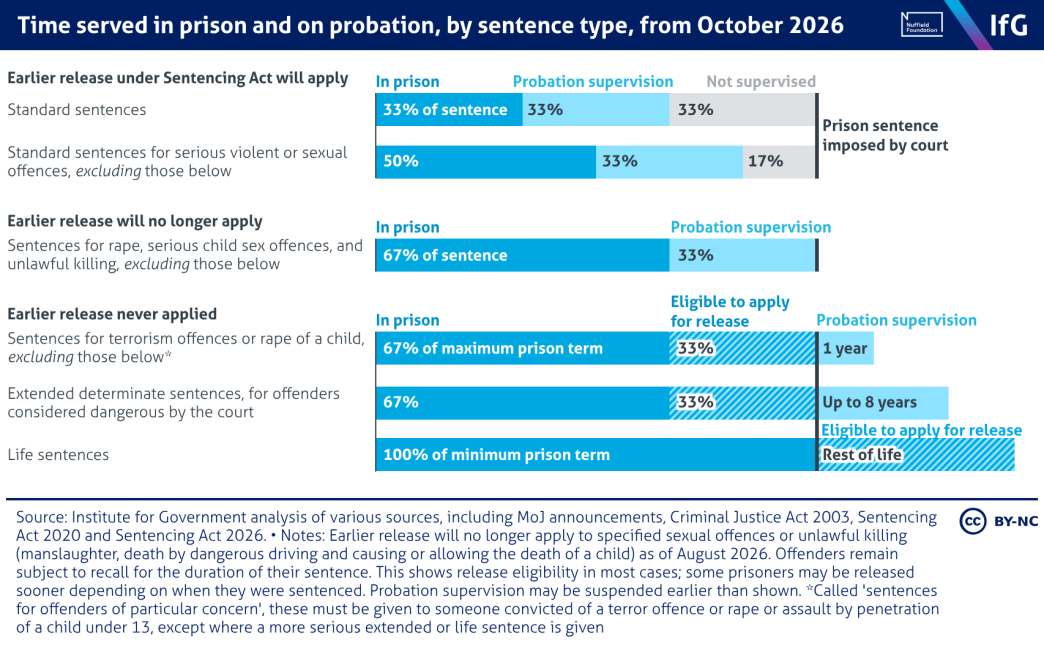
This will see most prisoners who are serving standard determinate sentences (regular prison sentences) released after serving a third of their sentence in prison. They will then be subject to ‘intensive supervision’ in the community for the second third of their sentence, including in most cases being fitted with an electronic monitoring tag until they are 40% of the way through their sentence. 200 Inside Time, ‘Earlier releases under Sentencing Act to start in September’, Inside Time, 30 June 2026, retrieved 21 September 2026, https://insidetime.org/newsround/earlier-releases-under-sentencing-act-to-start-in-september For the final third of their sentence, offenders will not be actively supervised; however they will remain subject to their licence conditions and to recall if they commit a further offence – but, crucially, only if the probation service finds out, which is far from guaranteed. 201 Institute for Government interviews, 2026.
Some of those serving sentences for serious violent and sexual offences who were previously released after two thirds of their sentence will now be released halfway through.* They will then also be subject to an intensive supervision period, although it is not clear how long this period will be. The most serious sentences – extended determinate sentences, sentences for offenders of particular concern, imprisonment for public protection and life sentences – will be unaffected. These prisoners will continue to have to apply for release once they are eligible, after serving their minimum tariff, and if successful will then be supervised as usual in the community for the remainder of their sentence.
This has produced an even more convoluted system of sentences and releases than we had before, and the Burnham government has made this even worse by subsequently adding further exemptions. As the chart above shows, the same length of sentence imposed by a court could lead to vastly different amounts of time spent in prison, depending on the offence type and the kind of sentence. Some people serving five year sentences will spend less time in prison than those serving four-year sentences. Someone given a ‘standard’ six-year sentence, not considered dangerous or of particular concern by the court, could serve two, three or four years in prison, based on the offence they were convicted of, not on their risk level or behaviour in custody.
Equally importantly, someone released after two years would then have just two years being supervised by probation, or perhaps even less, before their sentence was effectively over. Calling this a ‘six-year sentence’, when only four years are actually served in prison or under supervision, risks further undermining transparency in sentencing and public trust.
Other measures in the Sentencing Act were introduced earlier and initial indications are positive. The presumption to suspend any sentence of 12 months or less came into effect in late March 2026, as did the changes affecting recalls.** These both seem to have
contributed to a rapid drop in the prison population of about 1,600 from March to April 2026.*** This decrease has not been sustained, however, with the prison population in September once again approaching record levels. This may be because these offenders are frequently breaching the terms of their sentence, or because the probation service is struggling to manage them effectively in the community. However, the evidence suggests that community sentences have lower reoffending rates than short prison sentences, even for repeat offenders.
202
Eaton G and Mews A, The impact of short custodial sentences, community orders and suspended sentence orders on reoffending, Ministry of Justice, 2019, https://www.gov.uk/government/publications/impact-of-short-custodial-sentences-community-orders-and-suspended-sentence-orders-on-reoffending
That means these changes may still reduce reoffending and pressure on the prison population in the medium to long term.
If the Sentencing Act had been implemented in full, projections from the Ministry of Justice (MoJ) suggest it would have successfully put prisons on a more stable footing. Capacity would still have been extremely tight, with prisons remaining at 97–98% capacity until at least 2032, and the upper range of population projections continued to exceed estimated capacity. But for the first time in several years, forecast capacity was expected to consistently exceed projected population growth after the Sentencing Act was implemented.
* This returns the release point for these prisoners to the pre-2020 status quo, when all prisoners with a fixed term sentence were released at the halfway point.
** Previously, prison leavers could be recalled to custody either for a fixed period of 14 days (for a sentence of up to a year) or 28 days (for longer sentences), or for a ‘standard’ recall, where they would stay in prison for the rest of their sentence or until released by the parole board, whichever came first. 14- and 28-day recalls have been abolished, and replaced with a 56-day recall. Since June 2025, standard recalls can only be used for most offenders if they are subject to multi-agency public protection arrangements or have been charged with a new offence. Since March 2026, a standard recall must be used in these cases. Crucially, from January 2026, this change was applied retrospectively to offenders who were already in prison after a standard recall, so many of these people who had already served 56 days were released in stages in early 2026.
*** It will take a year for the full effect of these changes to be felt, but the impact will be front-loaded, given the number of people who previously received fairly short prison sentences of under three months.

Some of the changes have serious downsides, making sentencing even more opaque and shifting substantial risk onto the probation service. But after years of successive governments utterly failing to tackle this problem, enacting major sentencing reforms was set to be a real achievement of the Starmer government – especially in the face of significant political and public opposition. This progress has been imperilled by the Burnham government’s decision to exempt some prisoners from earlier release under the Sentencing Act.
The Burnham government has kept most of the measures in the Sentencing Act, but the changes to prison releases risk further crisis
Immediately after becoming prime minister in July 2026, Burnham announced a ‘pause’ on the implementation of the progression model of sentencing, which was due to come into effect from 2 September. 206 Beard J, Changes to automatic prisoner release dates in England and Wales, House of Commons Library, 2024, https://commonslibrary.parliament.uk/research-briefings/cbp-10974/ This was largely in response to significant public backlash and critiques from the victims’ commissioner and domestic abuse commissioner.
In early August, the government announced that the scheme would go ahead, but would no longer apply to people serving sentences for rape, serious sexual offences against children or grooming offences, whose release point had been due to move from two thirds of their sentence to halfway.
207
Ministry of Justice, ’Rape, serious child sex and grooming offences barred from sentencing changes’, press release, 4 August 2026, https://www.gov.uk/government/news/rape-serious-child-sex-and-grooming-offences-barred-from-sentencing-changes
In the face of ongoing public pressure, people serving sentences for unlawful killing, including manslaughter and death by dangerous driving, were subsequently also excluded. The most serious of these offenders would already have been excluded as they are serving extended sentences or sentences for offenders of particular concern. Nonetheless, the changes are still expected to reduce the total number of people released earlier under the scheme from around 6,000 to
around 4,500.
The new justice secretary, Alex Norris, may have felt empowered to make these changes because the prison population over the summer was somewhat lower than previously projected. But this appears to have been a short-term effect. It was partly due to changes to recall and short sentences, as set out above. But the biggest contribution to the recent fall in the prison population has come from an unexpected direction: a drop in the number of prisoners held on remand waiting for their trial or sentencing, thanks to the courts managing to hear these cases more quickly.
This has freed up some very welcome additional breathing room in prisons, but may prove challenging to sustain. Focusing heavily on cases where defendants are held on remand means even longer waits for other cases. The new practice direction on listing, implemented in criminal courts from October 2026, emphasises the ‘human impact’ of delays to hearings, including on both the victim and the defendant. 208 Courts and Tribunals Judiciary, Practice Direction on Listing in the Criminal Courts, Courts and Tribunals Judiciary, 2026, https://www.judiciary.uk/wp-content/uploads/2022/09/Practice-Direction-on-Listing-in-the-Criminal-Courts.pdf This is likely to encourage prioritisation of some serious cases where the defendant is on bail in the community, particularly rape and serious sexual offences, which may cause the remand population to rise again.

In the past few months, the headroom in prisons has been steadily shrinking. As of 28 September, it stood at just over 1,100 spaces in adult men’s prisons, down more than 200 on the previous week and 67% lower than at the end of April. 221 Ministry of Justice, prison population figures, 27 April and 14 September 2026. Exempting some offenders from earlier release under the Sentencing Act may well wipe out such razor thin margins and mean the government is forced into yet more emergency capacity measures before new cells come online.
Prison expansion is already behind schedule, leaving prisoners in unsafe cells
Avoiding a further capacity crisis in this parliament also relies on the other piece of the puzzle: expanding the prison estate to increase the supply of spaces. The prison population is currently slightly below projections, but even so, it is likely to swiftly rise to overtake existing capacity. Delivering additional prison spaces on schedule is necessary to avoid once again running out of room in prisons.
Around 3,200 new prison places have been added since 2024, 222 Smith H, ’How does Labour’s record on prison places compare to the Conservatives’, Full Fact, 14 August 2026, retrieved 1 October 2026, https://fullfact.org/crime/labour-prison-places-record/ largely due to the opening of a new prison in March 2025 (1,500 spaces) and temporary ‘rapid deployment cells’ (around 900 spaces). 223 Ministry of Justice, ’Prison building boom to make streets safer’, press release, 9 December 2025, https://www.gov.uk/government/news/prison-building-boom-to-make-streets-safer But the net increase in capacity has been negligible: a few hundred spaces at most. 224 Ministry of Justice, prison population figures, July 2024 and 14 September 2026. This is because around the same number of cells have been taken out of use, 225 Smith H, ‘How does Labour’s record on prison places compare to the Conservatives ?’, Full Fact, 14 August 2026, retrieved 21 September 2026, https://fullfact.org/crime/labour-prison-places-record due to dilapidation, safety concerns or other problems.
Both of the major expansion projects delivered since 2024 were initiated and largely delivered by previous Conservative governments; it currently takes at least seven years to construct a new prison. 226 Ministry of Justice, 10-Year Prison Capacity Strategy, GOV.UK, 2024, https://assets.publishing.service.gov.uk/media/67586f828a1ef8f66413b9c2/24.231_MOJ_10-Year_Capacity_Strat_Pub_v10.1_WEB.pdf Capacity is currently higher than projected, but that is mostly because of delays to planned maintenance work that will temporarily take cells out of use, including upgrading cells that are not fire safe. This means capacity is likely to decline before it rises again.
In December 2024, the National Audit Office estimated that the maintenance backlog in prisons was £1.8bn, with a further £1bn required by 2030 to bring the whole estate into a “fair condition”, including making all cells fire safe. 227 Comptroller and Auditor General, Increasing the Capacity of the Prison Estate to Meet Demand, Session 2024–25, HC 376, National Audit Office, 2024, www.nao.org.uk/wp-content/uploads/2024/12/increasing-the-capacity-of-the-prison-estate-to-meet-demand.pdf By comparison, the cumulative maintenance budget across 2024/25 and 2025/26 was just £520m – well short of the sums required. 228 House of Commons Committee of Public Accounts, Prison Estate Capacity: Fifteenth report of session 2024–25, HC 366, Parliament UK, 2025, retrieved 21 September 2026, https://committees.parliament.uk/publications/46985/documents/242927/default There also needs to be enough headroom in prisons to take cells out of use to complete essential maintenance.
The pipeline of planned expansion has already been delayed since 2024, with the rapid expansion of places now not due to start until 2028, rather than early 2027 (partly because of delays to planned fire safety works). The government is now not projecting to hit 90,000 prison spaces across England and Wales until November 2028, around a year later than planned. 229 Ministry of Justice, ’Annual Statement on Prison Capacity:2025’, GOV.UK, January 2026, https://www.gov.uk/government/publications/annual-statement-on-prison-capacity-2025 In January 2026, it claimed it was still on track to meet its target of 14,000 new places by 2031, but because of cells being taken out of use or lost to disrepair, the net increase will be substantially lower than this.
The delay appears to be largely due to the collapse of supplier ISG in September 2024, which was the main contractor for 17% of the MoJ’s planned additional spaces. 230 Comptroller and Auditor General, Increasing the Capacity of the Prison Estate to Meet Demand, Session 2024–25, HC 376, National Audit Office, 2024, www.nao.org.uk/wp-content/uploads/2024/12/increasing-the-capacity-of-the-prison-estate-to-meet-demand.pdf In 2025, this led the National Infrastructure and Service Transformation Authority (NISTA) to downgrade three key prison expansion projects from amber to red, meaning successful and timely delivery “appears unachievable”. 231 Inside Time, ‘Parts of government’s prison-building programme branded “unachievable”’, Inside Time, 18 August 2025, retrieved 21 September 2026, https://insidetime.org/newsround/parts-of-governments-prison-building-programme-branded-unachievable The large expansions from 2028 on are principally from new houseblocks in existing prisons, with some new prisons as well; these are more likely to be subject to unexpected delays than refurbishments or rapid deployment cells. 232 Ministry of Justice, 10-Year Prison Capacity Strategy, GOV.UK, 2024, https://assets.publishing.service.gov.uk/media/67586f828a1ef8f66413b9c2/24.231_MOJ_10-Year_Capacity_Strat_Pub_v10.1_WEB.pdf

Capacity pressure and delays to maintenance work are leaving thousands of prisoners in unsafe cells. As of 2024/25, 44% of cells did not have suitable in-cell fire detectors. 237 Ministry of Housing, Communities and Local Government, Crown Premises Fire Safety Inspectorate Annual Report 2024/25, GOV.UK, 2025, https://assets.publishing.service.gov.uk/media/690c5e0714b040dfe8292391/Crown_Premises_Fire_Safety_Inspectorate__CPFSI__annual_report_2024_to_2025.pdf The Starmer government abandoned plans to remove prisoners from non-compliant cells by the end of 2027, and set no new deadline to achieve this. 238 Preece R, ‘More than 60 prisons await vital improvements as government U-turns on fire safety’, Howard League for Penal Reform, 24 March 2026, retrieved 23 September 2026, https://howardleague.org/news/more-than-60-prisons-await-vital-improvements-as-government-u-turns-on-fire-safety Prisoners are particularly vulnerable to death and serious injury from fires because they cannot escape their cells, and fires are becoming increasingly frequent in the prison estate. Recorded fires in prisons increased 124% from 2019/20 to 2024/25, and there were more than 500 fire-related injuries in each of 2023/24 and 2024/25. 239 Ministry of Housing, Communities and Local Government, Crown Premises Fire Safety Inspectorate Annual Report 2024/25, GOV.UK, 2025, https://assets.publishing.service.gov.uk/media/690c5e0714b040dfe8292391/Crown_Premises_Fire_Safety_Inspectorate__CPFSI__annual_report_2024_to_2025.pdf The Crown Premises Fire Safety Inspectorate issued eight prisons with ‘Step Away’ notices from August 2024 to June 2026, indicating that it would be pursuing criminal proceedings were it not for the fact that publicly run prisons are immune from prosecution over fire safety. 240 Crown Premises Fire Safety Inspectorate, ‘Register of notices issued by the Crown Premises Fire Safety Inspectorate’, Ministry of Housing, Communities and Local Government, 2026, https://assets.publishing.service.gov.uk/media/6a86fd318d785493a9c89870/Register_of_Notices_issued_by_Crown_Premises_Fire_Safety_Inspectorate.pdf
Early release schemes and the struggle to manage capacity have caused releases in error to soar, although there has been progress in the past year
Releases in error have risen sharply in the past few years, largely thanks to the introduction of new and more complicated rules governing when people are released. This began before the various emergency early release schemes, as changes to sentencing – such as releasing certain serious offenders after two thirds of their sentence, rather than half – made calculating release dates more complex. But releases in error increased substantially during the Sunak government’s End of Custody Supervised Licence (ECSL)scheme and then much more after the Starmer government’s change to release certain prisoners after serving 40% of their sentence (the SDS40 scheme). There were more than two and a half times as many releases in error in 2024/25 as in 2023/24, and more than three and a half times as many as in 2022/23.

These errors are largely the predictable result of complex rules being applied by a system in crisis. 251 Owens L, Independent Review into Releases in Error: A report for the deputy prime minister, GOV.UK, 2026, https://assets.publishing.service.gov.uk/media/69df4b6f642d5aaff4e04fbf/Independent_review_into_releases_in_error_-_redacted.pdf There is a digital tool to calculate release dates, but it cannot be used in all cases, and because different parts of the criminal justice system use different systems, staff often rely on paper records or manual workarounds. 252 Ibid. In some cases, there are contradictions between prisoners’ digital and physical records (as was the case with Hadush Kebatu – the failed asylum seeker who was released in error, rather than being deported, after being convicted of sexual assault). 253 Owens L, Independent Review into Releases in Error: A report for the deputy prime minister, GOV.UK, 2026, https://assets.publishing.service.gov.uk/media/69df4b6f642d5aaff4e04fbf/Independent_review_into_releases_in_error_-_redacted.pdf
Every change requires updated guidance and recalculations of eligibility and release dates. The cumulative effect is a complex policy and operational environment, with layers of changing operational guidance… hard pressed operational officers and staff are now operating in a landscape that is more complex than any time in recent history. 254 Ibid., pp. 65, 66. – Dame Lynne Owens, independent Review into Releases in Error
It is also important to consider the flip side of releases in error: unlawful detentions, when a prisoner is not released when they should be. Interviewees generally thought unlawful detention is happening significantly more frequently than releases in error, 255 Institute for Government interviews, 2026. but there is currently no published data on this. Lynne Owens, in her review of releases in error, found that “it is highly likely that unlawful detentions present material financial and reputational risks for HMPPS [HM Prison and Probation Service]”, 256 Owens L, Independent Review into Releases in Error: A report for the deputy prime minister, GOV.UK, 2026, p. 134, https://assets.publishing.service.gov.uk/media/69df4b6f642d5aaff4e04fbf/Independent_review_into_releases_in_error_-_redacted.pdf while a random dip sample of releases conducted by the MoJ found 14 unlawful detentions in a sample of 386 cases – with the longest of these held unlawfully for 12 days. The same sample found only two releases in error. 257 Ibid., p. 74.
The Starmer government’s immediate response to releases in error was to bolster manual checks, including introducing a new release checklist to be signed off by a senior prison officer, and to pledge additional funding for digital and AI-based solutions to releases in error. These changes were introduced from November 2025, so may have contributed to fewer releases in error in 2025/26. Equally, however, this may have simply been the result of changes bedding in and slightly more time for staff to make decisions.
Under Starmer, the MoJ committed itself to investing up to £4m to expand the Calculate Release Dates service, produced by the in-house MoJ digital team, to “deliver a fully end-to-end system, with court data flowing straight into the correct prison record”, within two years. 258 Ministry of Justice, ‘Releases in error: policy overview’, GOV.UK, 15 April 2026, retrieved 23 September 2026, www.gov.uk/government/publications/response-to-the-independent-review-into-releases-in-error/releases-in-error-policy-overview Calculate Release Dates is part of Prison Digital Services, which is generally highly rated by prison staff. 259 Institute for Government interviews, 2026. Nonetheless, this end-to-end system is extremely ambitious and seems unlikely to be achievable in the current context, particularly given the ongoing limitations of Common Platform, the case management system in the criminal courts. 260 Institute for Government interviews, 2026.
The slight easing of capacity pressure has seen violence, deaths and protests in prisons all start to improve
The breathing room on capacity from around October 2025 to June 2026 had a noticeable impact on prisons. While interviewees still emphasised high rates of violence, drug use and organised crime within prisons, there was a general sense that the slight reduction in capacity pressure has allowed prisons to start to focus on improving conditions and bringing down violence, which was approaching record highs.

The assault rate per 1,000 prisoners was still 8% higher in 2025/26 than in 2023/24, but in the most recent quarter it was 3% lower than when Labour came into office.* September 2025 to March 2026 saw the biggest drop in assaults outside the pandemic, when prisoners were largely confined to their cells. The assault rate in women’s prisons has, however, continued to climb and was almost twice as high as the rate in men’s prisons in 2025/26. There were 660 assaults, 47 of them serious, for every 1,000 prisoners in women’s prisons. This compares to 342 assaults, 39 of them serious, for every 1,000 prisoners in men’s prisons.
* These figures are not exactly comparable as figures from before Q2 2018 exclude incidents occurring within the youth estate. However, this has a minimal impact on the total or the trend.

There has also been a sharp drop in protesting behaviour. Incidents at height (when prisoners climb on netting or roofs) and making barricades (obstructing access to part of the prison) fell 15% and 11% respectively from 2024/25 to 2025/26, and are both now lower than when Labour came into office in July 2024. Strikingly, these mark the first declines outside of the pandemic since 2012/13. Both self-harm and deaths have also fallen, down 10% and 12% respectively in the 12 months to March 2026 relative to the previous year. However, homicides are very high, with a record eight homicides in the 12 months to June 2026 and seven in the previous year, compared to a typical range of zero to three in earlier years. 262 Ministry for Justice, ‘Safety in custody statistics, England and Wales: deaths in prison custody to June 2026 assaults and self-harm to March 2026’, GOV.UK, 30 July 2026, retrieved 23 September 2026, https://www.gov.uk/government/statistics/safety-in-custody-quarterly-update-to-march-2026/safety-in-custody-statistics-england-and-wales-deaths-in-pr…

These improvements are extremely welcome and make a real difference to the prison environment for both prisoners and staff. But there are still serious problems with violence and disorder in prisons and gains so far are unlikely to be sustained with prisons now back above 98% occupancy levels. 265 MoJ, Prison population statistics, Monday 28 September 2026. Any delays to the release of prisoners who have already been given a release date, such as due to further policy changes, may also create serious flashpoints for violence and disorder that will need to be managed.
Prisons are increasingly short of prison officers, making packed prisons harder to manage
After years of being understaffed, prisons finally hit their target staffing level for band 3–5 prison officers in March 2024,* under the Conservative government. But staffing levels quickly began to deteriorate as recruitment efforts wound down. By June 2026, prisons were facing a vacancy rate for prison officers in publicly run prisons of 8%. This has primarily been driven by falling prison officer numbers, rather than an increase in the number of officers required.** While the leaving rate for band 3–4 prison officers has fallen from a high of 16% in 2021/22 and 2022/23 to 11% in 2025/26, this still means a high level of recruitment is needed to maintain existing officer numbers. In 2023/24, more than 4,800 people became band 3–4 prison officers, compared to just over 3,000 in 2025/26. 266 HM Prison and Probation Service, workforce statistics, March 2024 and March 2026.
* This refers to publicly run prisons only, as staffing data is not available for privately run prisons.
** While a large new prison did open during this period, HMP Millsike, this is privately operated and so is not included in this data.

Staff shortages continue to create operational challenges for prisons. They make it harder to maintain safety, ensure prisoners attend work and education, and allow prisoners enough time out of their cells. 272 Institute for Government interviews, 2026. These are likely to become harder to manage as capacity pressure increases again.
Reducing demand on prisons has shifted the burden to probation, which is already failing to meet its core requirements
The probation service is currently failing in its basic roles of rehabilitation and public protection. Not a single probation delivery unit that was inspected in 2024 or 2025 received a rating above ‘requires improvement’, and two thirds were rated ‘inadequate’ across all areas of service delivery, meaning that fewer than half of cases met the required standard. 273 Institute for Government analysis of HMI Probation, ‘Probation inspection ratings and scores table’, published 11 March 2025, updated 4 December 2025. The best-performing unit received a total score of 10 out of 21. Protecting the public is consistently the worst-performing area, with two thirds of cases rated insufficient across the country. The chief inspector of probation became so concerned by this that in late 2025 the inspectorate paused its standard inspection programme to focus exclusively on public protection. 274 HM Inspectorate of Probation, ‘Chief inspector announces dynamic inspection of public protection’, 6 October 2025, retrieved 23 September 2026, https://hmiprobation.justiceinspectorates.gov.uk/news/chief-inspector-announces-dynamic-inspection-of-public-protection
Both the short-term emergency releases and the Sentencing Act reforms will shift even more pressure onto this failing system.
Probation supervises three groups of offenders:
- people given community or suspended sentences by the court
- prison leavers
- people serving a sentence in prison.
People in custody are supervised by probation practitioners based in prisons, with a focus on sentence planning and preparation for release. Supervision in the community, meanwhile, is focused on risk monitoring and support.
The increase in probation’s overall community caseload due to early release schemes was fairly small, with the total caseload rising around 6% from June 2024 to December 2025. However, offenders being supervised after release are typically more complex and more likely to be high risk than those serving community or suspended sentences. 275 Ministry of Justice, ‘Identified needs of offenders, custody and community, 31 October 2024’, GOV.UK, 2025, retrieved 23 September 2025, https://www.gov.uk/government/statistics/identified-offender-needs-custody-and-community-31-october-2024/identified-needs-of-offenders-custody-and-co… , 276 Institute for Government interviews, 2026. Around 4,500 additional people are expected to be released earlier from October 2026 to June 2027, equivalent to almost 10% of the total post-release caseload a year earlier. Altogether, the post-release caseload is likely to be at least 15–20% higher by the end of 2026 than it was in June 2024.

People released under emergency early release schemes also often had very limited preparation for release, because they were often released with little warning and as part of a large group. This put extreme pressure on offender management units in prisons. In theory, probation staff in prisons should help prisoners arrange accommodation, benefits applications and medical support for when they are released, but much of this work is not happening effectively, if at all. 280 Institute for Government interviews, 2026.
This has created extra work for probation practitioners in the community and made it harder for prison leavers to get appropriate accommodation or support set up promptly. The return to a more normal rhythm of releases should ameliorate some of this by enabling better preparation for release. But the sheer number of releases will still be hard to manage.
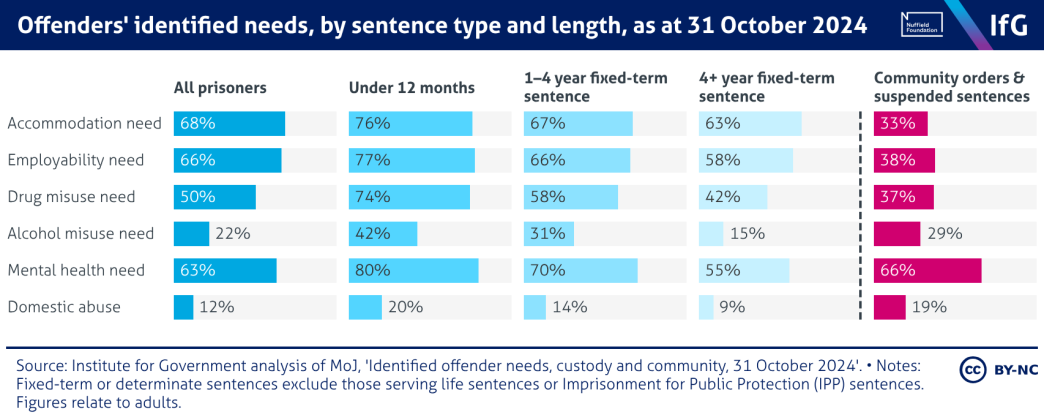
The presumption to suspend sentences of 12 months or less will also drive up the probation caseload, and this cohort typically has the most complex needs of any offenders. In October 2024, 74% of people serving prison sentences under 12 months had an identified need around drug misuse, compared to 50% of all prisoners and 37% of people on community sentences. 281 Ministry of Justice, ‘Identified needs of offenders, custody and community, 31 October 2024’, GOV.UK, 2025, retrieved 23 September 2025, www.gov.uk/government/statistics/identified-offender-needs-custody-and-community-31-october-2024/identified-needs-of-offenders-custody-and-community-… In addition, there is a severe shortage of available housing, which will continue to make effective supervision challenging. 282 Institute for Government interviews, 2026.
All this amounts to a very substantial increase in demand on the probation service, at a time when the service is already seriously overstretched and performing poorly. There are a number of reasons for this poor performance, but the most critical are insufficient capacity in the service and staff inexperience. 286 House of Commons Committee of Public Accounts, Efficiency and Resilience of the Probation Service: Sixty-fifth report of session 2024–26, HC 1235, UK Parliament, 2026, retrieved 23 September 2026, https://publications.parliament.uk/pa/cm5901/cmselect/cmpubacc/1235/report.html , 287 Institute for Government interviews, 2026. The MoJ has recognised the yawning capacity gap in probation and has taken a two-pronged approach to address it:
- increasing the number of probation officers and other practitioners
- reducing the amount of supervision and intervention that most people on probation receive.
Slow progress on recruitment means probation practitioners are still overstretched and ill-equipped to absorb additional demand
There has been a serious staff shortage in probation for several years, with the number of probation officers consistently 25–30% below target staffing. As of March 2026, nine probation delivery units (8% of the total) had a vacancy rate of 40% or more. 288 Institute for Government analysis of HM Prison and Probation Service, ‘HM Prison and Probation Service workforce quarterly: March 2026’, GOV.UK, 21 May 2026, retrieved 23 September 2026, www.gov.uk/government/statistics/hm-prison-probation-service-workforce-quarterly-march-2026

Despite a major recruitment drive and some improvement in retention, the number of probation practitioners has risen by only 3% since June 2024. This includes both qualified probation officers and more junior probation services officers, some of whom
are training for their probation officer qualification. Most of the increase has come from qualified probation officers, whose numbers are up 8%, as trainees who started during the 2021/22–2022/23 recruitment drive have qualified. But because these officers were already working as probation services officers, the overall increase in practitioners has been much smaller.
The number of trainee probation officers starting has also increased, but from an extremely low base. The total number recruited over 2024/25 and 2025/26 was just under 2,500, which remained well below the 3,000 recruited over 2021/22 and 2022/23. 291 Ibid. The government is expecting the supervision capacity gap in 2026/27 to remain over 20% of target staffing (equivalent to around 3,150 full-time employees), and is still not expecting to hit the target level by September 2027. 292 Ministry of Justice, ‘Annual statement on prison capacity: 2025’, GOV.UK, 29 January 2026, retrieved 23 September 2026, www.gov.uk/government/publications/annual-statement-on-prison-capacity-2025

However, there has been good progress on increasing the overall number of people working in the probation service, including in management and administrative roles. This is up 6.7% since June 2024. Our previous work has highlighted the importance of these back-office roles in the productivity and performance of the whole service, so this is very welcome to see. Nonetheless, the service as a whole remains unable to cope with its existing workload, let alone the large increase due to be implemented under the Sentencing Act 2026.

Rationing probation supervision is necessary to manage demand, but has serious drawbacks
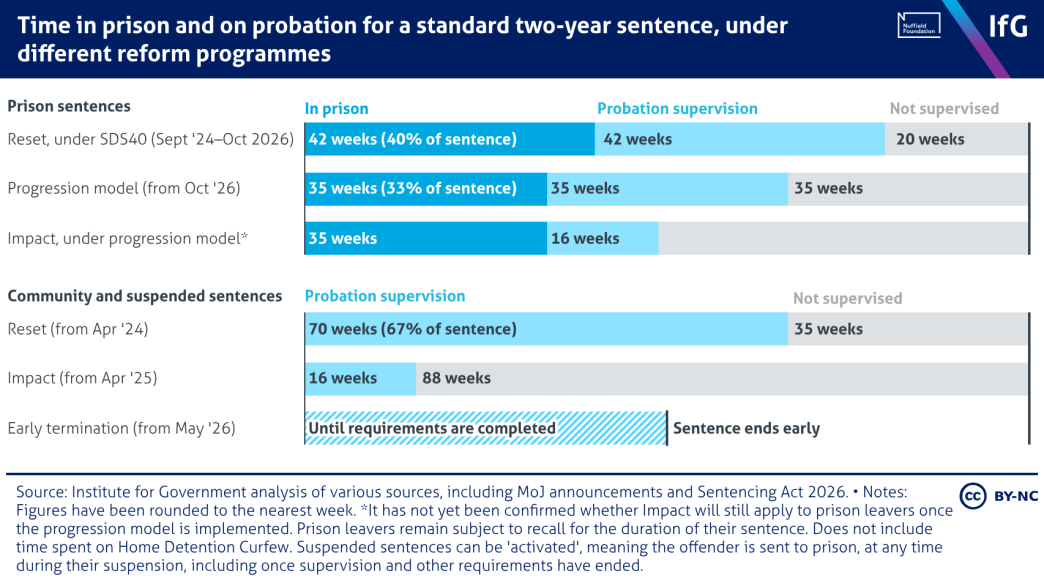
Given staff shortages, the government is also relying on reducing the size of the probation caseload and cutting the amount of supervision that most offenders receive, to manage demand. HM Prison and Probation Service (HMPPS) has set a goal of reducing workload by 25% by March 2027. 295 House of Commons Committee of Public Accounts, Efficiency and Resilience of the Probation Service: Sixty-fifth report of session 2024–26, HC 1235, UK Parliament, 2026, retrieved 23 September 2026, https://publications.parliament.uk/pa/cm5901/cmselect/cmpubacc/1235/report.html This approach started in spring 2024 under the Sunak government with the ‘Probation Reset programme, which suspends active supervision in the final third of an offender’s sentence (for community sentences) or licence (for prison leavers). During this period, offenders do not have meetings or other contact with their probation practitioner or receive rehabilitative support, but remain subject to the other conditions of their sentence, such as abiding by any exclusion zones or contact restrictions. Prison leavers on Reset remain subject to recall, although in practice this relies on the probation service becoming aware of any breaches or further offences they commit.
The Starmer government built on Reset through its ‘Impact’ programme, which was launched in April 2025 and suspends contact for most offenders much earlier, after just 16 weeks’ supervision. This means that an eligible offender who receives a 12-month community order will in fact be monitored for less than four months, even though they will technically remain on the probation caseload for the whole period.
Once the progression model in the Sentencing Act 2026 is fully implemented, most offenders will be supervised for a third of their sentence, and then spend the final portion of their sentence (also a third, in most cases) on licence, but without any active supervision. The government has not yet announced how this will interact with the Reset and Impact programmes. 296 Julius S, ‘Sentencing Act 2026 – next stage of implementation and accompanying probation reforms’, blog, Clinks, 20 August 2026, retrieved 23 September 2026, https://clinks.org/community/blog-posts/sentencing-act-2026-next-stage-implementation-and-accompanying-probation
Both programmes exclude certain offenders, such as those deemed to pose a very high risk of harm, subject to multi-agency public protection arrangements (MAPPA) or active child protection orders, and people convicted of sexual offences. But it is still likely to apply to most people on probation, including most prison leavers. Once the progression model of sentencing is fully implemented, most prison leavers will spend the final third of their sentence in this limbo: subject to restrictions and recall to prison, but with no active engagement with the probation service.
There are serious drawbacks to these programmes. They mean that the length of sentence imposed by the court becomes essentially a fiction for most offenders, risking further undermining public trust in the criminal justice system and making sentences even more convoluted and opaque, including to victims. It may also run counter to other reforms aiming to encourage community and suspended sentences over prison sentences: if courts do not view 16 weeks’ supervision as adequate to the crime, they may impose a prison sentence.
At the same time, the Reset and Impact programmes increase the risk that probation practitioners are being asked to carry. Because offenders technically remain on the probation caseload, their supervising practitioner is still likely to feel pressure and anxiety about any further offences they commit, particularly serious ones. This is especially true given the decision to suspend contact is based on the practitioner’s assessment of risk level. This can theoretically be reassessed at any point, but once contact has ceased, practitioners will rarely have any information that allows them to do a meaningful reassessment. In a service that has become increasingly risk averse – as seen, for example, in rapidly rising recall rates – this may create perverse incentives to categorise offenders as high risk unnecessarily, or to recall people to custody for minor breaches, even if doing so ultimately harms the offender’s chances of rehabilitation.
It would have been preferable to remove people from the probation caseload entirely at the point supervision ceases, both under Reset and Impact and the progression model for custodial sentences. This would be more transparent for judges and magistrates passing sentences, and for the public. It would also provide greater clarity – and less anxiety – for practitioners, without having any meaningful impact on risk levels or support for offenders. Finally, supervision in name only risks undermining its own effectiveness, if it means there are no practical consequences for breaches.
The progression model introduced in the Sentencing Act 2026 involves a similar approach to the Reset and Impact programmes, with supervision being suspended in the final part of the offender’s sentence. It is not clear how these programmes will interact with the progression model of sentences for prison leavers described above, which theoretically involves offenders being supervised for at least a third of their total sentence. If the Impact programme continues to apply, someone serving a six-year sentence for a non-violent offence (such as serious fraud) would have their probation supervision end before they were originally due to be released from prison.
The Sentencing Act also introduced yet another programme to reduce demand on probation: the early termination programme, which allows community and suspended sentences to be ended early. Previously, a sentence could only be terminated early for good behaviour by returning to court to sign off on the termination. Now, a panel of senior probation officers can decide to terminate an order early, so long as all sentence requirements have been completed and the offender passes a police record check.
This programme has several advantages over Reset and Impact. First, it is based on probation practitioners’ professional judgment. An offender’s probation supervisor must recommend them for early termination if they believe it is appropriate, and that decision must then be approved by the senior panel. Second, it also removes the offender entirely from the probation caseload, rather than simply suspending contact, which is better for both sides. And third, by ensuring that sentence requirements have been met – unlike Reset and Impact – it improves transparency and preserves the intention of the sentencing court much more effectively. Inevitably, however, these factors are likely to mean it has a slower effect on the probation workload. The government should monitor both the number of early terminations and the outcomes of these cases compared to those in Reset and Impact, and consider whether either or both of these predecessors can be revoked.
The probation service is also using another means of managing demand: Justice Transcribe, an AI tool that probation practitioners use to produce a summary of their meetings with people on probation and reduce the time spent writing up notes. Many probation practitioners and managers are extremely positive about the impact Justice Transcribe has had in terms of saving time and allowing them to focus more on sentencing planning and working with offenders. 303 Institute for Government interviews, 2026. , 304 House of Commons Justice Committee, ‘Oral evidence: rehabilitation and resettlement: ending of the cycle of reoffending’, 24 March 2026, retrieved 23 September 2026, https://committees.parliament.uk/oralevidence/17428/html HMPPS aims to achieve roughly a 6% reduction in demand on staff through the use of Justice Transcribe and other digital tools. 305 House of Commons Committee of Public Accounts, Efficiency and Resilience of the Probation Service: Sixty fifth report of session 2024–26, HC 1235, 2026, retrieved 23 September 2026, https://committees.parliament.uk/work/9278/Efficiency-and-resilience-of-the-Probation-Service/publications
The scramble to increase probation capacity has led to constant policy churn, with policies being implemented before they were even finalised
The environment of constant policy change and mixed messages created by all these different programmes has been difficult and stressful for staff to navigate. In a service that has experienced near-constant organisational change since it was broken up in 2014, one senior practitioner described this as “the toughest year yet”.
There is also a strong feeling among front-line staff that those designing these policies had little appreciation for what was happening on the ground. This has led to policies being rolled out while still only half-developed, and being adapted on the fly in response to operational realities. 306 Institute for Government interviews, 2026. As a result, staff are struggling to keep on top of frequently changing operational requirements and feel like their professional judgment is being sidelined in favour of centrally imposed policies, with little autonomy or flexibility in how they are applied.
A lot of what we are implementing is massively over-engineered… It feels like we are developing a painting-by-numbers approach, rather than trusting professionals to do a good job. – Probation practitioner
Burnham’s early decision, within two days of being prime minister, to pause the early release scheme then due to start in September, caused further turmoil and confusion among both prison and probation staff. 307 Syal R and Walker P, ‘Prisoner early release scheme paused by Andy Burnham may still go ahead’, The Guardian, 23 July 2026, retrieved 23 September 2026, www.theguardian.com/society/2026/jul/23/burnham-review-of-prison-early-release-causing-chaos-union Pushing the implementation back to 1 October meant recalculating release dates for 700 offenders who were due to be released in September. 308 Live reporting edited by Bosotti R and Thompson A, ‘Burnham pauses plan to release some prisoners early from September’, BBC, 23 July 2026, retrieved 23 September 2026, www.bbc.co.uk/news/live/c142jmxr5x6t?post=asset%3A68a56c77-bed6-40d9-b8eb-491dec2f7a05#post This wasted the preparation for offenders’ release that had already been done and will further squeeze capacity in probation, housing and other support services for October.
The probation service is critically in need of a period of stability to allow changes to bed in and staff to refocus on day-to-day offender management.
Pressure on probation means the service is struggling to manage cases effectively in the community
The rate at which prison leavers are recalled to custody is a key performance metric for probation. A certain level of recalls is likely to be a sensible means of risk management, but when recalls are being used very frequently, it is a sign that the probation service cannot adequately manage its caseload in the community. This has also become a major source of demand on prisons, with people recalled to custody making up 14% of the total prison population in March 2026 – up from just 8% 10 years before. Almost all prison leavers will at some point no longer be subject to supervision and recall, so it is not an effective long-term risk management strategy. The probation service needs to do all it can to ensure that people are no longer a risk to the public at the point supervision ends.
The number of recalls has skyrocketed in recent years, almost entirely driven by ‘administrative recalls’, when offenders breach the terms of their licence, rather than recalls for a further offence. In 2025, there were 74 recalls for every 100 people being supervised after release from prison, up from 35 in 2021.* Of those 74, 16 were because the offender had been charged with a further offence – up slightly from 13 in 2021, but still accounting for less than a quarter of all recalls. Half of all recalls were for those serving a sentence of under 12 months. In the first quarter of 2026, more people were recalled to prison than were released at the end of their sentence – the first time this has ever happened.
* A single person can be recalled multiple times within the same year.

Some of the breaches that lead to administrative recalls may be quite serious, such as the offender contacting the victim of their original offence or breaking a restriction on being around children. But most breaches are for much more minor things like missing an appointment, or for things outside the person’s control, such as becoming homeless and so breaching residency requirements. 315 Institute for Government interviews, 2026. In either case, heavy reliance on recalls suggests a lack of alternative options to impose consequences for breaches. As one probation practitioner we interviewed noted: “Our systems don’t support us to use alternatives to recall.”
Recalls should, in law, only happen when necessary to protect the public because an offender cannot be managed safely in the community, rather than as a punishment. 316 Kesar & Co Solicitors, ‘R (on the application of Goldsworthy) v the secretary of state for justice [2017] EWHC 2822 (admin)’, (no date) retrieved 23 September 2026, https://kesarandcosolicitors.co.uk/2017/11/24/1912 Administrative recalls impose a strict penalty for behaviour that is not, in itself, criminal, and they disrupt people’s accommodation, employment and support structures. This often contributes to a ‘revolving door’ in and out of prison for offenders with complex and multiple needs. There is little evidence that recalls reduce reoffending, except in the very short term. 317 Gehrsitz M, Grant S and McIntyre S, ‘From custody to community: does post-release supervision reduce re-offending?’, ADR UK, 27 May 2026, retrieved 23 September 2026, www.adruk.org/news-publications/publications-reports/publication/data-insight-from-custody-to-community-does-post-release-supervision-reduce-re-offen… If they undermine trust between an offender and their probation practitioner, they may even harm rehabilitation. 318 Shanks M, ‘Fixing fixed term recall’, Catch22, 12 February 2025, retrieved 23 September 2026, www.catch-22.org.uk/resources/insights-paper-fixing-fixed-term-recall , 319 Weaver B, Tata C, Munro M and Barry M, ‘The failure of recall to prison: early release, front-door and back-door sentencing and the revolving prison door in Scotland’, The European Journal of Probation, 2012, vol. 4, no. 1, pp. 84–98, https://strathprints.strath.ac.uk/37036/1/Weaver_etal_EJP_2020_The_failure_of_recall_to_prison_early_release_front_door.pdf The fact that community sentences are generally more effective at promoting rehabilitation than short prison sentences 320 Eaton G and Mews A, The impact of Short Custodial Sentences, Community Orders and Suspended Sentence Orders on Reoffending, Ministry of Justice, 2019, https://assets.publishing.service.gov.uk/media/5d1c732ee5274a08cdbe45c4/impact-short-custodial-sentences.pdf suggests that recalls may be counterproductive in many cases.
There is also not much to suggest that higher rates of recalls are either improving the protection of the public or a response to greater risks posed by people on probation. As mentioned above, relatively few recalls are because a prison leaver has been charged with a further offence. Yet there has been a rise in recorded ‘serious further offences’, a specific set of very serious offences, including murder and rape, committed by someone on probation supervision, or within 28 days of their supervision ending. Convictions for a serious further offence rose 10% from 2019/20 to 2023/24, while charges have risen much more steeply in recent years: up 51% from 2022/23 to 2024/25.* Those charged with a serious further offence accounted for 2% of all recalls in 2024/25.
* Charges are likely to be a better indicator of increases in serious further offending for recent years, because of the time it takes to secure a conviction for serious crimes.

But this rise in charges and convictions is unlikely to be due to a sharp rise in actual serious offences committed. The increase in serious further offences is principally driven by rape offences, with convictions for rape rising 57% from 2019/20 to 2023/24. This follows the implementation of the rape review action plan, published in 2021. Since then, rape charges have risen dramatically across the board, with overall prosecutions for rape across the whole population tripling, and convictions doubling, from 2019 to 2025. 338 Ministry of Justice, ‘Outcomes by offence’, 2017–25. These figures are not exactly comparable to those in serious further offence statistics, as those are based on when a charge is recorded, rather than when someone is prosecuted or convicted for an offence. But they strongly suggest that improvements in charge and conviction rates, rather than increases in offending, are driving the large rise in serious further offences seen in the data.
However, the risk of serious further offences does put a great deal of pressure and anxiety on probation practitioners, who often feel that they will be blamed for anything that goes wrong. 339 Institute for Government interviews, 2026. This risk-averse approach, coupled with practitioners carrying large caseloads, encourages high rates of recall. Practitioners often feel they do not have the time to dedicate to building a relationship with the people they are supervising, or to do an adequate assessment of their risk level. This can lead to a ‘better safe than sorry’ approach to recalls in the event of breaches. There has also been a culture shift in probation, focused much more on risk management than on promoting rehabilitation and providing support. 340 Comptroller and Auditor General, Building an Effective and Resilient Probation Service, Session 2024–25, HC 1354, National Audit Office, 2025, www.nao.org.uk/wp-content/uploads/2025/10/building-an-effective-and-resilient-probation-service.pdf , 341 Crest Advisory, ‘Written evidence submitted by Crest Advisory (RPS0003)’, November 2025, retrieved 23 September 2026, https://committees.parliament.uk/writtenevidence/151683/html The emphasis on ‘tougher’, more restrictive supervision under the Sentencing Act, including through much greater use of tagging, is likely to exacerbate this and may cause recall rates to increase even further.
Electronic monitoring is not working effectively and is unlikely to be able to deliver on the promises ministers have made
The progression model of sentencing relies heavily on electronic monitoring tags for the second stage of a prisoner’s sentence, with a presumption that prison leavers will be fitted with some kind of tag, monitoring their location, imposing a curfew or checking for alcohol consumption. The Burnham government also announced in August 2026 that it would impose GPS location monitoring on those convicted of serious sex offences for 12 months after their release, as well as “near real-time electronic monitoring data for probation staff”. 342 Ministry of Justice, ‘Rape, serious child sex and grooming offences barred from sentencing charges’, press release, GOV.UK, 4 August 2026, retrieved 23 September 2026, www.gov.uk/government/news/rape-serious-child-sex-and-grooming-offences-barred-from-sentencing-changes This amounts to a massive increase in the number of people being tagged, with at least twice as many people on bail or supervised by probation being tagged in 2027 as in March 2026. 343 Institute for Government analysis of Ministry of Justice, ‘Electronic monitoring statistics publication, England and Wales: March 2026’, GOV.UK, 23 April 2026, www.gov.uk/government/statistics/electronic-monitoring-statistics-publication-march-2026/electronic-monitoring-statistics-publication-england-and-wal… and Comptroller and Auditor General, Electronic Monitoring: Improving resilience to meet increasing demand, Session 2026–27, HC 266, National Audit Office, 2026, www.nao.org.uk/wp-content/ uploads/2026/07/electronic-monitoring-improving-resilience-to-meet-increasing-demand.pdf
In practice, however, it is unlikely that HMPPS will be able to deliver this. The electronic monitoring service is already performing poorly 344 Syal R, ‘Electronic tagging system failing to alert authorities of probation breaches, watchdog warns’, The Guardian, 4 August 2026, retrieved 23 September 2026, www.theguardian.com/society/2026/aug/04/electronic-tagging-unprepared-offenders-prisoners-watchdog and failing to meet demand. 345 Comptroller and Auditor General, Electronic Monitoring: Improving resilience to meet increasing demand, Session 2026–27, HC 266, National Audit Office, 2026, www.nao.org.uk/wp-content/uploads/2026/07/electronic-monitoring-improving-resilience-to-meet-increasing-demand.pdf From January to April 2026, fewer than two thirds (62%) of tags were successfully installed within two attempts. 346 Ibid. ,* More than 5,000 people who should be being monitored have not been tagged: 15% of all people with an electronic monitoring order. 347 Ministry of Justice, ‘Annex: Management Information, Electronic Monitoring Status Statistics: June 2026’, GOV. UK, 23 July 2026, retrieved 23 September 2026, www.gov.uk/government/statistics/electronic-monitoring-statistics-publication-june-2026/annex-management-information-electronic-monitoring-status-sta… Almost 1,600 additional people are wearing a tag that has not sent a signal to the monitoring system in the past 14 days, because of a technical fault, a failure to charge the equipment or similar reason. 348 Ministry of Justice, ‘Annex: Management Information, Electronic Monitoring Status Statistics: June 2026’, GOV. UK, 23 July 2026, retrieved 23 September 2026, www.gov.uk/government/statistics/electronic-monitoring-statistics-publication-june-2026/annex-management-information-electronic-monitoring-status-sta…
The MoJ is currently running a pilot where people are fitted with tags before they leave prison, to reduce the number of people who are unmonitored. However, prison and probation staff we spoke to widely viewed this as unrealistic for most prisons. 349 Institute for Government interviews, 2026.
In April 2026, HMPPS identified a significant risk that [electronic monitoring] processes and training may not be ready in time to support the implementation of the earned progression model and associated changes… Expanding a service while key elements are not yet working effectively increases the risk that performance or threats to public protection may worsen. – National Audit Office 350 Comptroller and Auditor General, Electronic Monitoring: Improving resilience to meet increasing demand, Session 2026–27, HC 266, National Audit Office, 2026, www.nao.org.uk/wp-content/uploads/2026/07/electronic-monitoring-improving-resilience-to-meet-increasing-demand.pdf
There is little understanding of how the police and probation are responding to breaches when they do happen. 351 Ibid. Many breach notifications that are sent may not be received. The system is poorly designed, with alerts sent straight to individual practitioners and no means of forwarding or flagging them if a practitioner is on leave. 352 Institute for Government interviews, 2026. Practitioners also have to proactively check if offenders have breached ‘exclusion zones’ that they are not allowed to enter, rather than being automatically alerted. All of these problems are only likely to become more acute with such a large increase in the number of people due to be monitored.
Tagging more people is also likely to substantially increase the workload for probation practitioners, when they are already short-staffed and struggling. They need to set appropriate conditions for the tag, adjust them as needed if, for example, the offender moves home or gets a new job, and then respond to any breaches in a proportionate way.
* An attempt to fit a tag could fail for a number of reasons, such as the person not being at the relevant address when they are supposed to be fitted with the tag, refusing to wear it or not being able to (due to an allergy or a tag of the right size not being available).
Rehabilitation both in custody and the community is fatally undermined by violence, drugs and a lack of adequate activity and support
Across both prisons and probation, performance problems are seriously undermining efforts at rehabilitation. Prisons are still extremely violent, despite some signs of improvement in early 2026. Purposeful activity – education, employment and rehabilitative courses – has similarly improved slightly in the past year. But it remains far from where it should be, with just 60% of prisoners in the average prison attending at least four activity sessions a week. This is down from 66% in 2023/24, despite the fact that education and employment are some of the best means of reducing reoffending. 353 Ellison M, Szifris K, Horan R and Fox C, ‘A rapid evidence assessment of the effectiveness of prison education in reducing recidivism and increasing employment’, Probation Journal, 2017, vol. 64, no. 2, pp. 108–28, retrieved 23 September 2026, https://repository.mmu.ac.uk/articles/journal_contribution/A_Rapid_Evidence_Assessment_of_the_effectiveness_of_prison_education_in_reducing_recidivis… employment/32448996?file=65012409 , 354 College of Policing, ‘Education in prisons’, 9 May 2016, updated 11 April 2024, retrieved 23 September 2026, https://www.college.police.uk/research/crime-reduction-toolkit/education-prisons Cuts to prison education budgets under the Starmer government have only worsened the situation.

Drug use and serious organised crime are blighting prisons and fuelling criminality both within prisons and in the community. 364 Gooch K and Treadwell J, ‘The prison firm: the “transportation” of organised crime, the evolution of criminal markets and contemporary prisoner society’, Criminology and Criminal Justice, 2024, vol. 25, no. 1, pp. 245–64, retrieved 23 September 2026, https://journals.sagepub.com/doi/full/10.1177/17488958241261802 The chief inspector of prisons has repeatedly highlighted the devastating impact this is having on prospects for rehabilitation within prisons as well as prisoner and staff safety. 365 HM Inspectorate of Prisons, HM Chief Inspectorate of Prisons for England and Wales: Annual report 2025–26, 2026, https://cdn.websitebuilder.service.justice.gov.uk/uploads/sites/19/2026/07/HMI-Prisons-ARA-25-26-FINAL.pdf Nor is this contained within the prison walls, with many reports of prisoners’ families being coerced into criminal activity or repaying debts incurred in prison, via threats to their loved ones in custody. 366 Institute for Government interviews, 2026.
Many prisons are losing the fight against criminality. Senior figures in organised crime gangs seem to operate with impunity, building up successful prison networks that make enormous amounts of money… Frustration, boredom and despair are driving the demand for drugs across the estate and yet the prison service has failed to reduce this demand” – HM Chief Inspector of Prisons 367 Ibid., p. 3.
Once in the community, the risk-focused, often punitive approach of probation and serious struggles finding accommodation and employment can further hamper rehabilitation. In general, probation practitioners rely on commissioned rehabilitative services, mostly run by the third sector, to support offenders’ with their needs, for instance around drugs, alcohol and housing. 368 Institute for Government interviews, 2026. This may be inevitable given staff shortages in probation, but it further emphasises the role of probation as a punitive and risk-focused organisation, rather than one that is helping offenders get back on their feet and turn their lives around.
There is a serious lack of provision around drug, alcohol and mental health treatment, whether provided by the NHS, the third sector, the local authority or the probation service. Some offenders spend their entire sentence or licence period on a waiting list for support. 369 Institute for Government interviews, 2026. This hampers efforts to address offending, given 50% of prisoners and 37% of those on community sentences have an identified drug misuse need and around two thirds have an identified mental health need. 370 Ministry of Justice, ‘Identified needs of offenders, custody and community, 31 October 2024’, GOV.UK, 2025, retrieved 23 September 2025, www.gov.uk/government/statistics/identified-offender-needs-custody-and-community-31-october-2024/identified-needs-of-offenders-custody-and-community-…
There are also major shortages of appropriate housing for prison leavers, including approved premises – intensively supervised residences for people on probation who pose a high or very high risk of harm. Inadequate housing, or no housing at all, is a key factor in many recalls to prison. 371 Institute for Government interviews, 2026. Those serving short sentences are the least likely to be in settled accommodation three months after release from custody, with fewer than two thirds (63%) of those supervised in stable accommodation, compared to 81% of all supervised prison leavers.
All these factors are harming rehabilitation and may be contributing to a recent rise in reoffending. Reoffending is very difficult to track reliably, but the ‘proven reoffending rate’ has been rising since late 2020. Reoffending statistics are calculated in three month cohorts, based on the date the person was released from prison or received a court sentence or caution within a three-month period. The proven reoffending rate tracks the proportion of these offenders who commit another offence within a year of that date, and receive a caution or conviction for that offence within 18 months of their original release, sentencing or caution. This means the most recent statistics are for people who were released from prison or received a sentence or caution from July to September 2024.*
The proven reoffending rate has been rising steadily since late 2020. This will have been strongly influenced by delays in the criminal justice system during the pandemic and by the substantial increase in police charges in recent years. Nonetheless, there does seem to have been a real rise in proven reoffending. For people released or sentenced in 2021/22, there were 1.1 proven reoffences per offender. Among the 2023/24 cohort, that jumped to 1.5 – an increase of 71%, substantially outstripping the total increase in cautions and convictions (11–12%**). 372 Ministry of Justice, ‘Proven reoffending statistics: July to September 2024’, 2026.
The increase in proven reoffending has been largely driven by rises in reoffending for those on community orders, and to a lesser extent suspended sentences. This suggests that performance failures and inadequate support from probation are having a very real effect on both offenders and the public.
* This includes the first tranche of 1,889 people who were released under SDS40, on 10 September 2024 (those serving sentences under five years). These people made up a maximum of 2.3% of the total cohort of 83,652 from June to September. Institute for Government analysis of Ministry of Justice, ‘Standard Determinate Sentences 40% (SDS40) Detailed Data, England and Wales’, 2026 and Ministry of Justice, ‘Proven reoffending statistics: July to September 2024’, 2026.
** This is not an exact comparison, as the data does not cover identical time periods, but it provides a general reference point.

Conclusion
The state of prisons and probation remains extremely poor. Violence and organised crime are rife in prisons, while probation is failing to provide adequate rehabilitation, manage offenders in the community or assess risk to the public appropriately. Reoffending is rising, purposeful activity is falling and both prisons and probation lack the capacity to meet demand. Emergency measures to manage capacity are placing huge strain on other services, particularly the police and housing services. Equally, lack of access to other services such as drug and alcohol and mental health treatment is contributing to ongoing problems in prisons and probation.
And yet, impossibly, this is a success story for the Starmer government. The situation when it came into office in July 2024 was so bad that it is a real achievement to have got this far. The government avoided disaster in the summer and autumn of 2024 and then took serious, politically difficult steps to get the prison population back on a stable trajectory. Ministers introduced policy changes and technological tools to free up probation capacity, at the same time as expanding the workforce. And in the final months of the Starmer government, we saw the benefits of easing pressure on prisons in the form of falling violence and disorder.
However, the Burnham government has a long way to go and there is plenty of room for things to go wrong. It must focus on building capacity and capability in probation, while maintaining enough space in prisons not only to avoid further emergency releases, but also to sustain lower rates of violence and drive more purposeful activity.
Recommendations
- Avoid imposing unnecessarily restrictive and punitive licence conditions on people on probation, to encourage trusted relationships with probation supervisors and reduce administrative recalls.
- Increase the number of probation practitioners at a steady pace, avoiding large staff influxes (and likely exits) as far as possible.
- Provide probation delivery units with more flexibility to hire or commission specialist services, such as housing and mental health advisers, to provide timely access to specialist support. This could be done using some of the budget currently allocated to increase probation capacity and improve performance.
- Reintroduce home detention as a first-line means of managing the prison population, should it become necessary.
- Develop a sentencing model that is transparent and understandable for the public and victims, with an explicit custodial period. For prison sentences, this should set out time in prison and time supervised in the community. Avoid the use of licence periods with no supervision.
- Emphasise purposeful activity in prisons, to try to drive down violence, self-harm and drug use.
- Topic
- Public services
- Political party
- Labour
- Administration
- Starmer government Burnham government
- Department
- Ministry of Justice
- Public figures
- Keir Starmer Andy Burnham
- Tracker
- Performance Tracker
- Publisher
- Institute for Government