Jackdaw and Rosebank
What are Jackdaw and Rosebank, and what position has the government taken on North Sea licences?
On 21 October 2026 Miatta Fahnbulleh, the energy secretary, announced that the government would permit exploitation of the Jackdaw gas field. A decision is still awaited on the future of the Rosebank oilfield. This explainer sets out the background to those decisions which have attracted more attention in the wake of the disruption to energy supplies and price hikes in the wake of the Iran war.
What are Jackdaw and Rosebank?
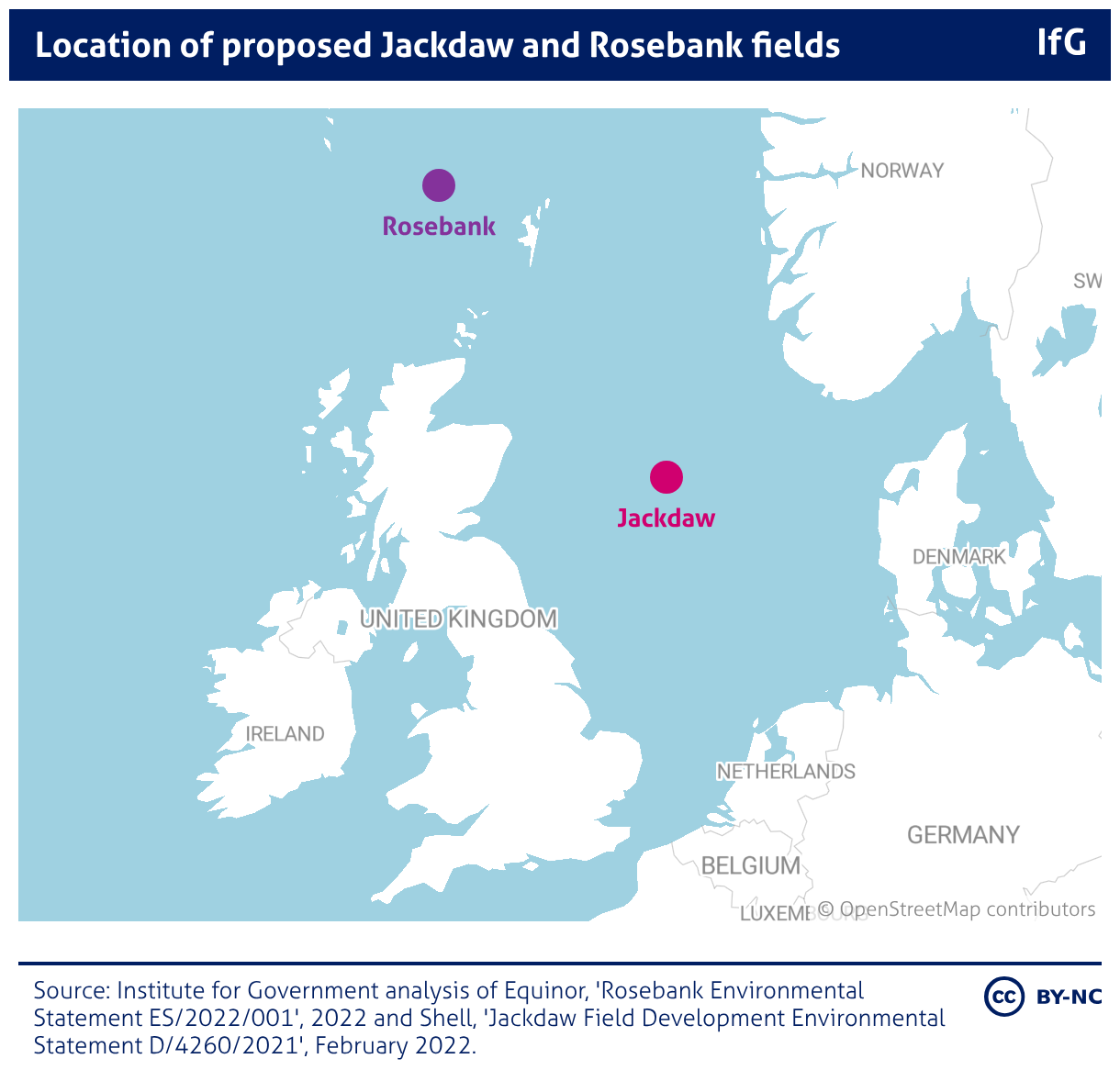
Both Jackdaw and Rosebank are major North Sea oil and gas projects. Jackdaw is a gas field 150 miles east of Aberdeen owned by Shell, which was originally approved in 2022, with production scheduled to begin in 2026.1 https://www.bbc.co.uk/news/articles/c3e1pw7npklo#:~:text=Permission%20for%20the%20Rosebank%20oil,the%20interests%20of%20the%20developers.&text=Tessa%…
Rosebank is an oil and gas field north-west of Shetland owned by Adura – a joint venture between Norwegian company Equinor and Shell. Oil is the main product – it is said to contain up to 300-500 million barrels – but it would also produce some gas. It was initially approved in 2023, when it was expected to started producing by 2026/7.2 https://www.bbc.co.uk/news/business-66933832
Rosebank is the UK’s last major undeveloped oil site. Jackdaw is one of the largest unexploited gas fields in the North Sea and was projected at peak production to account for 6.5% of the UK’s predicted gas production, which would produce enough energy to heat more than 1.4 million homes.1 https://www.bbc.co.uk/news/articles/c99g0vyrzmlo , 2 https://www.independent.co.uk/news/uk/politics/iran-war-oil-prices-jackdaw-miliband-b2951427.html The chief executive of Adura has said Jackdaw might be ready to supply gas by the winter if the government gave consent by August.3 https://www.thetimes.com/uk/scotland/article/adura-jackdaw-oilfield-north-sea-j5jh8b82g Proponents have suggested the projects would increase UK energy resilience by boosting domestic production and that UK production generally produces less emissions than imports.4 https://www.independent.co.uk/news/uk/politics/iran-war-oil-prices-jackdaw-miliband-b2951427.html On the other side climate campaigners argue they would do little to increase UK production while adding significantly to greenhouse gas emissions, and that they might displace Norwegian production which is not more emissions intensive than domestic production.5 https://www.independent.co.uk/news/uk/politics/iran-war-oil-prices-jackdaw-miliband-b2951427.html
Why did the decisions on Rosebank and Jackdaw need to be retaken?
Greenpeace (with Uplift in the case of Rosebank) brought legal claims against the decisions to allow the sites to be developed for oil extraction in 2022 and 2023 on the grounds that they were approved without taking into account the impact of emissions from burning the oil and were not compatible with the UK’s legally binding climate commitments.6 https://www.greenpeace.org.uk/news/jackdaw-rosebank-case-update/
Then in June 2024 the Supreme Court concluded (in a case about an oil drilling project in Surrey) that Environmental Impact Assessments (EIAs)7 Environmental Impact Assessments are designed to ensure that a local planning authority takes into account environmental impacts when making planning decisions. See: https://www.gov.uk/guidance/environmental-impact-assessment for planning applications must consider the environmental impact of emissions from burning fossil fuels (known as ‘scope 3’ emissions) for new fossil fuel extraction projects not just the emissions involved in extracting them.8 https://news.sky.com/story/future-of-new-oil-and-gas-projects-in-uk-thrown-into-doubt-after-landmark-supreme-court-decision-13155934

After that judgement the government announced that it would not contest the legal challenges to Jackdaw and Rosebank and in early 2025 the challenges were upheld and the previously granted consent was ruled unlawful.1 https://news.sky.com/story/rosebank-and-jackdaw-government-to-drop-legal-defence-of-uks-largest-untapped-oil-and-gas-fields-13205152
The judgement allowed work on both fields to continue but required new EIAs before production could start, meaning the government would have to grant fresh approval to allow exploration to proceed.2 https://www.bbc.co.uk/news/articles/c3e1pw7npklo#:~:text=Permission%20for%20the%20Rosebank%20oil,the%20interests%20of%20the%20developers.&text=Tessa%….
The government consulted on revised guidance to take into account scope 3 emissions and Shell submitted a new EIA for Jackdaw in September 2025, while additional information on Rosebank’s scope 3 emissions was submitted in July 2025.3 https://www.bbc.co.uk/news/articles/c99g0vyrzmlo , 4 https://assets.publishing.service.gov.uk/media/69203f995c394e481336ab61/Further_Information_Part_3_-_Relevant_Information_to_the_Project.pdf , 5 https://assets.publishing.service.gov.uk/media/68ef61fd82670806f9d5e0a9/Rosebank_Reg_12__1__Assessment_of_Scope_3_Emissions__OPRED_131025__errors_cor…
What decisions were needed?
The energy secretary, the regulator, the Oil and Gas Authority (OGA) (also known as the North Sea Transition Authority (NSTA) since 2022) needed to decide whether to grant consent again for each project based on the updated information.
The question for the government was whether approval is consistent with the UK’s legally binding climate commitments. In part this depended on whether the government judged that additional supply would increase demand – so that consenting to the fields would increase overall scope 3 emissions – or whether it thought that demand would remain the same regardless – at which point UK extraction would effectively be replacing imports and would be less carbon intensive than some import sources.
At the end of March the Offshore Petroleum Regulator for Environment and Decommissioning (Opred), which is part of DESNZ, requested further technical information from Adura, which the chief executive said it would ‘seek to supply as quickly as possible to keep the projects on track’.6 https://www.thetimes.com/uk/scotland/article/adura-jackdaw-oilfield-north-sea-j5jh8b82g
In 2022 the Climate Change Committee said that it had ‘not been able to establish the net impact on global emissions of new UK oil and gas extraction’ as UK extraction had a relatively low carbon footprint but the extra gas and oil extracted would support a larger global market overall.
It stated that it would support ‘a presumption against exploration’, which would ‘send a clear signal to investors and consumers’ and help the UK in its diplomatic efforts to strengthen climate ambition internationally, which has so far been the government’s argument against further exploration.7 https://www.theccc.org.uk/wp-content/uploads/2022/02/Letter-to-Kwasi-Kwarteng-Climate-Compatibility-of-New-Oil-and-Gas-Fields.pdf
What position has the government taken on North Sea licences?
In its 2024 manifesto, Labour committed to not approve new licenses for North Sea drilling but to honour existing licences. That would appear to cover Jackdaw and Rosebank, since their applications were already underway when Labour was elected.8 https://www.theguardian.com/environment/2026/apr/04/new-north-sea-drilling-jackdaw-rosebank-uk-gas-imports In November 2025 the government also announced plans for new ‘Transitional Energy Certificates’ to enable limited oil and gas production on or near to existing fields but reiterated its commitment not to approve new licenses.9 https://www.gov.uk/government/news/north-sea-future-plan-for-fair-managed-and-prosperous-transition Its position has been that more North Sea drilling would not improve UK energy security or have any impact on energy prices.10 https://www.theguardian.com/business/2026/apr/20/ed-miliband-to-double-down-on-net-zero-with-measures-to-combat-iran-energy-shock The Treasury, under both Rachel Reeves and John Healey had always been positive about backing development of these fields on the assumption they would provide both jobs and tax revenues.
What has the government now decided?
The Greenpeace case against Jackdaw and Rosebank was decided in the Scottish courts. Lord Ericht quashed (“reduced” in Scottish law jargon) the original decisions of the Secretary of State and OGA/ NSTA22 , meaning that the decisions needed to be retaken. However, he then suspended the quashing (reduction) orders until the Secretary of State and OGA/NSTA made new decisions. This means that work has been continuing on both Jackdaw and Rosebank in the interim before a new decision is reached.11 https://www.instituteforgovernment.org.uk/explainer/jackdaw-and-rosebank#footnoteref92_55ks72l
The government has now given consent to development of Jackdaw which can reportedly start production in the near future. The accompanying announcement also envisages the establishment of an Energy Wealth Fund, with an initial capital of £2 billion and into which future revenues from Jackdaw (and presumably if consented, Rosebank) would flow – a sort of hypothecation that the Treasury is normally quite reluctant to see. The press notice says that: “The Energy Wealth Fund will support investment in the renewable and low carbon energy industries that will power Britain’s future. It will help ensure more value from Britain’s energy resources is invested for the long term, supporting the green transition and creating a lasting national asset for future generations.” This is clearly an attempt to address criticisms that the decision to give the go-ahead to Jackdaw undermines the government’s commitment to the green transition.
Could there be a further legal challenge?
It is always possible that new proceedings could be instigated against the retaken decision. The secretary of state and NSTA will hope that they have managed to defuse the risk of such further challenge – but it cannot be ruled out on either substantive (because the SoS or OGA gets the law wrong) or procedural (e.g. the consultation is flawed) grounds. The government has faced repeated challenges in the courts to its net zero strategy.
- Topic
- Net zero
- Keywords
- Energy Climate change Environment
- Department
- Department for Energy Security and Net Zero
- Public figures
- Ed Miliband
- Publisher
- Institute for Government