Energy resilience
The Middle East crisis has put energy resilience back on the agenda.

Energy resilience is a key part of overall national resilience. The Iberian Peninsula outage in April 2025, for example, caused widespread disruption to energy, transport, communications and payment systems in Spain. While the UK’s vulnerability to global supply shocks was exposed when disruptions in gas supply caused by the Ukraine war triggered rapid energy price increases that pushed the government into very costly support measures. With the current conflict in the Middle East triggering another energy supply shock, energy resilience is once again rising up the agenda.
Who is responsible for energy resilience in the UK?
The Department for Energy Security and Net Zero (DESNZ) has primary responsibility for UK energy security, while the Cabinet Office leads on overall resilience.
The energy regulator Ofgem is required to carry out its functions in a way that secures a diverse and viable long-term energy supply and to monitor the resilience of energy suppliers. 84 www.gov.uk/government/publications/strategy-and-policy-statement-for-energy-policy-in-great-britain/strategy-and-policy-statement-for-energy-policy-i… It also sets annual targets on customer interruptions for energy companies. 85 https://hansard.parliament.uk/commons/2025-05-06/debates/677F2839-E88F-47F9-9586-634BF91836AB/EnergyResilience
The National Energy Systems Operator (NESO) is responsible for balancing electricity supply and demand in real-time, and for strategic planning and advice for gas security and supply. National Gas Transmission, the gas distribution network, is responsible for balancing supply and demand in the gas network, providing gas infrastructure and facilitating competition in gas supply. 86 www.gov.uk/government/publications/strategy-and-policy-statement-for-energy-policy-in-great-britain/strategy-and-policy-statement-for-energy-policy-i…
How resilient is the UK’s energy system?
Both DESNZ and NESO state that Great Britain has one of the most reliable energy systems in the world and that energy disruptions are rare. 87 https://assets.publishing.service.gov.uk/media/691b47e25a253e2c40d7062c/neso-north-hyde-report-government-response.pdf 88 www.neso.energy/document/363891/download
There have been no nationwide power outages since the national grid was created 75 years ago. 89 https://hansard.parliament.uk/Commons/2025-04-30/debates/65C98923-DECC-4A24-B3DB-6595FEDC910C/EnergyGridResilience#:~:text=I%20want%20to%20reassure%2…. The most common cause of power disruptions in the UK has been storms and extreme weather events. For example, in 2021 Storm Arwen resulted in over one million customers losing power. 90 www.ofgem.gov.uk/research/storm-arwen-report
Clean power by 2030: How could a Labour government achieve its mission for power sector decarbonisation?
How Keir Starmer can knock down the 10 biggest barriers to Labour's 2030 clean power plan.
Read the report
How reliant is the UK’s energy system on gas and oil?
The government’s clean power mission aims to decarbonise the power sector by 2030, and the government is aiming to electrify the economy as far as possible. However, gas and oil supplies are still a critical component of UK energy security.
Over the past few decades, UK electricity generation has transitioned away from coal and towards renewables, particularly wind. But while renewables do not have the same security of supply issues as gas, building renewable energy infrastructure at speed is reliant on global supply chains. Renewables are also intermittent, so in the absence of significant storage capacity a source of dispatchable capacity is needed. In the UK this is largely provided by gas.
The amount of gas used for electricity generation has dropped since the Ukraine energy crisis in 2022, but in 2024 gas was still responsible for 26% of annual electricity consumption. 94 www.neso.energy/document/372661/download 95 www.iea.org/countries/united-kingdom/electricity Because of the way energy prices are set in the UK gas still generally sets the price of power generation – 85% of the time in 2024 – as it most often fills the last ‘marginal’ bit of demand, which then sets the price. 96 https://eciu.net/analysis/reports/2025/marginal-gains-how-wind-is-pushing-gas-out-of-the-power-market-and-cutting-costs
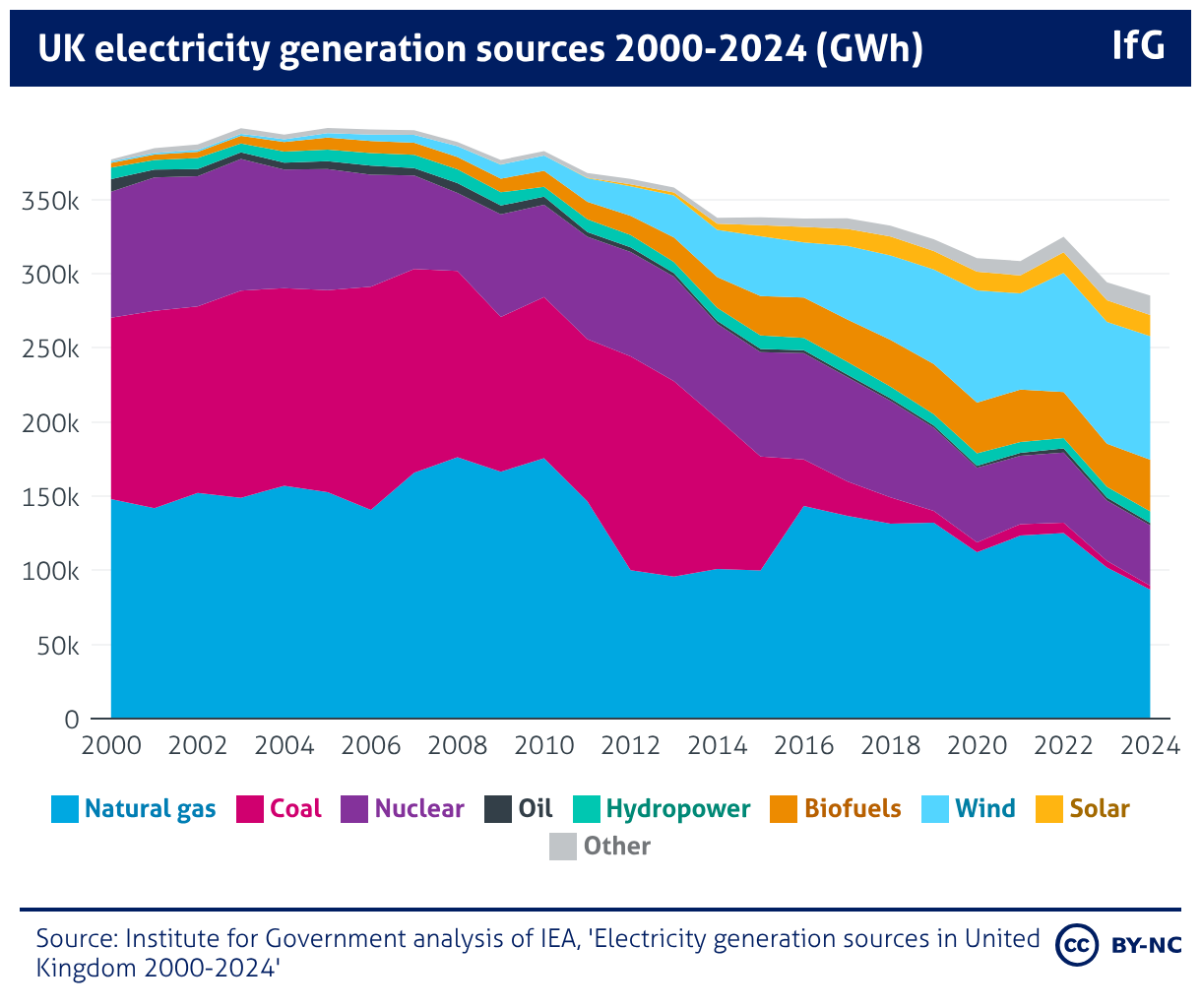
Electricity generation is only part of the energy system, with electricity accounting for only 21% of total final energy consumption in the UK in 2023 110 According to the IEA (International Energy Agency). compared to 42% for oil products and 29% for natural gas. 111 www.iea.org/countries/united-kingdom/energy-mix In 2024, 80% of households in the UK used natural gas to heat their homes, 112 www.neso.energy/document/372661/download while 92.4% of transport consumption – the biggest component of final energy consumption every year since 1988 – was accounted for by petroleum fuel in 2024. 113 www.gov.uk/government/statistics/energy-consumption-in-the-uk-2025/energy-consumption-in-the-uk-ecuk-2025
Where does the UK get its oil and gas from?
Gas
The UK gets its gas from a range of sources. These include the United Kingdom Continental Shelf and Norwegian Continental Shelf through pipelines, and as LNG (Liquid Natural Gas) imports by ship from, primarily, the USA and Qatar. 114 www.neso.energy/document/372661/download Production from the UK’s North Sea oil and gas deposits has been steadily declining, making secure import sources more important. Historic levels of domestic production mean the UK has limited natural gas storage capacity, which is an issue for energy security in the context of high import dependence. 115 www.energy-uk.org.uk/wp-content/uploads/2025/04/Fuelling-the-Future-gas-storage-and-energy-security.pdf
Oil
The UK is more than self-sufficient in petrol but is a net importer of oil products, with diesel accounting for 40% of product imports. The UK’s IEA membership means it is required to hold oil stocks equivalent to 90 days of net imports, and it held 11.2 million tonnes of stocks at the end of 2024. 116 https://assets.publishing.service.gov.uk/media/68dbe4c7c487360cc70c9f5f/DUKES_2025_Chapter_3.pdf
How does that compare to other countries?
The picture is mixed across Europe. Some countries, like the Netherlands, have a similar reliance on gas along with renewables to generate electricity. 117 www.iea.org/countries/the-netherlands But other countries are less dependent on gas for power generation and are less exposed to global supply shocks. In France, for example, nuclear provided 67% of total electricity generation in 2024, while in Norway hydropower provided 89%. 118 www.iea.org/countries/france/energy-mix 119 www.iea.org/countries/norway
Other countries have also made far more progress in electrifying home heating and transport. 120 https://ehpa.org/market-intelligence/ Norway, for example, has achieved very high electric vehicle and heat pump uptake, further limiting its exposure to fossil fuel supply shocks. 121 www.bbc.co.uk/news/articles/cg52543v6rmo 122 www.carbonbrief.org/guest-post-how-heat-pumps-became-a-nordic-success-story/

When it comes to security of supply, the UK was also one of the most biggest energy importers in Europe as of 2023 – fifth according to International Energy Agency statistics behind Germany, the Netherlands, Italy and France. 125 www.iea.org/data-and-statistics/data-product/world-energy-balances The UK also has significantly less natural gas storage capacity than many other European countries. 126 www.energy-uk.org.uk/wp-content/uploads/2025/04/Fuelling-the-Future-gas-storage-and-energy-security.pdf

Can Rachel Reeves protect both households and the public finances from the energy price shock?
An expert webinar explored the impact of war in the Middle East on energy bills.
Watch the webinar
Have risks to energy resilience increased?
Electrification is increasing (and changing the patterns of) electricity demand as more consumers switch to heat pumps and electric vehicles. And increasing numbers of renewables are making the power system more complex – as generation is becoming more decentralised. Digitalisation also introduces cybersecurity threats while climate change is driving more extreme weather events. 132 https://es.catapult.org.uk/insight/will-net-zero-trigger-more-blackouts-or-make-our-energy-system-more-resilient/#:~:text=GB%20is%20better%20prepared…. 133 https://assets.publishing.service.gov.uk/media/6825b81485c0250741b014a3/enhancing-resilience-in-UK-energy-networks.pdf
Energy import dependency has increased as domestic oil and gas production has declined, with NESO expecting these trends to continue – leaving the UK more vulnerable to gas supply shocks. NESO suggests that the diversity of gas supplies is beneficial to security of supply but expects Norwegian and European imports to become less available, meaning that overall it judges that the maximum realistic supply of gas to GB is falling.
134
www.gov.uk/government/statistics/total-energy-section-1-energy-trends
135
www.neso.energy/document/372661/download
While annual gas demand has fallen over the last 20 years, and is expected to keep falling as electrification continues, peak day gas demand is still above levels in 2010 and is expected to fall more slowly, with NESO expecting tighter gas supply margins by 2030.
136
www.neso.energy/document/372661/download


What is current government policy on energy resilience?
The government’s policy is that electrifying the economy and decarbonising the electricity supply will boost energy security in the long term, with the switch from fossil fuel imports to home-grown clean energy diversifying the UK’s generation mix and leaving the UK less exposed to global supply disruptions in future. 145 https://hansard.parliament.uk/Commons/2026-03-09/debates/5DA573C7-B4B0-462E-BD48-EFAE52E3FCCA/MiddleEastEconomicUpdate#contribution-8B7A9E3C-2FC5-42F… In the meantime it is consulting on how to ensure security of gas supply through the transition as gas will continue to be an important source of dispatchable power generation as well as home heating. 146 https://assets.publishing.service.gov.uk/media/69440cf49273c48f554cf5ed/gas-security-of-supply-consultation-document.pdf DESNZ is also developing an Energy Resilience Strategy to be published in 2026 and has set up an Energy Security and Resilience Taskforce. 147 https://assets.publishing.service.gov.uk/media/691b47e25a253e2c40d7062c/neso-north-hyde-report-government-response.pdf
Opposition parties, and US president Donald Trump, have suggested the government should grant new licenses for oil and gas exploration in the North Sea. 148 https://observer.co.uk/news/business/article/energy-security-rests-not-with-the-us-but-in-the-north-sea The government is currently committed to not allowing any new licenses, but its North Sea Future Plan promises new Transitional Energy Certificates to enable oil and gas production on or near to existing fields for a small amount of additional extraction. 149 www.gov.uk/government/news/north-sea-future-plan-for-fair-managed-and-prosperous-transition#:~:text=The%20plan%20implements%20the%20government's,mana…
However, the North Sea is a mature field, with windling reserves that are comparatively expensive to access and new exploration needing long lead in times. 150 www.neso.energy/document/364541/download Carbon Brief estimated that UK gas production in the UK is set to drop by 99% by 2050 compared to 2025 levels, or 97% with new licenses. 151 www.carbonbrief.org/analysis-why-clean-energy-will-cut-uk-gas-imports-by-more-than-north-sea-drilling/ More domestic production could provide some additional tax receipts when global prices spike. This might give government some help with cushioning the economic impacts of supply shocks, but any impacts are likely to be small and would not arrive quickly. Overall, additional North Sea Oil licensing is unlikely to significantly improve the UK’s energy resilience. 152 www.nesta.org.uk/blog/the-energy-edit-2/
How could the Middle East conflict test UK energy resilience?
Conflict in the Middle East has again demonstrated that the UK remains exposed to international energy shocks despite the increase in renewables. If gas supplies to the UK were severely disrupted that could raise concerns about the impact on electricity supply given the UK’s limited storage capacity and dependence on gas. And if gas imports were constrained and prices stay high for long periods then there may be questions about the UK’s failure to invest in more diverse sources of baseload generation and move households more quickly towards heat pumps and EVs.
- Topic
- Net zero
- Keywords
- Energy Climate change
- Department
- Department for Energy Security and Net Zero
- Public figures
- Ed Miliband
- Publisher
- Institute for Government