The UK electricity market
How does the electricity market work, and how is the government seeking to change it?


Why does gas often determine the price of electricity in the UK?
Despite gas providing a decreasing proportion of the UK’s energy generation the price households and businesses pay for electricity is often closely linked to the wholesale price of gas.
Households and businesses enter contracts with electricity suppliers 41 https://www.instituteforgovernment.org.uk/explainer/domestic-energy-bills who in turn buy electricity on the wholesale market from generators and energy traders. Wholesale electricity prices are not regulated and are instead set by trading on the ‘spot’ (or day-ahead) market. 42 There are some exceptions to this. Trading may also take place outside the power exchange in bilateral or ‘over the counter’ electricity trading. While the prices and amounts are not made public, this electricity would likely be resold on the spot market if the initial price paid was below the spot price (or suppliers would charge retail customers as if they had purchased on the spot market, enabling them to pocket any gains from buying the energy bilaterally earlier at a discount). Some generators may also have a power purchase agreement (PPA) where they sign a long term agreement, outside the power exchange, to sell a fixed amount of power to a specific buyer at an agreed price.
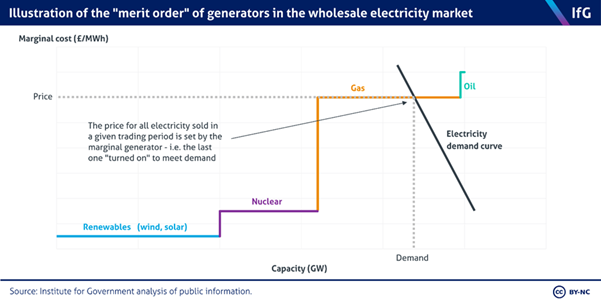
In these markets, electricity generators bid to contribute to the power grid. Each will have its own short run marginal cost (SRMC), reflecting their cost of producing an additional unit of electricity, based on factors such as the efficiency of the generation method, location and their own fuel costs. A company’s SRMC will be the lowest price generators will be willing to sell electricity.
Renewables such as wind and solar tend to have the lowest SRMC because they do not use any fuel. By contrast, gas-fired power stations have high SRMCs because each additional unit of electricity generated requires extra fuel to produce, and the production of electricity from renewables is more efficient as less energy is wasted as heat.
These bids to supply electricity are accepted by the power exchange, NordPool, in price order from cheapest to most expensive until demand is met, in what is known as ‘merit order’. This means sources of electricity with the lowest SRMC (as noted, typically renewables) are the first bids to be accepted. Then, subsequent bids are accepted until there are enough units in the grid to meet demand.
At this point, price paid by energy suppliers or traders to the generators or traders is set by the SRMC of the last generating unit used to meet demand. In the UK that is often gas – being among the most expensive to produce.
However, gas serves a vital role in balancing electricity supply and demand because it can more easily be ramped up or scaled back than other sources, which on their own are unable to power the entire UK. Renewable output, for example, can fluctuate due to changes in weather and gas stations will often be ramped up to close the gap in demand. 43 Nuclear energy provides a fairly constant source of power that is difficult to turn on and off. In recent years, French nuclear power stations have been managed increasingly flexibly but this is still more costly and technically challenging than generating power consistently.
This means that, although most UK electricity is produced by generation methods with lower marginal costs, the price that is paid in both wholesale and retail markets is often set much higher.
Why do all generators receive the same price?
It may seem odd that electricity produced with low-cost renewables should end up costing suppliers (and so consumers) the same as electricity generated by gas-fired power stations, but this is a common feature of competitive auction markets.
The reason for this is that if markets instead ran on a ‘pay as bid’ model, with generators being paid at the price they bid rather than at the highest-priced supplies, the market would be susceptible to strategic bidding.
Generators, particularly lower-cost ones, would have little incentive to bid at their true marginal cost and instead could bid at the price at which they expect the market to clear, which would often be higher. This would likely skew the market and require additional controls.
However, the link between gas and electricity has come under scrutiny, particularly during the recent energy crises caused by the Russian invasion of Ukraine in 2022 and war in the Middle East in 2026. These conflicts led to higher global gas prices which lead to higher electricity prices for UK businesses and households. On 21 April 2026 the government announced a suite of measures including some aimed at breaking this link.
What has the government proposed on the gas–electricity link, and will it work?
Most new renewables projects are set up with a Contract for Difference (CfD). 44 https://www.instituteforgovernment.org.uk/article/explainer/private-finance-models-infrastructure This sets a “strike price” that generators are guaranteed. If the market price is lower, the government will top it up; if the market price is higher, the generator will pay it back. Crucially, that makes the SRMC of gas irrelevant to the price received by that generator.
However, many older low-carbon projects (around a third of UK electricity generation 45 https://www.carbonbrief.org/qa-how-the-uk-government-aims-to-break-link-between-gas-and-electricity-prices/ ) do not hold CfDs and enter the market in the same way as gas and other generators do. The government wants these generators to voluntarily sign up to CfDs and has raised the windfall tax rate on them to encourage them to do so.
This will weaken the link between gas and electricity prices because if the price of gas is higher than the strike price, the difference will be paid back by more renewable generators (depending on how many make the switch). This would be particularly valuable in times of very high gas prices.
There is merit to this move though the immediate impact on households bills may not be dramatic 46 https://ukerc.ac.uk/news/delinking-gas-and-power-a-top-priority-for-government-ukercs-pot-zero-proposal-leads-the-way/ – it will depend on how many generators take up the new contracts, and the current incentives may need to be strengthened. 47 https://resolutionfoundation.substack.com/p/cutting-the-cord It will also be important for the government to set the strike price at the right level. Too low and generators will not sign up voluntarily, too high and the government will lock in higher prices for a longer period of time.
What other options are have been proposed?
- Increase renewable energy and energy storage
The increasing amount of renewable energy generation and energy storage in the UK is already breaking the link between gas and electricity prices. In 2026 gas only sets the price of electricity 60% of the time, compared to more than 90% in 2021. 48 https://www.carbonbrief.org/qa-how-the-uk-government-aims-to-break-link-between-gas-and-electricity-prices/ This means gas will become less likely to be the marginal generator and therefore lower marginal cost renewables will set the price of electricity for more of the time, while more storage reduces the need to fire up gas power stations in times of higher demand or lower renewables production.
This is happening without any change to how the wholesale market works. However, even if the government achieves its objective of 95% clean power by 2030, the National Energy System Operator (NESO) 49 https://www.instituteforgovernment.org.uk/explainer/national-energy-system-operator estimates that gas may continue to set the price of electricity 15% of the time so the link between gas and electricity prices will not be broken completely.
- Market reform
The government ran a recent Review of Electricity Market Arrangements to consider wider reforms to the electricity market including approaches to delink electricity and gas prices. These included a Green Power Pool – an optional separate market for renewables alongside the wholesale market and a Split Market – splitting the wholesale market into one section for renewables and one for other generators. The government decided not to pursue these options because they believed they wouldn’t achieve their objectives. 50 https://assets.publishing.service.gov.uk/media/65eb48f362ff48ff7487b30a/rema-options-assessment.pdf For instance, they would be challenging and time consuming to deliver at a time when the government wants to rapidly increase renewable capacity and they create new risks around generators trying to game the multiple markets.
- Other interventions
The government could also take the more radical step of abandoning the current competitive market approach outlined above. Proposals have included taking gas out of the market entirely by nationalising gas plants 51 https://www.common-wealth.org/publications/crude-awakening-averting-the-unfolding-energy-crisis or moving gas generation into a strategic reserve under a long term contract and central buying arrangement. 52 https://www.stonehavenglobal.com/managing_decline_a_regulated_asset_base_for_legacy_gas_in_the_age_of_clean_power There is no indication that the government is considering either currently.