
There is a lot of debate about how far UK government policy is constrained by the gilt (or bond) market. This is the market that funds government borrowing. This explainer sets out how that works, who owns government debt, and what determines the interest rate charged on that debt.
How does the government borrow money?
In every year since 2001, the government has run a deficit. 27 https://commonslibrary.parliament.uk/research-briefings/sn06167/ This means that its spending has exceeded revenues. The government funds that difference by borrowing from financial markets. 28 Even if spending did not exceed revenues, the government would still need to borrow to re-finance old debt that is expiring.
The amount of government borrowing, and the interest rate the government has to pay on its debt, have a big impact on the government’s finances. In recent years, the interest rates on UK government debt have increased. Around 9% of government spending is currently on debt interest payments, 29 https://obr.uk/efo/economic-and-fiscal-outlook-march-2026 roughly the same as the budget of the Department for Education. 30 OBR forecast for central government debt interest spending in 2026-27 (net of APF) is £109.4bn. The 2025 Spending Review set the Department for Education’s Total Delegated Expenditure Limit for 2026-27 at £106.6bn.
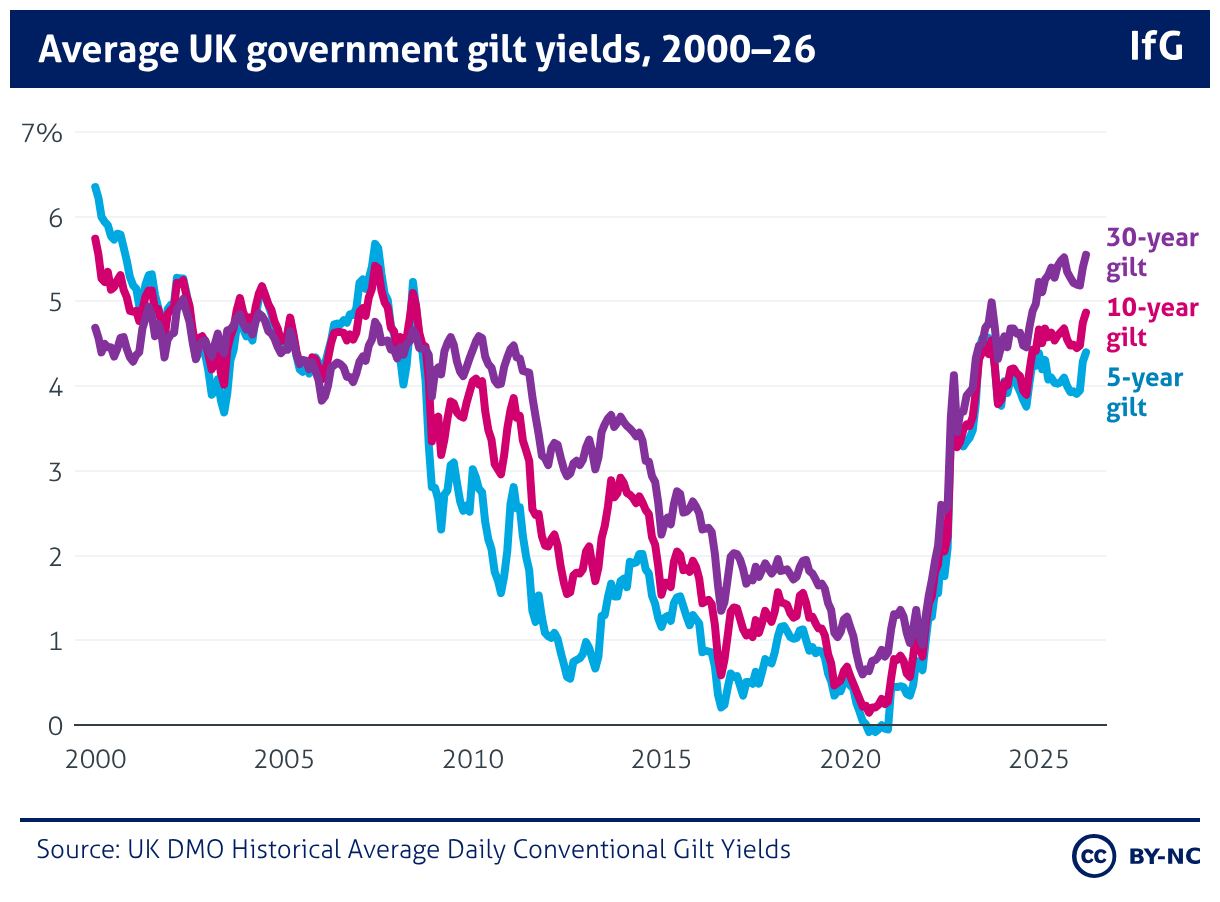
What is a gilt?
All governments borrow from financial markets by issuing bonds. A ‘gilt’ is the specific name for a bond issued by the UK government. 36 In addition to gilts, the government issues Treasury bills. These are short term bonds that mature within a year and form a much smaller part of government financing.
A bond is effectively an ‘IOU’. It is a contract whereby the government commits to pay the owner a certain amount each year (a ‘coupon’) and, when the bond matures (called ‘redemption’), to repay the ‘principal’. For example, an investor who paid £100 for a 10-year gilt with a coupon of 5% would receive £5 a year in coupon payments and then £100 in ten years when the gilt matures.
Most gilts are issued in nominal terms, meaning repayments are fixed at the point the contract is entered into. The government also issues index-linked gilts, where repayments also depend on the level of inflation.
How does the government issue gilts?
The government issues gilts through the Debt Management Office (DMO), an executive agency of HM Treasury 37 Executive agencies deliver specific services for their sponsor department. For more information, see https://www.instituteforgovernment.org.uk/explainer/public-bodies . Every year, the government forecasts how much borrowing it needs to finance its spending and gives the DMO a ‘financing remit’. This sets out the total amount of gilts it needs to sell, whether they will be index-linked or not and what value of gilts should have a short, medium or long maturity. 38 https://www.dmo.gov.uk/responsibilities/financing-remit/ The DMO then sells debt through auctions or, more rarely, through groups of private sector banks. The DMO can also change the mix of gilts it issues based on financial conditions. 39 https://www.dmo.gov.uk/media/gnffn5rz/sa030326.pdf
The choice about what types of gilt to issue depends on what there is demand for in the market. For instance, pension funds may want to buy long maturity index-linked government debt because they want certainty about their ability to pay pensions decades in the future, which also depend on inflation. In addition, it may depend on the government’s risk appetite. Long maturity gilts will lock the government into paying the agreed interest payment for a long time. This gives the government certainty, but doesn’t give it flexibility to take advantage of any fall in interest costs in the coming years. In practice, the government issues debt at a range of maturities to balance the benefits of certainty and flexibility.
How much debt does the government issue each year?
In 2026/27, the government expects to borrow £137bn to fund spending and to spend a further £141bn to redeem previous gilts that have matured. When other changes have been taken into account, the DMO’s financing remit is set to raise £252bn through the sale of gilts. 40 https://www.gov.uk/government/publications/debt-management-report-2026-27/debt-management-report-2026-27
Most of this debt will be short (up to seven years) and medium (seven to 15 years) term, though some is left unallocated so that the government can choose the best approach based on market conditions later in the year.

What determines the government’s interest costs?
Once a gilt is issued, the price paid by the government to the holder is fixed (or linked to inflation). But those gilts can be traded on the open market. That market price gives an up-to-date impression of how buyers and sellers in the market view UK government debt.
The market price depends on the credibility that the government can repay its debt; expectations about inflation; and how this compares to alternative financial assets such as other governments’ debt. The current market price for existing UK debt helps set the price at DMO auctions of new government debt.
The government’s total interest bill depends on the interest rates on all of its debt, not just what it costs to issue new debt today. This means that if interest rates on new government debt jump up, the government’s interest bill increases fairly slowly, as it continues to pay the agreed interest costs on its pre-existing stock of debt. 42 The exception is gilts held by the Bank of England, where the cost moves in line with the interest rate set by the bank, and moves immediately.

How does the gilt (or bond) market respond to political events?
Gilt traders often buy and sell UK government bonds in response to political events, which affects their price (and so the effective interest rate). The price of gilts depends on how credible it is that the government will repay debt over a long period, and the value of that against other assets, which depends on things like the Bank of England base interest rate and inflation. Political events that change the market’s expectation about how easily the government will pay back debt in future, or how high inflation will be, will lead to changes in the market price.
The most notable example of this in recent years was the aftermath of Liz Truss’s ‘mini-budget’ in 2022. A big fiscal stimulus, combined with her government’s disregard for institutions like the OBR and constraints like fiscal rules, led markets to become nervous about the credibility of the UK government while also increasing inflation expectations.
Who owns the government’s debt?
UK government gilts are largely owned by a mix of domestic and international financial institutions. This includes pension funds, insurance companies and commercial banks. After the financial crisis, the Bank of England (through its quantitative easing programme) became a big holder of UK government debt. This is slowly being reversed, but the Bank of England still owns over 20% of UK government debt.
Who holds gilts has changed over time. Historically, pension funds and insurance companies have been the largest holders of UK government debt, and particularly long maturity and index-linked debt, as this is a good match for the needs of defined benefit pension schemes for stable, predictable long-run returns. But this is changing as fewer people have defined benefit pension schemes and more participate in defined contribution schemes which are more likely to be invested in stocks and shares. If this continues, the government may need to find new buyers for its debt, and may need to issue more debt with shorter maturities and/or pay higher interest rates to attract them. 44 https://obr.uk/frs/fiscal-risks-and-sustainability-july-2025
- Topic
- Public finances
- Department
- HM Treasury
- Publisher
- Institute for Government