Learning from the DevoLab: How can mayors use their powers to deliver ‘good growth’?
Eight lessons for how devolved powers can be best used in practice.

Summary
The Burnham government has made devolution central to its plans for “good growth in every postcode”. It argues that delivering that growth will require “a fundamental rewiring of the way our country works”.1
Cabinet Office, ‘Rewiring the state – Cabinet statement’, GOV.UK, 11 August 2026, retrieved 11 August
2026, www.gov.uk/government/publications/rewiring-the-state-cabinet-statement/rewiring-the-state-cabinet-
statement-html
To achieve this, it has committed to putting “the most important powers to drive local growth in the hands of local leaders”, announcing further devolution of key responsibilities, including 16–19 technical skills, employment support, and funding for affordable housing, alongside new fiscal powers that will allow mayors to retain a share of income tax from 2028.2
Cabinet Office, ‘Rewiring the state – Cabinet statement’, GOV.UK, 11 August 2026, retrieved 11 August
2026, www.gov.uk/government/publications/rewiring-the-state-cabinet-statement/rewiring-the-state-cabinet-statement-html
Mayors will be expected to use these powers, alongside their existing responsibilities for transport, housing, adult skills, investment and economic development, to deliver good growth. At the same time, the government has committed to establishing strategic authorities across the country by the end of 2028.3
Cabinet Office, ‘Rewiring the state – Cabinet statement’, GOV.UK, 11 August 2026, retrieved 11 August
2026, www.gov.uk/government/publications/rewiring-the-state-cabinet-statement/rewiring-the-state-cabinet-statement-html
The government describes its push for “good growth” as an approach in which “economic progress goes hand in hand with social progress underpinned by democratic accountability.”4
Cabinet Office, ‘Rewiring the state – Cabinet statement’, GOV.UK, 11 August 2026, retrieved 11 August
2026, www.gov.uk/government/publications/rewiring-the-state-cabinet-statement/rewiring-the-state-cabinet-
statement-html
This indicates that good growth will not be judged only by economic outcomes but also by its wider social impact.
This term and approach stems from Burnham’s experience as mayor of Greater Manchester, which launched a Good Growth Fund in 2025 to “pioneer a new model of economic growth”.5 Greater Manchester Combined Authority, ‘Mayor Andy Burnham unveils plan to pioneer new model of economic growth with £1bn good growth fund’, 19 November 2025, retrieved 1 October 2026, www.greatermanchester-ca.gov.uk/news/mayor-andy-burnham-unveils-plan-to-pioneer-a-new-model-of-economic-growth-with-1bn-gm-good-growth-fund-and-pipel… The fund aims to drive growth that is shared across the city region and leaves “no one or no place” behind.6 Greater Manchester Combined Authority, ‘Greater Manchester Good Growth Fund’, no date, retrieved 1 October 2026, www.greatermanchester-ca.gov.uk/what-we-do/economy/greater-manchester-good-growth-fund It uses public investment to attract private capital and to direct capital to housing, employment and regeneration projects that support the wider policy goals of the Greater Manchester Combined Authority (GMCA).7 Greater Manchester Combined Authority, ‘Report: Greater Manchester Good Growth Fund’, 28 November 2025, retrieved 1 October 2026, https://democracy.greatermanchester-ca.gov.uk/documents/s41037/5C%20Good%20Growth%20Fund%20CA%20Paper%2018.11.25.pdf At the 2026 budget, the government announced £285m of capital funding to establish good growth funds in all mayoral areas and all areas progressing towards establishing a strategic authority.8 Ministry of Housing, Communities and Local Government, ‘Good Growth Funds: place selection and indicative allocations’, GOV.UK, 28 October 2026, retrieved 17 November 2026, www.gov.uk/government/publications/good-growth-funds-place-selection-and-indicative-allocations/good-growth-funds-place-selection-and-indicative-allo…
The IfG DevoLab
But devolving powers, though important, is only the first step to achieving good growth. The benefits of greater local control will depend on how effectively those powers are used in practice – and how effectively mayoral strategic authorities (MSAs) develop clear priorities, build regional partnerships and deliver for their residents. The challenge, then, is not simply to devolve power, but to make devolution work effectively.
Launched in July 2025, the IfG DevoLab aims to help achieve this. We have been exploring the policy innovations enabled by devolution, identifying what works and what places can learn from each other, holding events in Sheffield, Manchester, Leeds and Birmingham to experience the devolution programme first hand. Through 15 case studies spanning 10 mayoral regions, the series has examined how mayors and local leaders are using devolved powers to tackle some of their most pressing challenges. Links to the case studies are found throughout, and include:
- reducing health inequalities
- securing investment
- improving transport connectivity
- increasing the supply of affordable homes
- developing a shared vision for regional growth.
As England enters a new phase of devolution, the experience of strategic authorities across different policy areas and places offers valuable insight into how devolved powers can be best used in practice. Drawing on those case studies, this paper identifies eight lessons that emerge consistently and that together provide practical guidance for mayors, local leaders and central government.
Key findings
|
The lessons
1. Mayors can provide visible and consistent leadership to maintain momentum and deliver long-term strategic priorities
Strong mayoral leadership can help regions deliver ambitious long-term projects that require sustained political support. By acting as a visible champion for flagship programmes, mayors can build public support, sustain momentum, and provide a clear point of accountability. They can also provide a strong, single voice for their regions, acting as a focal point for engagement with central government and investors. Providing a consistent, clear message is also crucial for attracting private investment.1
Shaw H, Isaac M and Paun A, Learning from the DevoLab #2: How mayors can secure investment into regional
economies, Institute for Government, February 2026, www.instituteforgovernment.org.uk/publication/devolab-2-mayors-investment-regional-economies
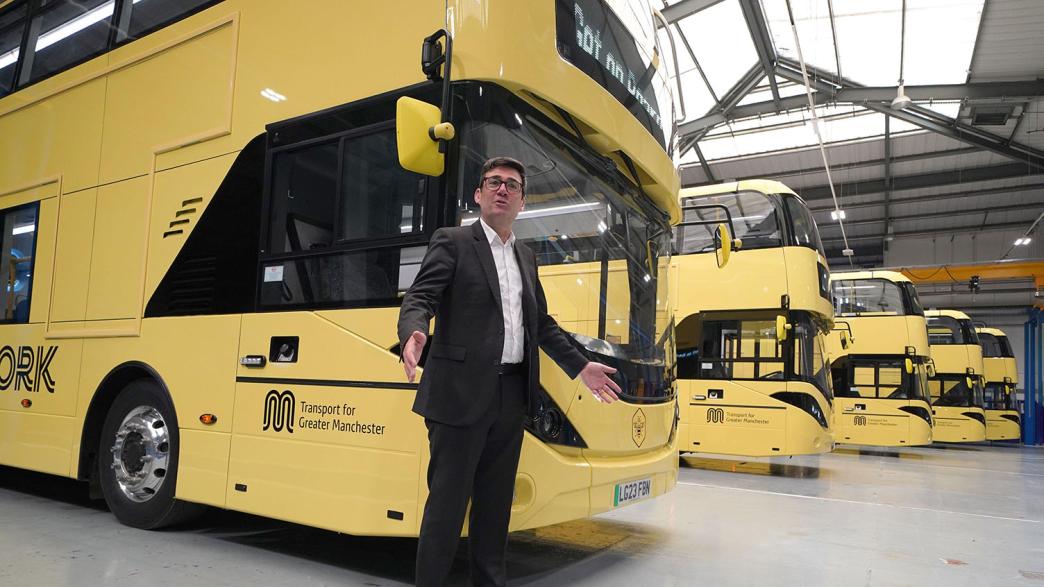
During his time as mayor, Andy Burnham made the Bee Network (Greater Manchester’s integrated public transport system) a clear personal priority. He emphasised its importance in improving access to jobs, education and services across the region, particularly for communities that had previously been poorly served by public transport, arguing that better connectivity would underpin Greater Manchester’s long-term vision for good growth.2
Greater Manchester Combined Authority, Delivering the Bee Network, 29 November 2024, https://
democracy.greatermanchester-ca.gov.uk/documents/s34954/GMCA%2020241129%20Delivering%20
the%20Bee%20Network.pdf
Integrated transport featured in all three of Burnham’s mayoral manifestos, with bus franchising in particular playing a key role in his 2021 campaign.3 Burnham A, ‘Our manifesto for Greater Manchester’, GMCA, 2017, retrieved 18 August 2026, https://d3n8a8pro7vhmx.cloudfront.net/andy4mayor/pages/68/attachments/original/1489493923/Andy_Burham_Manifesto_A4_12pp_copy.pdf?1489493923 , 4 Burnham A, ‘Our Place. Our Time’, manifesto, 2021, retrieved 18 August 2026, https://andyformayor.co.uk/wp-content/uploads/2021/04/Andy-Burnham-Manisfesto-v2.1-002.pdf , 5 Burnham A, ‘Greater Manchester leading the way’, manifesto, 2024, retrieved 18 August 2026, https://andyformayor.co.uk/wp-content/uploads/2024/04/Andy-Burnham-Manifesto-A4-v3.0-FINAL.pdf Burnham was also Greater Manchester Combined Authority’s (GMCA) portfolio lead for transport and was a prominent advocate for the Bee Network by promoting the brand across the region through local events and public appearances. This visible political leadership helped build public and political support for a complex and long-term transport project, while also providing a clear point of accountability for residents, central government and delivery partners.
However, while mayoral leadership is important for driving projects forward and delivering regional priorities, it is not always sufficient. The West Yorkshire mass transit system, for example, is one of mayor Tracy Brabin’s core priorities, but has faced delays after a government review identified governance and planning risks in West Yorkshire Combined Authority’s approach to the project.6 Stokes S, ‘£2.5bn tram plan delayed after government review’, BBC News, 18 December 2025, retrieved 12 November 2026, www.bbc.co.uk/news/articles/c78vrzpzle2o
2. Mayors can convene local partners to develop innovative solutions to complex, cross-cutting challenges
Mayors can also use their convening powers to build partnerships around shared local priorities and address complex cross-organisational challenges, including in areas where they lack formal powers. To make progress on these challenges, mayors can develop pilot programmes to trial new approaches and test for proof of concept. In South Yorkshire, mayor Oliver Coppard has championed the Beds for Babies programme, which aims to address child poverty, improve childhood development and increase trust in statutory services by providing free beds and bedding to children aged five and under. The programme supports Coppard’s wider ambition to make South Yorkshire the “healthiest region in England”.1
The South Yorkshire Mayor’s Health Equity Panel, ‘Health is Wealth in South Yorkshire: How to become the UK’s healthiest region’, 2024, retrieved 18 August 2026, www.southyorkshire-ca.gov.uk/getmedia/c2ac7866-2c57-4dc8-ba4f-9be70fdf2cb8/hep-report-aw-final-2025-07-18.pdf
Although mayors have limited formal powers over health services, Coppard used his position as chair of South Yorkshire’s Integrated Care Partnership to secure support for the programme from NHS partners, local authorities and other key stakeholders.2
South Yorkshire Mayoral Combined Authority, ‘South Yorkshire’s Mayor to invest £2.2m to guarantee beds
for babies – a safe space to sleep for every child aged 0-5’, 12 March 2024, retrieved 18 August 2026,
www.southyorkshire-ca.gov.uk/news/article/12cf5653-9626-437b-b8e2-98884859c985

Upon election as mayor of Greater Manchester in 2017, Burnham made tackling homelessness his top priority, introducing the A Bed Every Night scheme to provide emergency accommodation for people experiencing homelessness. While statutory responsibility for homelessness primarily lies with local authorities, Burnham was able to bring together councils, health services, charities and other partners around a city-regionwide approach, helping to coordinate services and additional funding, including £1.5m of NHS funding, for the programme in 2019.3
Greater Manchester Combined Authority, ‘A Bed Every Night, Greater Manchester’s rough sleeping
strategy, secures significant NHS funding’, 19 June 2026, retrieved 23 October 2026, www.greatermanchester-ca.gov.uk/news/a-bed-every-night-greater-manchester-s-rough-sleeping-strategy-secures-significant-nhs-funding
In the North East, mayor Kim McGuiness has made tackling child poverty her number one priority, introducing a Child Poverty Reduction Unit in 2024 which developed a five-year action plan to reduce child poverty.4
North East Mayoral Strategic Authority, ‘Child Poverty Reduction Unit’, no date, retrieved 3 November
2026, www.northeast-ca.gov.uk/child-poverty-reduction-unit
Backed by £28.6m of investment from the North East Mayoral Strategic Authority (NEMSA), the plan includes a pilot of the mayor’s childcare grant to support barriers to work, education and training for parents and carers, expanded provision of baby boxes to families in receipt of universal credit, and support to families delivered through schools.5
North East Mayoral Strategic Authority, ‘North East Mayor takes the lead in fight against child poverty
with a £28.6m action plan for the region’, 22 July 2025, retrieved 3 November 2026, www.northeast-ca.gov.uk/news/education-skills-and-inclusion/north-east-mayor-takes-the-lead-in-the-fight-against-child-poverty-with-a-28-6m-action-pl…
While child poverty is a complex problem with complex long-term drivers, McGuiness has been able to use her mayoral role to bring together councils, cross-sector organisations, parents, carers and young people to coordinate a region-wide approach which reflected the specific challenges facing the North East.6
North East Mayoral Strategic Authority and Wavehill, Child Poverty Prevention Programme Final Evaluation,
October 2025, www.northeast-ca.gov.uk/child-poverty-reduction-unit
3. Mayors can spearhead the development of long-term growth strategies, founded on a robust evidence base, around which local parties can unite
Mayors play an important role in defining a long-term strategic vision for their region, bringing local authorities, businesses and other partners together around shared priorities. Overarching regional strategies, such as the Greater Manchester Strategy and the West Yorkshire Plan, provide a framework for coordinating decision-making and investment across a place. These are supported by statutory plans, including local growth plans, spatial development strategies and local transport plans, which help translate ambition into action.
As recommended by a previous Institute for Government report, effective strategies should be grounded in a strong evidence base, make clear choices about priorities and trade-offs, and build consensus among regional partners. Leaders do not need everyone to agree on everything but should establish a clear set of priorities around which partners can coordinate.
For example, the East Midlands Combined County Authority (EMCCA) has developed the East Midlands Inclusive Growth Framework to provide a long-term, shared vision for inclusive growth in the region.1
East Midlands Combined County Authority, East Midlands Inclusive Growth Framework, October 2025, www.eastmidlands-cca.gov.uk/content/uploads/2025/10/2025-10-13-EM-Inclusive-Growth-Framework_FINAL.pdf
Developed through 12 months of research and engagement with partners, the framework defines inclusive growth as “a model of growth that values everyone’s contributions whilst also sharing out the benefits.”2
East Midlands Combined County Authority, East Midlands Inclusive Growth Framework, October
2025, www.eastmidlands-cca.gov.uk/content/uploads/2025/10/2025-10-13-EM-Inclusive-Growth-
Framework_FINAL.pdf
This concept has similarities with the government’s focus on ‘good growth’ and the importance of economic progress going “hand in hand with social progress”.3
Cabinet Office, ‘Rewiring the state – Cabinet statement’, GOV.UK, 11 August 2026, retrieved 11 August 2026, www.gov.uk/government/publications/rewiring-the-state-cabinet-statement/rewiring-the-state-cabinet-statement-html
To achieve this, it sets out an overarching mission and six ambitions to guide investment, programme delivery and partnership working.
For a newer strategic authority with a relatively limited history of collaboration across the region, the framework provided an opportunity for EMCCA to not only address economic challenges but also to build relationships, develop a common sense of purpose and agree a set of shared priorities with partners across the region.

Similarly, the Greater Manchester Strategy sets out a shared 10-year vision for the region, agreed by the 10 constituent local authorities in Greater Manchester.4
Greater Manchester Combined Authority, Greater Manchester Strategy, 2025, retrieved 21 August 2026,
https://togetherwearegm.co.uk/our-vision/greater-manchester-strategy/
The strategy guides specific programme priorities and investment: for example, the Sister innovation district is a key project within the Central Growth Cluster, one of the six growth locations identified in the strategy. Sister will help to deliver the strategy’s ambition for innovation-led regeneration and the creation of competitive sector clusters in advanced manufacturing, health innovation and digital technologies.
The project also aims to support Greater Manchester’s overarching ambition of delivering good growth across the region, with Sister providing “opportunities for jobs, amenities and green space… it’s not just advanced manufacturing”.5 Edwards R, Presentation at ‘IfG DevoLab #2: How can mayors and strategic authorities secure investment into regional economies?’, Institute for Government event, 20 October 2025, retrieved 23 October 2026, www.instituteforgovernment.org.uk/event/devolab-2-mayors-strategic-authorities-secure-investment
Shared goals developed at a local level can also play an important role in building consensus and coordinating action on growth ambitions. For example, the Sheffield City Goals were developed collaboratively by stakeholders from across the city to establish a shared set of 18 goals for Sheffield through to 2035. To support delivery, Sheffield City Council is also undertaking a series of neighbourhood conversations with residents to better understand local identities and ensure decisions are taken and services are delivered at the right level and in the right places. During the development of the Sheffield City Goals, the council engaged South Yorkshire Mayoral Combined Authority and ensured the goals aligned with the regions broader strategic priorities especially in areas such as transport, skills, housing and economic development, where many of the key policy levers sit at the regional level.
4. Mayors can enter into structured investment and regeneration partnerships with local authorities and other regional stakeholders to drive place-based growth
Mayors hold responsibilities across a range of policy areas that shape local economic performance, but they cannot deliver growth alone. Achieving mayoral priorities and delivering good growth requires partnerships with various stakeholders, including local authorities, delivery partners and central government. Mayors can do this by acting as system leaders, convening partners around shared priorities and coordinating collaborative working on regional projects.
For MSAs, this requires recognition of where they can add value and where to bring partners in. For example, the Riverside Sunderland regeneration project is led by Sunderland City Council but supported by NEMSA. While the council leads on planning and regeneration, NEMSA has supported the project through revenue and investment funding and helping to align it with wider regional priorities.1 Riverside Sunderland, ‘£42m boost for Sunderland regeneration scheme’, 15 October 2024, retrieved 21 August 2026, https://riversidesunderland.com/ps42m-boost-sunderland-regeneration-scheme For example, the project has been designated as part of NEMSA’s Creative Development Zone, with £300,000 investment from NEMSA, matched by Sunderland City Council, to unlock the project’s next phase of development.2 North East Mayoral Combined Authority, ‘New Mayoral Development Zone provides £600,000 boost to Sunderland’s future as a creative capital’, 10 December 2025, retrieved 21 August 2026, www.northeast-ca.gov.uk/news/culture-creative-tourism-and-sport/new-mayoral-development-zone-provides-600-000-boost-to-sunderland-s-future-as-a-creat…
Mayoral development corporations (MDCs) are an increasingly important vehicle for formalising partnerships to deliver large-scale regeneration projects.3 Mitchell M, Devolution and urban regeneration: How can metro mayors transform England’s towns and cities, Institute for Government, December 2024, www.instituteforgovernment.org.uk/publication/devolution-urban-regeneration MDCs are statutory bodies through which mayors, local authorities, investors and other stakeholders can coordinate regeneration.4 Mitchell M and Isaac M, ‘Mayoral development corporations’, Institute for Government, 16 June 2026, retrieved 21 August 2026, www.instituteforgovernment.org.uk/explainer/mayoral-development-corporations For example, in 2019, Stockport Borough Council and GMCA established the Stockport Town Centre MDC as a dedicated vehicle to regenerate the west of the town centre.5 The Stockport Town Centre West Mayoral Development Corporation (Establishment) Order 2019, No.1040, June 2019, retrieved 2 June 2026, www.legislation.gov.uk/uksi/2019/1040/made
The MDC board includes leaders from each major party on the council, senior council officers, Homes England, GMCA and private sector representatives. The MDC has its own constitution and adheres to a set of governance principles, including a commitment to collaborative working between the mayor and Stockport council to agree how development is to proceed.6 Burnham A, ‘Stockport Mayoral Development Corporation Delivery Plan 2019-2020’, Greater Manchester Combined Authority, 27 September 2019, https://democracy.greatermanchester-ca.gov.uk/documents/s2240/GMCA%20Report%20on%20MDC%20Delivery%20Plan%20and%20Appointment%20of%20the%20Board%20Par… Since its establishment, the MDC has delivered 1,200 homes, 16,000 square metres of employment space and a new transport interchange, while attracting over £600m in investment.7 The Developer, ‘Stockport Town Centre West, Stockport for Stockport Mayoral Development Corporation with Stockport Council, GMCA and Homes England’, (no date), retrieved 30 September 2026, https://thedeveloper.live/place-database/stockport-town-centre-west-stockport-for-stockport-mayoral-development-corporation-with-stockport-council-gm… Its regeneration has also aimed to address deprivation and inequality in northern parts of the borough, helping to ensure the benefits of growth are more widely shared.8 Issac M, Shaw H, Paun A, Learning from the DevoLab #4: How mayors can increase the supply of affordable homes, Institute for Government, 2 July 2026, retrieved 30 September 2026, www.instituteforgovernment.org.uk/publication/devolab-4-mayors-affordable-homes
To date, three mayors – in London, Greater Manchester and Tees Valley – have created MDCs to drive regeneration schemes, but some have faced challenges.9
Mitchell M and Isaac M, ‘Mayoral development corporations’, Institute for Government, 16 June 2026, retrieved 12 November 2026, www.instituteforgovernment.org.uk/explainer/mayoral-development-corporations
The South Tees Development Corporation, set up by Tees Valley mayor Ben Houchen in 2017 to regenerate the former steelworks at Teesside has been subject to an independent review of its governance and financial arrangements and in October 2026, the government confirmed a ‘best value inspection’ of Tees Valley Combined Authority (TVCA) to review its financial sustainability and governance.10
Department for Levelling Up, Housing and Communities, ‘Independent review report: South Tees
Development Corporation and Teesworks Joint Venture’, 29 January 2024, retrieved 23 October
2026, www.gov.uk/government/publications/independent-review-report-south-tees-development-corporation-and-teesworks-joint-venture
, 11
Ministry of Housing, Communities and Local Government and McMahon J, ‘Best Value Inspection confirmed at Tees Valley Combined Authority’, GOV.UK, 15 October 2026, retrieved 23 October 2026, www.gov.uk/government/news/best-value-inspection-confirmed-at-tees-valley-combined-authority
In November 2026, TVCA agreed to dissolve two of its MDCs, in Hartlepool and Middlesbrough, following a review which found that they no longer remain the most appropriate mechanisms for delivering regeneration in those areas.12 Tees Valley Combined Authority, ‘Tees Valley Combined Authority cabinet agenda papers: 13 November 2026’, 13 November 2026, retrieved 12 November 2026, https://teesvalley-ca.gov.uk/about/wp-content/uploads/sites/2/2026/11/TVCA-Cabinet-Agenda-Papers-13-November-2026.pdf MDCs tend to be used to address large, complex regeneration challenges that require land assembly, infrastructure coordination and a focused delivery organisation.13 Mitchell M, Devolution and urban regeneration: How can metro mayors transform England’s towns and cities, Institute for Government, December 2024, www.instituteforgovernment.org.uk/publication/devolution-urban-regeneration The TVCA review found that the regeneration of Hartlepool did not necessarily require an MDC, and that new mayoral planning powers may bring forward development more quickly.14 Tees Valley Combined Authority, ‘Tees Valley Combined Authority cabinet agenda papers: 13 November 2026’, 13 November 2026, retrieved 12 November 2026, https://teesvalley-ca.gov.uk/about/wp-content/uploads/sites/2/2026/11/TVCA-Cabinet-Agenda-Papers-13-November-2026.pdf
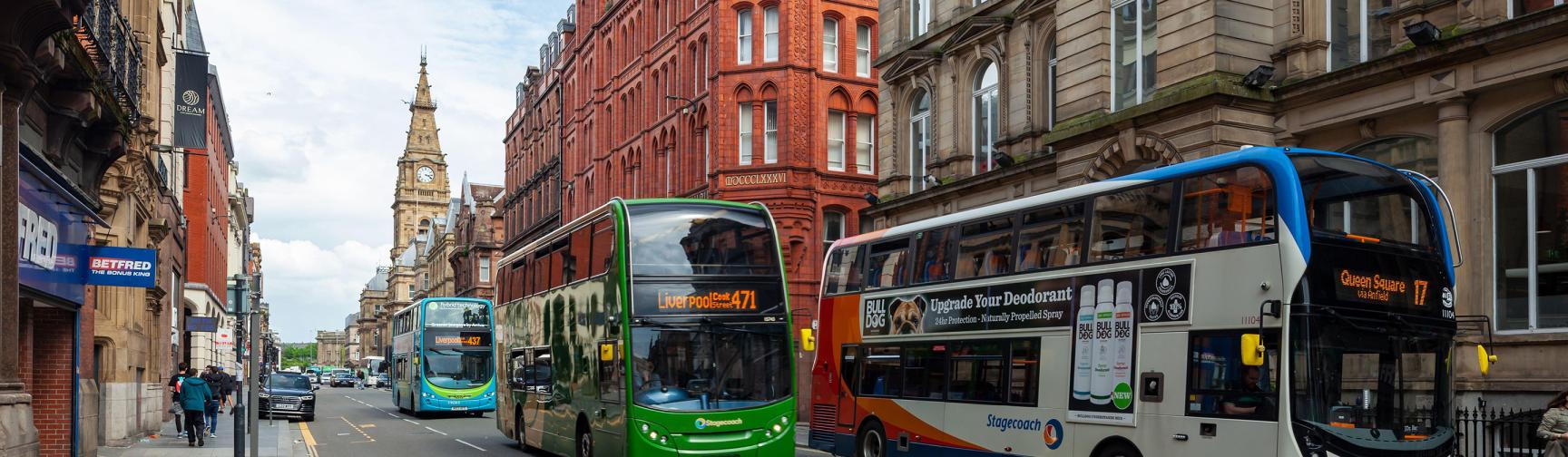
Buses in Liverpool City Centre.
5. Mayors can join the dots and bring about coordinated intervention across transport, skills, housing and other drivers of good growth
Delivering good growth will require coordinated intervention across different policy areas and a recognition of the links between the economic, social and environmental challenges that different regions face. Mayors are well placed to lead this coordination and to align their powers and funding behind a shared vision for their region.
For example, several mayors are developing integrated transport networks, recognising that improved transport connectivity can be an important driver of good growth. Not only this, but it can also widen access to employment and training, support better health and environmental outcomes and ensure that the benefits of growth are shared more widely across a region.1 Mazhikeyev A and others, Infrastructure and connectivity: Strengthening regional transport linkages for a more productive Midlands, The Productivity Institute, June 2025, www.productivity.ac.uk/wp-content/uploads/2025/06/THEMAT3.pdf , 2 Local Government Association, ‘How local transport infrastructure influences economic inclusion’, 5 November 2024, retrieved 30 September 2026, www.local.gov.uk/publications/how-local-transport-infrastructure-influences-economic-inclusion , 3 Benson M and Reardon L, ‘The role of transport in improving access to opportunities’, UK Parliament, 28 January 2025, retrieved 30 September 2026, https://post.parliament.uk/the-role-of-transport-in-improving-access-to-opportunities , 4 Mihaylova N, How transport offers a route to better health, The Health Foundation, February 2021, retrieved 30 September 2026, www.health.org.uk/reports-and-analysis/briefings/how-transport-offers-a-route-to-better-health Steve Rotheram, mayor of Liverpool City Region, for example, argued that franchising buses will allow the region to consider not just if a route makes money, but if it “helps somebody take a job, gets a student to college or allows an older person to remain independent.”5 Rotheram S, ‘Here in Liverpool, buses are back under public control – and that’s great for the only people who really matter’, The Guardian, 8 September 2026, retrieved 23 October 2026, www.theguardian.com/commentisfree/2026/sep/08/liverpool-buses-public-control-privatisation-services-passengers
Improved policy coordination at the local and regional level can support improved outcomes for residents.6 Davison N, Casebourne J, Clarke M, Wilson S, Joining up public services around local, citizen needs: Perennial challenges and insights on how to tackle them, Institute for Government, 29 October 2015, retrieved 1 October 2026, www.instituteforgovernment.org.uk/publication/report/joining-public-services-around-local-citizen-needs GMCA has piloted a devolved employment support programme that joins up services across skills, health and housing. ‘Working Well’ brings together a family of employment support services designed to support people with poor health at risk of, or experiencing, long-term unemployment. As well as connecting employment support with physical and mental health services, the programme also refers participants to skills programmes, housing support and social care services, taking a holistic approach to tackling unemployment.
An evidence review commissioned by the Department for Work and Pensions concluded that integration was particularly important for people facing multiple barriers to work, as it enables the use of a single intervention to address a range of interconnected problems.7 Department for Work and Pensions, ‘What works to support disadvantaged groups towards employment? Research summary’, 11 August 2025, retrieved 23 October 2026, www.gov.uk/government/publications/what-works-to-support-disadvantaged-groups-towards-employment/what-works-to-support-disadvantaged-groups-towards-e… Working Well programmes have supported more than 87,000 residents since 2014, with more than 32,000 gaining employment.8 Britton T, Presentation at IfG DevoLab #1 event, 14 July 2025, retrieved 23 October 2026, www.instituteforgovernment.org.uk/event/devolab-devolution-health-inequalities Almost all of these participants faced multiple barriers to work.
In West Yorkshire, the region’s Local Growth Plan identifies three ‘corridors of opportunity’ and provides a spatial framework for investment and growth that connects key economic sites and sets out how its most significant growth opportunities can be unlocked.9 West Yorkshire Combined Authority, ‘West Yorkshire Local Growth Plan’, December 2024, retrieved 18 August 2026, www.westyorks-ca.gov.uk/about-us/our-vision-and-mission/local-growth-plan This approach reflects West Yorkshire’s polycentric geography and the distinct opportunities found across the region.10 Reeves T, Presentation at ‘IfG DevoLab #5: How can mayors and local leaders create a shared vision for regional growth?’, Institute for Government event, 2 July 2026, retrieved 19 August 2026, www.instituteforgovernment.org.uk/event/devolab-5-mayors-local-leaders-regional-growth It also recognises that supporting growth across West Yorkshire will require the mayor to coordinate action across transport, regeneration, skills and support for high-growth sectors. For example, the development of mass transit is identified as a key enabler of growth, helping to connect people and businesses to opportunities across the region.
Mayors can also formalise approaches to joined-up working across policy areas. The mayor of London has a legal duty to produce a health inequalities strategy that identifies major health inequalities and sets out how bodies, including the Greater London Authority itself, should address them.11 UK Parliament, Greater London Authority Act 1999 (as amended by the Greater London Authority Act 2007) Part 5A: The Health Inequalities Strategy, 2007, retrieved 23 October 2026, Greater London Authority Act 2007 The English Devolution and Community Empowerment Act conferred a similar statutory health inequalities duty on all mayors, requiring strategic authorities to “have regard” for improving health and reducing health inequalities across their region.12 Ministry of Housing, Communities and Local Government, ‘English Devolution and Community Empowerment Bill’, GOV.UK, 10 July 2025, retrieved 23 October 2026, https://publications.parliament.uk/pa/bills/cbill/59-01/0283/240283.pdf
As part of his health inequalities strategy, the mayor of London, Sadiq Khan, has committed to embedding a Health in All Policies (HiAP) approach into the work of the GLA.13 Mayor of London and London Assembly, ‘MD2940 establishment of GLA Group public health function’, 16 March 2022, retrieved 19 August 2026, www.london.gov.uk/decisions/md2940-establishment-gla-group-public-health-function Led by the GLA Group Public Health unit, the approach aims to address the underlying causal drivers of ill health across a range of policy areas. For example, the group has supported work on air quality and transport, providing input into the development and expansion of the mayor’s Ultra Low Emission Zone (ULEZ), while also supporting action on housing, working with London councils and the NHS to convene a Homeless Health and Care Summit.14 Mayor of London and London Assembly, GLA Group Public Health Unit – Inaugural Annual Report 2024: Progress and impact 2022-2024, 2024, retrieved 19 August 2026, www.london.gov.uk/programmes-strategies/health-and-wellbeing/gla-group-public-health-unit/gla-group-public-health-unit-inaugural-annual-report-2024
IfG DevoLab
An initiative from the Institute for Government, dedicated to exploring the policy and governance innovations enabled by devolution. Explore the innovations. Learn from the results. Share the lessons.
Explore the series

6. Mayors can allocate ‘just enough’ public investment to address viability challenges and catalyse private investment
Delivering good growth requires strategic investment in housing, transport and regeneration projects, which cannot be met through public funding alone. MSAs can play an important role in de-risking infrastructure projects and catalysing private investment. To achieve this, mayors can develop pipelines of priority projects and investment vehicles that can blend public and private finance to target investment towards regional priorities.
West Midlands mayor Richard Parker has worked with investors and government ministers to unlock up to £3bn of private investment in the Birmingham Sports Quarter regeneration project.1 West Midlands Combined Authority, ‘New tram route to Sports Quarter as chancellor announced £2.4bn transport funding for region’, 4 June 2025, retrieved 21 August 2026, www.wmca.org.uk/news/new-tram-route-to-sports-quarter-as-chancellor-announces-2-4bn-transport-funding-for-region The West Midlands Combined Authority (WMCA) has worked closely with local council leaders and government ministers to invest in a new tram route for the West Midlands Metro, connecting the Sports Quarter to central Birmingham and HS2 links. The new tram route will increase the viability of the project and has been central to securing a multi-billion-pound commitment from Knighthead, a US investment firm which owns Birmingham City football club. The Sports Quarter is one of the West Midlands’ major catalytic regeneration projects and aims to drive inclusive growth in east Birmingham and north Solihull – one of the most deprived parts of the region.2 Birmingham City Council, ‘Britain’s biggest and most powerful Development Corporation launched to drive £11bn regeneration of East Birmingham’, 19 May 2026, retrieved 30 September 2026, www.birmingham.gov.uk/news/article/1782/britains_biggest_and_most_powerful_development_corporation_launched_to_drive_11bn_regeneration_of_east_birmin… , 3 West Midlands Combined Authority, West Midlands Growth Plan, July 2025, https://growth.wmca.org.uk/assets/WestMidlandsGrowthPlan.pdf
Similarly, the West of England Combined Authority (WECA) has forward funded a new entrance for Bristol Temple Meads railway station to support viability and build investor confidence in the Bristol Temple Quarter regeneration project.4 Bristol Temple Quarter, ‘Eastern Entrance’, no date, retrieved 21 August 2026, www.bristoltemplequarter.com/project/eastern-entrance The project is one of the UK’s largest urban regeneration schemes and aims to transform over 130 hectares of brownfield land into a series of mixed-use districts with affordable homes.5 Bristol Temple Quarter, ‘Our vision’, no date, retrieved 30 September 2026, www.bristoltemplequarter.com/vision , 6 Bristol Temple Quarter, ‘Our vision’, no date, retrieved 30 September 2026, www.bristoltemplequarter.com/vision Upfront public sector investment can be decisive in supporting large regeneration schemes: speaking about the project, WECA chief executive Stephen Peacock has stated that combined authorities and their public sector partners “need to lay down the tracks before the private sector can come in and do its bit”.7 Peacock S, Presentation at ‘IfG DevoLab #4: How mayors can increase the supply of affordable homes’, Institute for Government event, 25 February 2026, retrieved 30 September 2026, www.instituteforgovernment.org.uk/event/devolab-4-mayors-supply-affordable-homes
7. Government can support mayors to succeed by accelerating progress towards funding simplification and fiscal devolution
Short-term, fragmented and ring-fenced funding can undermine strategic planning and make it harder for mayors to deliver on long-term priorities. Regions have shown the benefits that can arise from longer-term funding certainty. In Liverpool City Region, Merseyside’s Special Rail Grant settlement from the Department for Transport has given Merseytravel and the combined authority the sustained funding certainty required to take a strategic, long-term approach to improving the rail network. This has allowed for the local procurement of Class 777 trains, which it owns outright.1 Liverpool City Region Combined Authority, Long Term Rail Strategy, 2018, https://api.liverpoolcityregion-ca.gov.uk/wp-content/uploads/2023/09/LCRCA_RAIL_STRATEGY_MAY18.pdf Ownership of the trains gives the city region greater control to shape investment, maintenance and service improvements around local priorities, rather than relying on decisions made by outside parties.
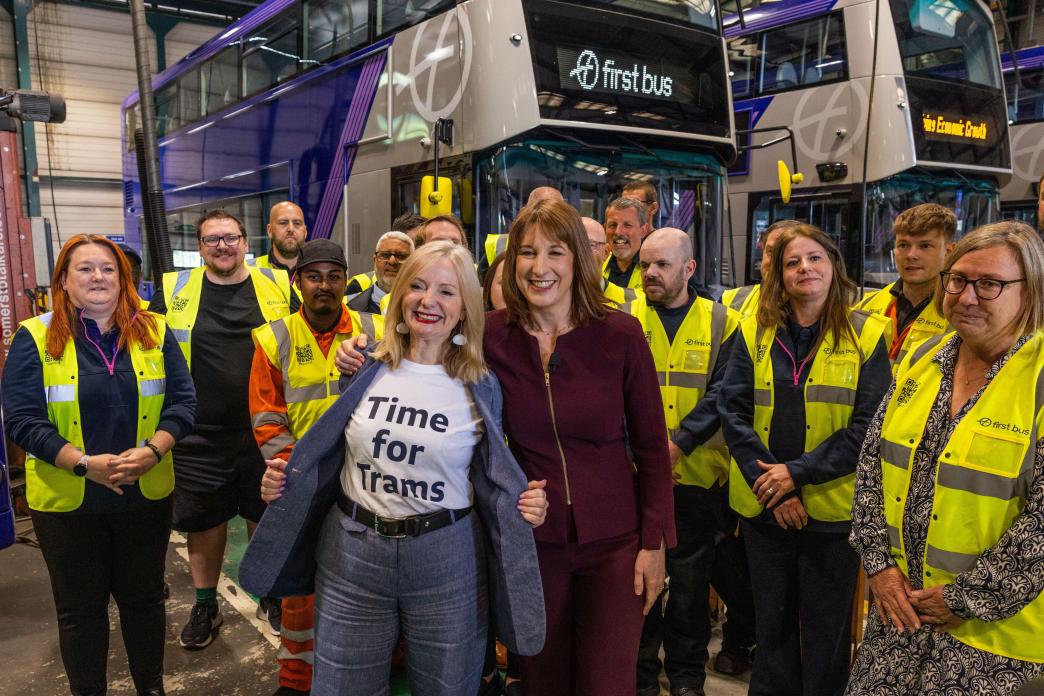
West Yorkshire Mass Transit, a large-scale tram system planned to connect the region’s five core urban centres, will require significant capital investment, with the first phase estimated to cost between £2bn and £2.5bn.2 West Yorkshire Combined Authority, ‘West Yorkshire Mass Transit: progress update and further development funding release’, 25 July 2024, retrieved 18 August 2026, https://westyorkshire.moderngov.co.uk/mgConvert2PDF.aspx?ID=37589 Despite its completion date being pushed back several years due to an independent review, the government’s commitment of £2.1bn through the Transport for City Regions programme has been crucial for providing the first phase of the project with greater certainty and a sense of momentum.3 Department for Transport, ‘Transport for City Regions funding allocations’, 4 June 2025, retrieved 18 August 2026, www.gov.uk/government/publications/transport-for-city-regions-funding-allocations , 4 Cabinet Office, ‘Rewiring the state – Cabinet statement’, GOV.UK, 31 July 2026, retrieved 18 August 2026, www.gov.uk/government/publications/rewiring-the-state-cabinet-statement/rewiring-the-state-cabinet-statement-html , 5 Blackburn R, ‘Delays for long-awaited Leeds mass transit opening, Tracy Brabin reveals’, Yorkshire Evening Post, 17 December 2025, retrieved 18 August 2026, www.yorkshireeveningpost.co.uk/news/politics/leeds-mass-transit-network-opening-delayed-until-late-2030s-5446915
Government should continue to build on the progress they have made with funding simplification to date. The introduction of integrated settlements for established MSAs was an important first step. By bringing multiple funding streams into a single flexible pot with multi-year certainty, integrated settlements have provided eligible mayors with greater freedom to allocate resources and have supported more effective long-term decision making. The government’s recent announcements that mayors will retain a share of business rates and income tax is a welcome further step, moving beyond funding flexibility and towards greater fiscal autonomy.6 Cabinet Office, ‘Rewiring the state – Cabinet statement’, GOV.UK, 31 July 2026, retrieved 18 August 2026, www.gov.uk/government/publications/rewiring-the-state-cabinet-statement/rewiring-the-state-cabinet-statement-html
8. Government can help build the capability and capacity of MSAs through direct funding, secondments and strategic partnerships
To make a success of their powers, and further powers coming down the line, mayors and strategic authorities need strong institutional capacity and delivery capability to coordinate programmes of investment.
The government recognises that the success of devolution rests “on local institutions having the firepower and backing to use their powers effectively” and has committed to building up capacity in MSAs and local authorities.1
Cabinet Office, ‘Rewiring the state – Cabinet statement’, GOV.UK, 31 July 2026, retrieved 18 August 2026, www.gov.uk/government/publications/rewiring-the-state-cabinet-statement/rewiring-the-state-cabinet-statement-html
It can support capacity through long-term funding, secondments, strategic partnerships, sharing best practice and increased capacity funding. In August 2026, the government announced a package of measures to strengthen local capacity, including the secondment of high-performing civil servants into MSAs, with every MSA receiving between five and ten officials for periods of six to nine months, a new civil service fast stream pilot in Yorkshire and the Humber, and a digital devolution programme to build data and digital capability in MSAs.2
Prime Minister’s Office, 10 Downing Street, ‘Whitehall officials to be posted into mayors’ offices as PM
marks first month of No10 North’, GOV.UK, 21 August 2026, retrieved 27 August 2026, www.gov.uk/government/news/whitehall-officials-to-be-posted-into-mayors-offices-as-pm-marks-first-month-of-no10-north
Another way to build MSA capacity is through strategic partnerships with national delivery bodies. Housing projects require significant technical, financial and delivery expertise, which are often in short supply across the sector. To build capacity and support housing growth and regeneration, Homes England has agreed ‘strategic place partnerships’ with 10 MSAs. These partnerships align national housing and regeneration investments with the strategic priorities of elected mayors, providing an opportunity for Homes England to share technical expertise and delivery capacity with MSAs, while also helping Homes England to align housing investment with regional needs and priorities.
For example, WCMA’s ‘strategic place partnership’ with Homes England commits both organisations to work collaboratively to accelerate housebuilding in the region, with a particular focus on remediating “difficult to deliver and stalled brownfield sites”, in line with the region’s ‘brownfield first’ approach.3
West Midlands Combined Authority and Homes England, West Midlands Strategic Place Partnership
Business Plan, 2025, https://governance.wmca.org.uk/documents/s15605/Enc.%202%20for%20West%20Midlands%20Strategic%20Place%20Partnership%20Update.pdf
, 4
West Midlands Combined Authority, ‘Region’s ambitious target to build 215,000 new homes remains on
track’, 12 January 2024, retrieved 30 September 2026, www.wmca.org.uk/news/region-s-ambitious-target-to-build-215-000-new-homes-remains-on-track
Through the partnership, WMCA and Homes England are developing a pipeline of priority housing projects that require joint intervention from both partners.5
West Midlands Combined Authority, ‘Homes England and West Midlands Combined Authority launch
Strategic Place Partnership’, 15 March 2024, retrieved 21 August 2026, www.wmca.org.uk/news/homes-england-and-west-midlands-combined-authority-launch-strategic-place-partnership
MSA partnerships with Homes England also look set to develop further. In October 2026, Liverpool City Region became the first MSA to sign a Place Delivery Agreement with Homes England and the National Housing Bank.6 Homes England, ‘Liverpool City Region and Homes England sign first Place Delivery Agreement’. GOV.UK, 2 October 2026, retrieved 23 October 2026, www.gov.uk/government/news/liverpool-city-region-and-homes-england-sign-first-place-delivery-agreement The agreement establishes a dedicated joint delivery unit bringing together staff from all three organisations and is intended to move the relationship “from collaboration to co-delivery.”7 Homes England, ‘Liverpool City Region and Homes England sign first Place Delivery Agreement’. GOV.UK, 2 October 2026, retrieved 23 October 2026, www.gov.uk/government/news/liverpool-city-region-and-homes-england-sign-first-place-delivery-agreement
Similar arrangements are emerging between MSAs and organisations such as the National Wealth Fund and Great British Railways (GBR), enabling MSAs to access specialist expertise and strengthen their delivery capability, while also helping these national bodies better understand and respond to local priorities. At our DevoLab event on transport connectivity, Richard Crabtree, head of mayoral partnerships at GBR, noted that through the Railways Bill, MSAs are being positioned as natural partners to GBR, with GBR able to support regions with expertise in railway delivery and mayors bringing their place-based knowledge.8
Crabtree R, Presentation at ‘IfG DevoLab #3: How devolution can improve transport connectivity’,
Institute for Government event, 6 November 2025, retrieved 23 October 2026, www.instituteforgovernment.org.uk/event/devolab-3-devolution-transport-connectivity
To build capacity and support housing growth and regeneration, Homes England has agreed ‘strategic place partnerships’ with 10 MSAs.
Conclusion
Devolution is central to the Burnham government’s ambition for good growth. Different places face distinct challenges, but they do not need to start from scratch. Learning what works elsewhere, and why, can help mayors and local leaders make better use of their devolved powers to tackle local priorities and deliver good growth in their places.
Our DevoLab case studies highlight practical lessons in leadership, partnership and delivery that regions can learn from each other. As devolution deepens and extends across England, the IfG DevoLab will continue to bring places together, through events, case studies and analysis, helping regions to share the ideas, evidence and experience that will be essential to turning devolved powers into better outcomes for local people.
- Topic
- Devolution
- Keywords
- Local government Health Welfare
- Series
- IfG DevoLab
- Publisher
- Institute for Government