Working to make government more effective

Explainer

How will the new prison early release scheme work?

The Sentencing Act 2026 has brought in several changes to early release in England and Wales.

A prisoner being released
Once again, a new prime minister faces an imminent prison capacity crisis.

The Sentencing Act 2026, brought in by the Starmer government, makes several changes to how and when prisoners are released to serve the rest of their sentence in the community. The Burnham government made some changes to the rules – so who is being released, and when?

What is happening to prison sentences?

From 1 October 2026, a change to sentencing rules means most adults serving a standard prison sentence will be released earlier than the date originally set. Prisoners convicted of less serious offences, who currently spend 40% or 50% of their sentence in prison, will leave prison after a third of their sentence. A second group, currently released after two thirds of their sentence, will leave after half.

Leaving prison does not end the sentence. The person continues to serve the rest of their sentence in the community ‘on licence’, under conditions set by probation, and can be returned (or ‘recalled’) to prison if those conditions are breached. 27 https://commonslibrary.parliament.uk/research-briefings/cbp-10974/  There are good reasons most people do not spend their entire sentence in prison: if they did, then they would not be subject to any conditions or monitoring by probation after release. 

The practical effect of these changes is to shift more of the sentence from prison into the community. They are being made because prisons are almost full – and expected to run out of space completely by November without intervention. These changes are intended to replace repeated emergency measures used as prisons have approached full capacity.

Who is being released, and when?

The changes apply to adults serving a ‘standard determinate sentence’. This is the most common kind of sentence and is for a fixed number of years or months, set by a judge. Offenders serving these sentences are released automatically (that is, without having to apply to the Parole Board). 28 https://www.gov.uk/government/publications/sentencing-bill-2025/sentencing-bill-progression-measures-factsheet   

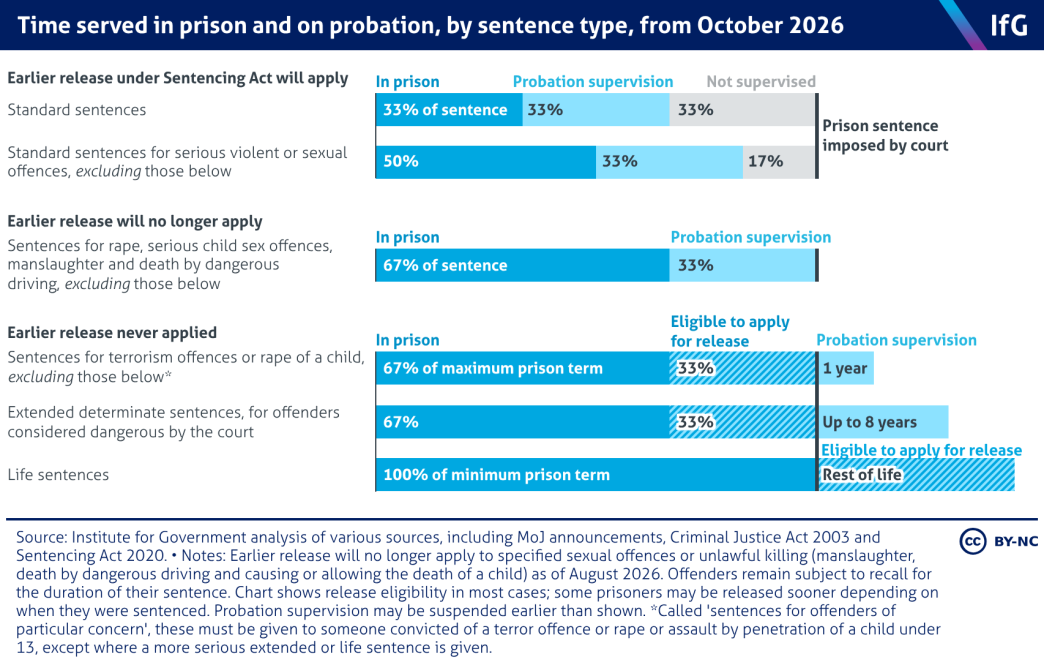
The chart below shows the different kinds of prison sentences and how much of each offenders will now spend in prison. The government calls this new structure the ‘progression model’. On 4 August it excluded rape, serious child sexual and grooming offences, moved the start date back by a month and announced extra supervision and support for victims. 29 https://www.gov.uk/government/news/rape-serious-child-sex-and-grooming-offences-barred-from-sentencing-changes   

Prison early release scheme

Most eligible prisoners will spend a third of the sentence in prison

People who now leave prison after 40% or 50% of their sentence will generally leave after completing a third. On a six-year sentence, that means two years in prison, two years under probation supervision and two further years on licence. In the final two years there will be no routine probation supervision, but conditions still apply and a breach can lead to recall.

For eligible prisoners who currently serve two thirds of a sentence in custody, the earliest release point will move to half. On a six-year sentence, they would spend three years in prison. They would then be supervised for the next third of the total sentence – two years in this example – and spend the final year on licence without routine supervision. 

The government intends probation supervision to be more ‘intensive’ than previously under this new model – with a presumption of electronic tagging, as well as faster access to monitoring data for probation, exclusion-zone alerts, random drug testing and powers to restrict driving or attendance at pubs and events. 30 https://www.gov.uk/government/news/rape-serious-child-sex-and-grooming-offences-barred-from-sentencing-changes  The conditions used will depend on the individual case.

The most serious sentence types, and specified sexual offences, are excluded

The model does not apply to life sentences or extended determinate sentences, or to other cases in which release is controlled by the Parole Board because the court has assessed the offender as dangerous or of particular concern. People sentenced as children are also excluded. Prisoners convicted of rape, serious child sexual offences and grooming will keep their existing release dates.

Eligible prisoners will be released automatically, unless they have extra days added to their sentences for breaking the rules

Although the policy was originally described as an ‘earned progression’ model, eligible prisoners will not have to prove that they have been rehabilitated or behaved well in prison but, as now, will automatically leave prison at the set date, unless an independent adjudicator adds days for serious breaches of prison rules. This is better understood as release that can be lost through misconduct than as a reward for rehabilitation. 

While the government may have wanted to implement a system of ‘earned’ release, the situation in prisons is so bad that a genuinely earned system would be unfair and unworkable. Prisoners have very limited access to employment and education to earn their release, and capacity in prisons is so limited that the vast majority of eligible prisoners must be released early to free enough prison places. 34 https://www.instituteforgovernment.org.uk/sites/default/files/2025-10/performance-tracker-2025-criminal-justice-system.pdf   

Implementation starts in October and will be phased

The new rules are due to start on 1 October 2026. Existing prisoners will move on to them in tranches rather than being released on a single day. The size of each tranche will depend on the prison population and the mix of sentences at the time. 35 https://www.gov.uk/government/news/rape-serious-child-sex-and-grooming-offences-barred-from-sentencing-changes  

The Burnham government has narrowed the scheme 

Shortly after becoming prime minister, Andy Burnham announced a ‘pause’ on implementing the new release rules then on 4 August confirmed that people serving sentences for rape, serious child sexual and grooming offences would no longer be eligible. This is expected to mean about 1,000 fewer people are released early, with around 5,000 people now be affected over the first 10 months, rather than about 6,000 previously expected. 36 https://www.theguardian.com/society/2026/aug/04/fewer-prisoners-early-release-burnham-tightens-rules    

The government has also announced £10 million for victim support, a national helpline and greater involvement for victims in setting licence conditions.

Why are early releases needed?

The immediate reason is adult men’s prisons are operating at around 97% capacity – only slightly down from its peak of 99% in the summer of 2024 – while demand is expected to rise as more cases reach court and defendants spend longer on remand (in custody awaiting trial). Though even with the reforms, and the government’s prison-building programme, demand may exceed capacity until at least late 2027; it can take an average of seven years to build and open a new prison, while projects are often delayed. And with almost a quarter of prisoners already in crowded accommodation, with the additional risks to staff and prisoner safety that brings, simply packing prisoners in more tightly is not an option either.

This is a long-running problem. The prison population has doubled over the past 30 years despite falling crime. This has been largely due to sentences getting longer: the average custodial sentence imposed at the Crown Court was more than 25% longer in 2023 than in 2012. 41 https://www.instituteforgovernment.org.uk/publication/performance-tracker-2025/criminal-justice/prisons  The number of people recalled to prison after release, and those on remand, have also increased dramatically in recent years. 42 https://www.instituteforgovernment.org.uk/publication/performance-tracker-2025/criminal-justice/prisons  

The Independent Sentencing Review estimated that the 2023 Act would reduce the projected population by around 9,800 in 2028 compared with continuing with existing arrangements. 43 https://assets.publishing.service.gov.uk/media/682d8d995ba51be7c0f45371/independent-sentencing-review-report-part_2.pdf   

What would happen if prison spaces ran out entirely?

A complete lack of prison spaces would be highly disruptive and the pressure would spread across the criminal justice system. In 2023 and 2024, police cells were used as temporary prison accommodation and some defendants were released on bail rather than held in custody. 44 https://www.instituteforgovernment.org.uk/publication/crisis-prisons  In a severe shortage, the police and courts would stop being able to arrest and imprison people who commit offences now.

The crisis in prisons

How to start fixing the problems at the heart of the criminal justice system.

Read report
Wandsworth
Political party
Labour
Administration
Burnham government
Public figures
Andy Burnham
Publisher
Institute for Government

Related content