What did we learn from the CBI conference speeches?
Louise Haigh is clearer about her attitude to markets than Kemi Badenoch.
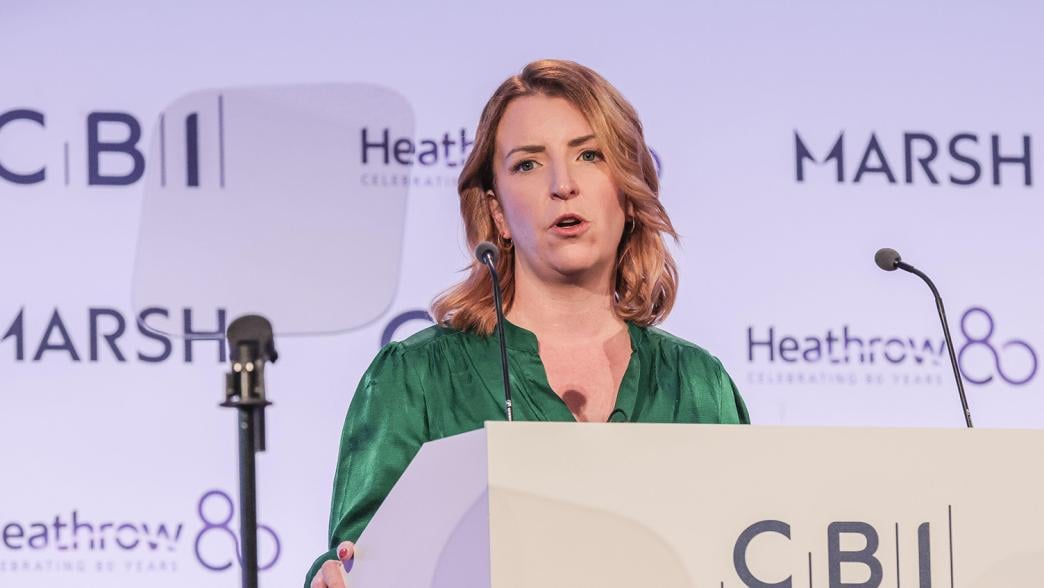
This year’s CBI conference featured keynotes from Louise Haigh, first secretary of state in the Burnham government, and the Conservative leader Kemi Badenoch. Perhaps surprisingly, Giles Wilkes says it was the Labour speaker who articulated a clearer attitude towards markets than the Conservative.
“This is not about whether markets work. They do”. Uttered by first secretary of state Louise Haigh to the CBI Annual Conference, these words would have been uncontroversial to most of those listening. For the past few hundred years – a period of world-changing growth – the essentials of life have been mostly provided to British consumers by markets. That is not going to change.
Haigh cleared up the Labour position on public ownership somewhat
Public ownership is always the exception. We do not expect our groceries, car, phone, cinema ticket, newspaper or shirt to be provided by the state. Even the parts that are publicly financed rely on private ingenuity to work: the state may own railway concessions and pay for the NHS, but it is profit-maximising businesses that discover new drugs, build train engines and so forth.
Perhaps it is not ideal that Haigh felt the need to spell this out – a reflection of the confusion wrought by Andy Burnham’s repeated praise for public ownership and disdain for what he calls 40 years of neo-liberalism. But I doubt most of the audience were ever worried about either politician coming for their assets. There are elements of the Labour movement that lament how markets provide the basics of life and see profit as pure extraction, always going to someone else. But these ideas rarely proceed from lip-service to legislation.
Haigh’s speech was instead about a far narrower set of markets where the privatised model has come under fire: certain essential services that tend towards monopoly and were often publicly owned for a good chunk of the 20th century. The chargesheet is familiar. Staggering along in a deluded state of would-be competition, they adopt the worst features of free market capitalism, the profit-extraction, while under-delivering on the best, the provision of choice to the consumer. As she said, “where competition exists, it should be left to thrive”. The problem is that the conditions for thriving are not always in place.
But she did take aim at ‘essential services’ like water and energy
To cut to the specifics: Louise Haigh means water and energy (particularly networks), and little beyond that. This is where consumer unhappiness is most acute, where regulation has mushroomed – and where England’s fully privatised approach is a genuine international outlier. Community- or government-owned energy is quite common in the US, and European states often own not only their own utilities, but a fair chunk of ours too.
It is where there is a decent case to be made for state ownership actually to improve certainty for customers – for while nobody should assume that public sector managers are smarter, their behaviour may be more predictable than the profit-chasing sort, operating in a monopoly and spending most of their time second-guessing the next move of the regulator. Years-long queues for grid connections and new reservoirs demonstrate why reform is needed.
There is the outline of a case for more public control or ownership here, and nothing to object to with principles like affordability, investability and accountability. It is refreshing to hear a Labour politician argue that users and not producers should be the priority. Haigh was also candid about the state’s role in creating friction and uncertainty, promising to cut down the number of arm’s-length bodies currently complicating the landscape, and tiresome procurement rules. Time is a tax, as she repeatedly acknowledged.
The limits of voicing principles
Nevertheless, an elucidation of principles can only go a certain way towards reassuring a business audience. More political control swaps in one form of uncertainty for another. When Haigh calls for “good actors” to be backed, and “fair returns” for all, she sets in motion an argument for what is good and fair. Values like clarity, certainty, consistency and fairness do not align perfectly, and into the gaps will rush lobbyists and campaigners. There is a reason politicians in the past have delegated questions of a fair return on capital to technocrats, which they sometimes need to experience to appreciate.
At the least, though, I would argue that Haigh has helped to clear up somewhat the question of what Labour thinks about markets – they are a nice idea, if they work.
Kemi Badenoch showed less clarity on the subject
Curiously the next political speaker, Conservative leader Kemi Badenoch, was marginally less clear on the subject. This reflected the more ambiguous attitude to business that the Conservatives have shown ever since the great falling out over Brexit. On the one hand, Badenoch had to show that she fully understands why lower trading barriers and bigger markets are a good thing – on the other, she is choosing to maintain her party’s position against any renegotiation of a Brexit deal that undermines these principles, that the British public largely believes to be a failure, and few businesses see the advantage of.
Badenoch returned to her attack-mode comfort zone
This tension was a constant theme throughout her appearance, which Badenoch attempted to soften through regular jibes at some of the government’s more business-unfriendly measures, like the rise in employer NICs and higher national minimum wage. Another device was to point at various bad-news stories – the closure of Denby Pottery, the departure of Compass Group from the UK stock market – and ask, with a dollop of derision, what these have to do with membership of the EU.
An even less plausible line was to explain to business that a mere 8% of their number actually export to Europe. But these are the biggest and most productivity-driving companies, the ones most exposed to global competition, and it felt rather unconservative to suggest their small number rendered their problems unimportant.
The Conservatives’ formula of lower energy costs, less regulation, light taxes and flexible labour markets ought to please business, but it is one they would have heard constantly over the 14 years to 2024. Badenoch’s answer to the obvious audience question – why wasn’t this all done before, then? – was both weak and overconfident: “well, it would have had I been in charge”.
This kind of naivety about the real political difficulties of doing the right thing is acceptable for an opposition party a few years away from office, but “sheer political will” is a worse answer than none once in government.
A return to mercantilism?
What is more confusing is the flavour of anti-market mercantilism that has begun to infect Conservative rhetoric in recent days. One of Badenoch’s lines of attack against moving closer to the EU was the triumphant declaration that it is not just the UK that sells to the EU, but the EU sells back to us – and more! The idea that running a deficit is reason to downplay the advantage of trade is embarrassing outside of the Trump White House, particularly on the 250th anniversary of Adam Smith’s Wealth of Nations. This follows a foray into the “Lump of Labour” Fallacy at PMQs last week, when Badenoch challenged the prime minister to explain where the jobs for 100,000 EU migrants might come from. That is Old Labour thinking, to be kind.
On business, Labour and the Conservatives are not so far apart
There is much in common between Labour and Conservative business policies. Both are frustrated by a clogged-up state and high energy prices, and both appear to realise that business taxes have risen about as far as they should or can. They might even each agree on how elements of utility regulation have gone wrong. Business has recently faced a choice between the Scylla of an anti-market Labour Party, and the Charybdis of the truculently anti-Europe Conservatives. At present, it is Labour that appears closest to proving the more attractive.
- Keywords
- Public spending Internal market Business Trade
- Administration
- Burnham government
- Public figures
- Louise Haigh Kemi Badenoch
- Publisher
- Institute for Government