Working to make government more effective

Comment

Seven things we learned from Keir Starmer’s first reshuffle

What does the prime minster’s first major reshuffle tell us about his new-look government?

Prime minister Sir Keir Starmer on the frontbench in the House of Commons after his reshuffle. Next to him on his right is David Lammy, who has replaced Angela Rayner as deputy PM.
Prime minister Keir Starmer with his new frontbench following the September 2025 reshuffle. Photo credit: House of Commons.

Angela Rayner’s resignation last week kicked off a far bigger reshuffle than many were expecting. In the end, half of the cabinet changed jobs or left government, with rafts of junior ministers also being shuffled in and out. Our live blog has been keeping track of all the moves and its authors give their seven key takeaways from the week’s action.

1. This was not the small reshuffle many expected, with half of the cabinet changing jobs

At the start of September, No.10 sources were briefing there would be a small reshuffle in the lower ministerial ranks. And it seemed that was the case as, on the first day back from summer recess, Keir Starmer moved some No.10 advisers around and brought Darren Jones into his office in the newly created role of ‘chief secretary to the prime minister’. However, Angela Rayner’s resignation – following an independent investigation into the deputy prime minister’s tax affairs – prompted a full-scale reshuffle that saw half of the cabinet in new jobs by the end of the week (of 27 attending cabinet, 12 moved jobs three of those left the cabinet and two left government altogether).
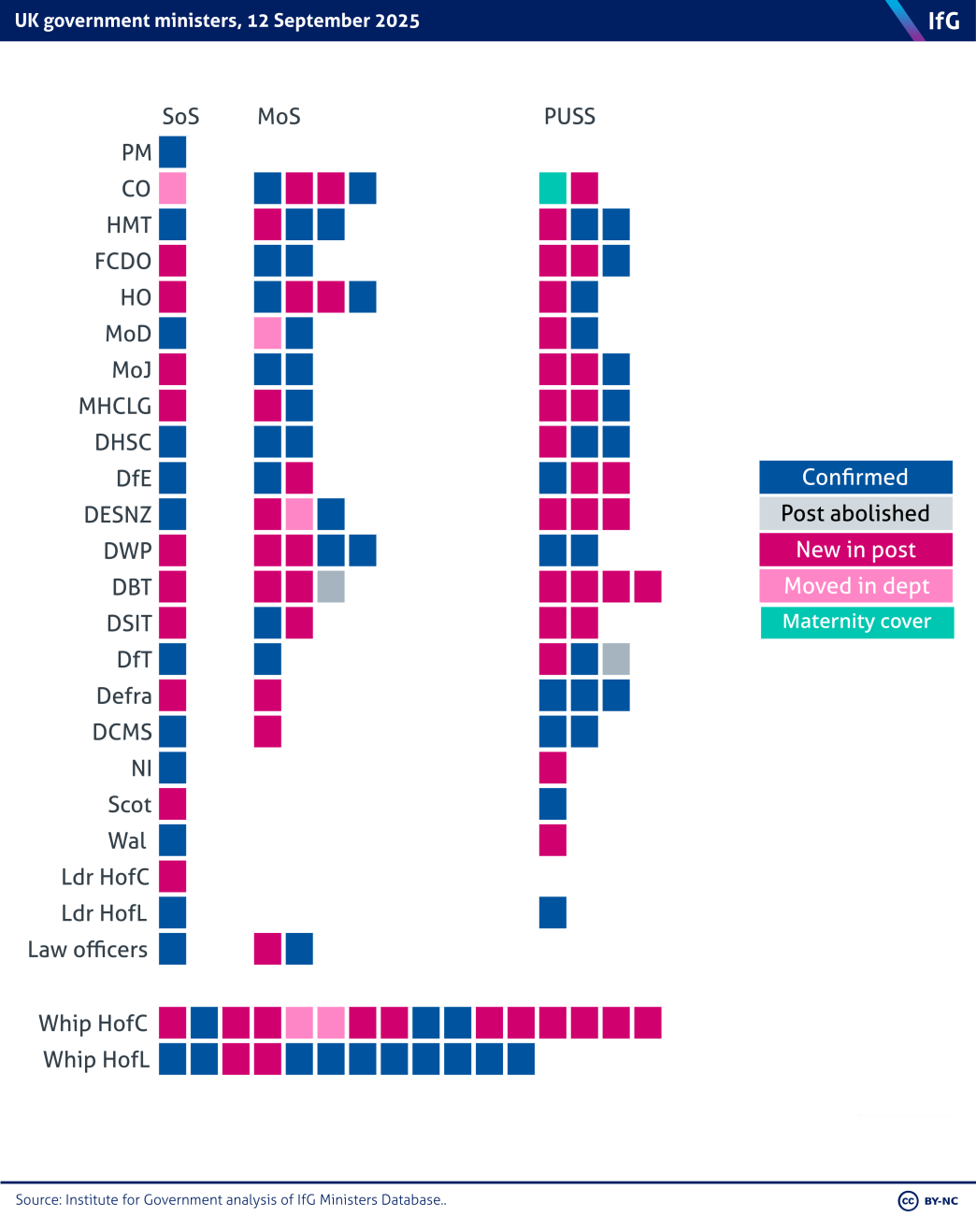
A waffle chart from the Institute for Government to show the moves in the cabinet during Keir Starmer's first reshuffle.

Starmer had said of his earlier No.10 ‘reset’ that the personnel changes were designed to support a focus on delivery. And that may have carried more water at the time, but by ultimately moving so many ministers he has unavoidably introduced uncertainty and disruption into government as they get up to speed with their new portfolios and, in many cases, with their first government role. Some changes could be particularly disruptive, including putting in a completely new team at the business department and moving Shabana Mahmood out of her role at the justice department in the middle of some of the largest reforms to the criminal justice system for a generation. Mahmood’s move to the Home Office, and Yvette Cooper’s subsequent move to the Foreign Office, also means two of the four great offices of state have new leaders.

2. Starmer’s reshuffle saw the 2024 intake become the largest group in government

Following the 2024 general election some 231 of Labour’s 411 MPs were newly elected to parliament. In Starmer’s first government just before the reshuffle, just 10 of 89 ministers in the Commons were newly elected in July 2024. After the reshuffle, that number has risen to 33 (of 93), making the 2024 intake the largest group in government. 

These new ministers have spent their first year as MPs getting to grips with parliament and cutting their teeth in a range of different roles. Ten have spent the year gaining useful parliamentary experience, serving on at least one select committee; Louise Sandher-Jones, to her credit, has paid her dues serving on five bill committees. Another 16 have spent some time as parliamentary private secretaries. While sometimes derided as “bag holders”, or a way for the government to increase the payroll vote for free, these roles have clearly served as successful stepping-stones for ambitious new MPs.

Disloyalty has also been noted: none of the 126 Labour MPs who threatened rebellion to the welfare bill back in June have been given a ministerial role. And though concessions from the government reduced the number of actual rebels to just 47, with so many MPs to choose from it looks like Keir Starmer has taken note. This leaves a mixture of Labour MPs on the backbenches – including Liam Byrne, Emily Thornberry and Debbie Abrahams, who are forging careers in the committee system – next to new MPs that have yet to make an impression or who have but in the wrong way. It will be interesting to see how Starmer handles the government’s relationship with its backbenchers. 

September 2025 reshuffle: New-look government gets down to business

Who's who in Keir Starmer's cabinet

Read the live blog
David Lammy, the new deputy prime minister, enters No.10

3. Three of the great offices of state are now run by women, though overall gender balance shifted back towards men

Prime ministers balance various considerations when forming a cabinet: experience, loyalty, expertise and representation among them. Starmer’s first cabinet, appointed last year, was the most gender balanced in history. Women held key positions, with Rachel Reeves as the first woman chancellor, Angela Rayner the first woman deputy prime minister and Yvette Cooper at the Home Office. Excluding minsters attending cabinet, Starmer’s full cabinet on returning in September was evenly split with 11 men and 11 women.
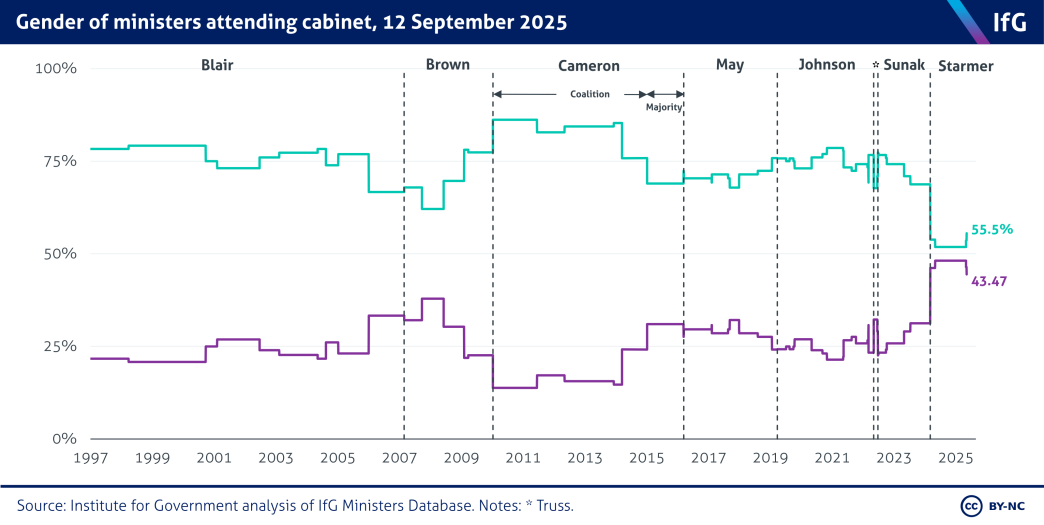
A line chart from the Institute for Government to show the gender balance of cabinets under Tony Blair, Gordon Brown, David Cameron, Theresa May, Boris Johnson, Liz Truss, and Rishi Sunak.

The latest reshuffle has shifted the balance slightly towards men, although women continue to occupy key positions. For the first time ever, three of the great offices of state are held by women: Cooper moved to the Foreign Office as Shabana Mahmood assumed her role at the Home Office; Reeves remained at the Treasury. Among junior ministers the proportion of women has fallen, but among parliamentary under secretaries of state women still make up a majority. Across government as a whole, despite a fall in the proportion of women, representation remains will above the 27% seen at the end of the Sunak administration. 
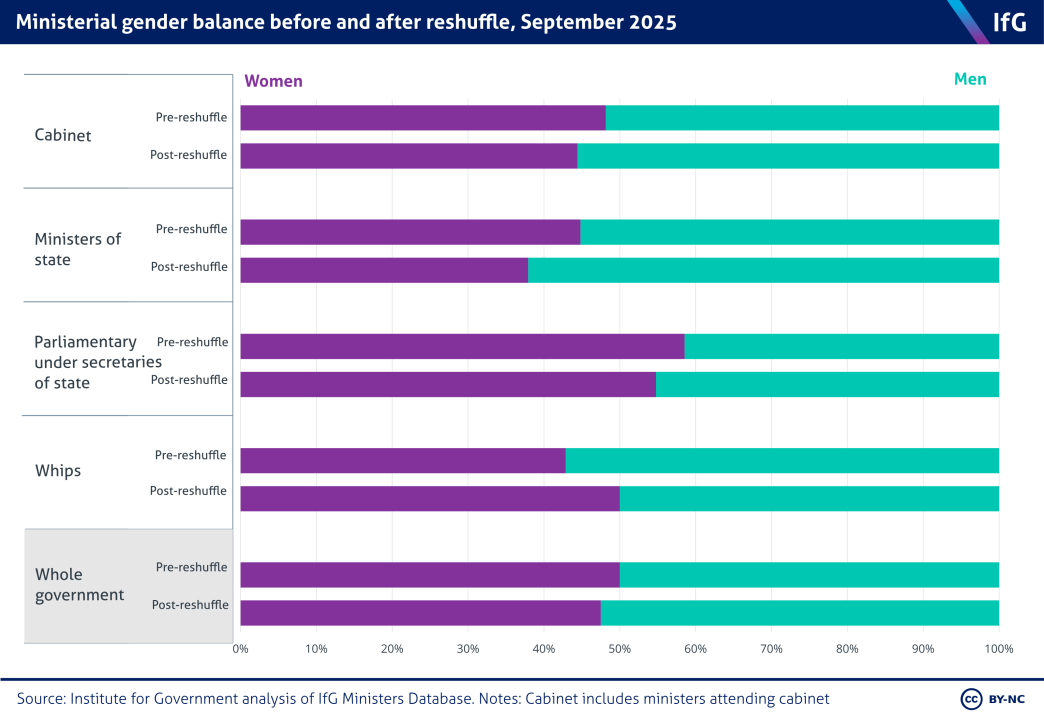
A bar chart from the Institute for Government to show the gender balance of the Starmer cabinet before and after the September 2025 reshuffle.

4. The North of England continues to be well represented

The mayor of Greater Manchester, Andy Burnham, expressed concern about the regional balance of the cabinet following the reshuffle. And it is the case that two of the highest profile departures were Greater Manchester MPs Angela Rayner (Ashton-under-Lyne) and Lucy Powell (Manchester Central). In total, five of those ousted from government represent seats in Greater Manchester. However, the North of England as a region remains very well represented in cabinet, with 10 of 24 ministers attending from northern constituencies.

Across the rest of the UK there are four cabinet ministers from London, including the prime minister himself (Holborn and St Pancras), with four more from the South: Darren Jones (Bristol North West), Heidi Alexander (Swindon South), Peter Kyle (Hove and Portslade) and Emma Reynolds (Wycombe). There are only two cabinet ministers from the devolved nations, the secretaries of state for Scotland and Wales, Douglass Alexander and Jo Stevens respectively.

The full government has a wide geographic spread too: there are 12 ministers from Wales, nine from Scotland, 14 from London and 26 from constituencies across the North West, North East and Yorkshire.  

5. The government still has a mountain to climb with its legislative programme

With everyone in place, attention shifts back to the business of government. And there is much business to do. The government recently extended the parliamentary session into next spring to give itself some more time to pass its key legislation – but with such a major reshuffle the timing starts to look tight again.

Alan Campbell has taken over from Lucy Powell as leader of the Commons. He is charged with smoothing the passage of the government’s wider legislative programme and avoiding further hurdles such as the rebellion on the welfare bill earlier this year. He is an experienced parliamentarian, but can only do so much to steady the ship. Ministers themselves are responsible for shepherding their bills through parliament.

Sixteen bills from the King’s Speech are currently underway, and most sponsoring departments now have new leadership. In some cases, both the secretary of state and the bill minister have changed. For legislation already well underway the challenge is getting fresh ministers up to speed quickly on what they will have to deliver, while for those at an earlier stage – such as the English devolution bill – the bigger question is whether the government will maintain its original direction and momentum.

Every department also relies on at least one minister in the Lords. These peers – usually junior ministers – have the responsibility for guiding the legislation through the Lords and leading debates. They often juggle wider portfolios than their Commons counterparts and have less support. This latest reshuffle has left the Lords ministers stretched. Four have gone, with just three new ministers being appointed. One of these new appointees, Liz Lloyd, who until recently was Keir Starmer’s director of policy delivery and innovation has three roles: a minister in DSIT, DBT and a Lords whip. Two other existing Lords ministers have been given additional portfolios. 

The three new Lords ministers, Baroness Levitt who joined the upper house in January, and soon to be Lord Stockwood and Liz Lloyd all face the steep learning curve of adjusting to the workings of Westminster – or as former trade minister Lord Green once put it, navigating “a strange part of that strange animal” – as well as getting to grips with Whitehall and their new portfolios. This is indeed a tricky role, but with so many complicated pieces of legislation heading their way, one they will need to get to grips with fast.

How will Keir Starmer’s No.10 reset work?

An IfG expert briefing explored the prime minister's reshuffle of his No.10 team.

Watch the event
Keir Starmer leaving No.10

6. Is Starmer’s new government still ‘mission led’?

Labour’s five missions were the party’s flagship policy goals before getting into government. Although, amid the subsequent announcements of three ‘foundations’, six ‘milestones’ and six ‘first steps’ that variously accompany or underpin the missions, observers could be forgiven for any uncertainty over where the missions stand.

This reshuffle has raised more questions than it has answered on missions. Starmer’s initial moves last Monday – his No.10 reset – focussed on the centre of government and included dissolving the Mission Delivery Unit in the Cabinet Office and moving some of the team to report to the new chief secretary to the prime minister, Darren Jones. Before the implications of this move could be revealed, Jones was additionally promoted to chancellor of the Duchy of Lancaster, replacing Pat McFadden.

McFadden had in effect been mission control. He chaired the five mission boards and led on co-ordination from the centre while driving civil service reforms to help make government more “mission-driven”. He was supported in this by Georgia Gould, who had previously championed missions as leader of Camden Council. But she too has been moved, to DfE. It is unclear who, if anyone, will be picking up her role, and whether Darren Jones will prioritise the “complete rewiring of the state” alongside driving delivery for the government. 

At the individual mission level, there is more stability. Four of the mission leads have kept their jobs and the only change at the top (albeit a big one) has been Shabana Mahmood taking over the safer streets mission from Yvette Cooper as the new home secretary. Starmer will be hoping her previous role at MoJ, which was also involved in this mission, will stand her in good stead.

7. Starmer has continued to use joint ministers to reach across departments

The government has added one extra minister who holds roles across two departments – now seven compared with to six before the reshuffle. Those newly appointed to joint roles are: 

  • Lord Vallance, who has picked up responsibilities at DESNZ in addition to his role at the science department
  • Baroness Smith, who becomes a joint minister between DWP and  DfE, with the move of skills policy to DWP
  • Dan Jarvis, who takes on a role in the Cabinet Office alongside his role in the Home Office
  • Liz Lloyd, who will join the House of Lords to become a joint minister between DSIT and DBT
  • Chris McDonald, who joins the government as a minister in DESNZ and DBT. 4 Michael Shanks was originally given additional responsibilities in DBT while keeping his role in DESNZ but it was later announced that he would only hold the role at DESNZ.

Presumably the prime minister’s idea behind appointing joint ministers is to ensure that departments work better together, rather than falling into their traditional siloes. Linking the energy department to both the business and science departments should, for instance, help ensure the viewpoints of business and researchers are heard when the government makes decisions on energy and climate issues. And where the prime minister moved joint ministers on to new roles, he replaced them in their joint role – Ian Murray, for example, moved from running the Scotland Office to taking over Chris Bryant’s old role across DCMS and DSIT – ensuring at least some consistency.

Topic
Ministers
Political party
Labour
Administration
Starmer government
Department
Number 10
Publisher
Institute for Government

Related content