Irish reunification
What is a border poll? What would happen if Northern Ireland and the Republic of Ireland voted in favour of reunification?
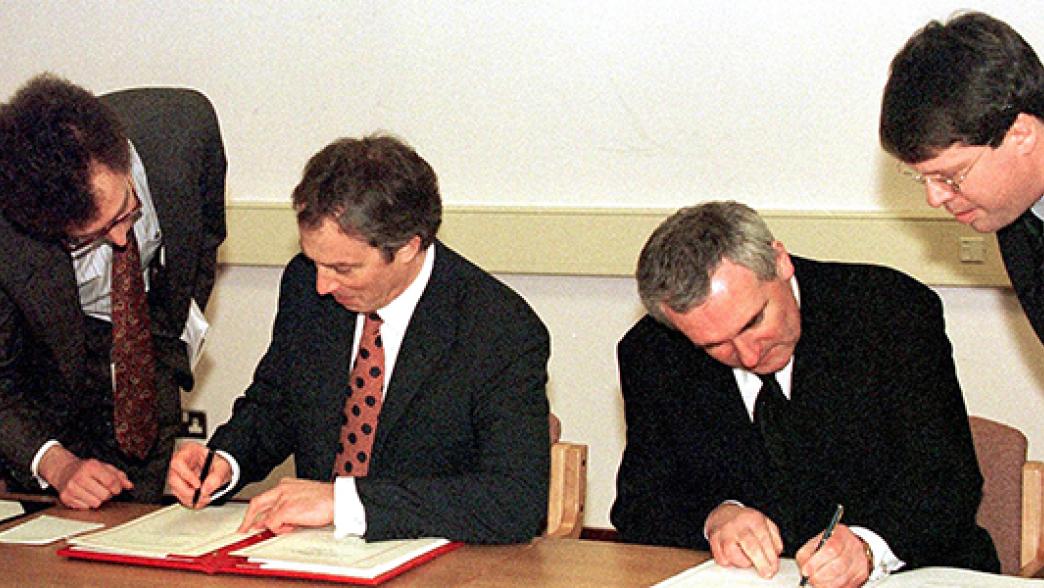
The Good Friday Agreement (also known as the Belfast Agreement) recognises the right of the people of the island of Ireland to bring about a united Ireland, subject to the consent of both parts. Therefore, in order for Irish reunification to take place, border polls must be held in Northern Ireland and the Republic of Ireland.
What is a border poll?
A border poll is the term for a referendum on Irish reunification. The first border poll took place in 1973, when voters were asked whether they wanted Northern Ireland to remain part of the UK or be joined with the Republic of Ireland. 99% voted in favour of remaining in the UK. However, the poll was boycotted by most of the nationalist community; turnout was only 59%.
The Good Friday Agreement states that consent for a united Ireland must be “freely and concurrently given” in both the North and the South of the island of Ireland.1 The Belfast Agreement, available at assets.publishing.service.gov.uk/government/uploads/system/uploads/attachment_data/file/1034123/The_Belfast_Agreement_An_Agreement_Reached_at_the_Multi-Party_Talks_on_Northern_Ireland.pdf#page=3 This is widely interpreted to mean that future border polls must be held in Northern Ireland and the Republic of Ireland at the same time.
How would a border poll be held in Northern Ireland?
As part of the Good Friday Agreement, an explicit provision for holding a Northern Ireland border poll was made in UK law. The Northern Ireland Act 1998 states that “if at any time it appears likely to him that a majority of those voting would express a wish that Northern Ireland should cease to be part of the United Kingdom and form part of a united Ireland”, the Secretary of State shall make an Order in Council enabling a border poll.2 www.legislation.gov.uk/ukpga/1998/47/contents
It is not clear exactly what would satisfy this requirement. The Constitution Unit suggests that a consistent majority in opinion polls, a Catholic majority in a census, a nationalist majority in the Northern Ireland Assembly, or a vote by a majority in the Assembly could all be considered evidence of majority support for a united Ireland.3 www.ucl.ac.uk/constitution-unit/sites/constitution-unit/files/185_a_northern_ireland_border_poll.pdf However, the Secretary of State must ultimately decide whether the condition has been met.
The Order in Council must specify the details of the poll, including the date, franchise, the question and “any other provision about the poll which the Secretary of State thinks expedient”. The referendum would be regulated under the UK’s Political Parties, Election and Referendums Act 2000 and overseen by the UK Electoral Commission, which would have a statutory duty to assess the “intelligibility” of the referendum question.4 www.legislation.gov.uk/ukpga/2000/41/contents Once the Representation of the People Bill passes through Parliament and receives Royal Assent, sixteen- and seventeen-year-olds will also be eligible to vote.
The legislation stipulates that a secretary of state may not make provision for a border poll within seven years of a previous poll.
How would a border poll be held in the Republic of Ireland?
The Good Friday Agreement does not specify a parallel mechanism for triggering a border poll in the Republic of Ireland. The country’s constitution does however contain a provision for two types of referendum: a constitutional referendum and an ordinary referendum.5 assets.gov.ie/6523/5d90822b41e94532a63d955ca76fdc72.pdf
A constitutional referendum must be held on any amendment to the constitution, which must first be passed through both chambers of the Oireachtas – Irish Parliament.
An ordinary referendum can be held on a proposed bill if at least half of the members of the upper house and a third of the members of the lower house of Parliament object to the proposal, and the President refuses to sign the bill on this basis.
However, neither of these procedures seem appropriate for a border poll as the Good Friday Agreement implies that it would be held on the principle of reunification, before negotiations take place and a concrete proposal can be put in legislation. It is therefore not entirely clear how a referendum in the Republic of Ireland would be held at this stage.
This is further complicated by the fact that once negotiations for a united Ireland are concluded, implementing the outcome of the negotiations would require a constitutional amendment in the Republic, and therefore another referendum.
Therefore, either two referendums would need to be held: the first an extra-constitutional referendum on the principle of reunification and the second to approve a constitutional amendment. This begs the question of whether two referendums should also be held in the North.
Alternatively, the border polls in Northern Ireland and the Republic of Ireland would need to take place at different times, but this is potentially contrary to the Good Friday Agreement.
What would happen if Northern Ireland and the Republic of Ireland voted in favour of reunification?
If both Northern Ireland and the Republic of Ireland voted in favour of reunification, the Good Friday Agreement states that it “will be a binding obligation on both governments to introduce and support in their respective parliaments legislation to give effect to that wish”.
Before this can be done, the exact terms of reunification would need to be worked out. One important question would be whether separate arrangements were retained for Northern Ireland, or whether the six counties of Northern Ireland would be fully integrated into the unitary Irish state.
In August 2017, a joint committee of the Irish Parliament suggested that the Northern Ireland Assembly could continue as a devolved regional parliament within Ireland.6 webarchive.oireachtas.ie/parliament/media/committees/implementationofthegoodfridayagreement/jcigfa2016/brexit-and-the-future-of-ireland.pdf
It also suggested that the intergovernmental British-Irish Council could continue, allowing for an ongoing British role in the matters of Northern Ireland to reassure the unionist community.
These recommendations had cross-party support in the committee and built on proposals previously made by the nationalist Social Democratic and Labour Party (SDLP) in Northern Ireland.
Who supports a border poll?
The nationalist party, Sinn Féin, which won the most seats in the 2022 Northern Ireland Assembly elections, supports holding a border poll. In February 2024, Sinn Fein’s Michelle O’Neill, the First Minister of Northern Ireland and the first nationalist to hold this position, said she believes a border poll will be carried out in this decade.7 www.irishnews.com/news/northern-ireland/oneill-expects-poll-on-irish-unity-to-take-place-in-next-decade-EG7MZQKTZVB3PBNYSIAN3P3EZA/
The other major nationalist party, the SDLP, has warned against setting an “arbitrary deadline” for a vote before plans on how a united Ireland would work are in place. In October 2025, SDLP leader Claire Hanna called on the British and Irish government to “begin planning for the future.”8 BBC News, SDLP wants Irish ministry to prepare for border poll, https://www.bbc.co.uk/news/articles/c8xr2engrxko
The unionist parties, including the Democratic Unionist Party (DUP) and Ulster Unionist Party (UUP), oppose a vote on reunification. The 2022 DUP manifesto said a border poll would mean “months and years of arguing and fighting, rather than fixing our health service and […] growing our economy."9 Democratic Unionist Party, Assembly Election Manifesto 2022, mydup.com/policies/assembly-election-manifesto-2022. In July 2026, DUP leader Gavin Robinson insisted there is no “increasing pressure for a border poll”.10 Independent, Irish border poll ‘not top of my list of priorities,’ says Bryant, https://www.independent.co.uk/news/uk/home-news/chris-bryant-chris-northern-ireland-irish-andy-burnham-b3025397.html
In 2024, Naomi Long, leader of the cross-community Alliance Party, said that the party could treat the border poll as a matter of conscience, and in October 2025, she called for more clarity from the Secretary of State on “what the conditions for a border poll would be.”11 BBC News, Clarity needed on border poll, says Naomi Long, https://www.bbc.co.uk/news/articles/c5y9pyj9w8wo
In Westminster, the UK Government’s position is that the conditions for a referendum have not been met.12 www.bbc.co.uk/news/uk-northern-ireland-44126499 UK Prime Minister Andy Burnham said that in his first meetings with politicians in Northern Ireland discussions about a border poll will be “off the table.”13 BBC News, Burnham says united Ireland pol is ‘off the table’ during first NI visit, Andy Burnham says a united Ireland poll is 'off the table' during first NI visit - BBC News The Secretary of State for Northern Ireland, Sir Chris Bryant, has also said that it is “not top of my list of priorities."14 Independent, Irish border poll ‘not top of my list of priorities,’ says Bryant, https://www.independent.co.uk/news/uk/home-news/chris-bryant-chris-northern-ireland-irish-andy-burnham-b3025397.html
In September 2026, following the Scottish Parliament and Senedd 2026 elections, which saw the election of nationalist First Ministers in Scotland and Wales, the leaders of the SNP, Plaid Cymru and Sinn Féin signed a joint declaration which stated: “Our nations have the right to self-determination. No Westminster government has the right to block democracy or undermine the principle that our people will decide their own future.”15 The Herald, Read in full: SNP, Plaid Cymru, Sin Fein sign pact, https://www.heraldscotland.com/news/26547642.read-full-snp-plaid-cymru-sinn-f-sign-pact/
In response, the DUP Deputy First Minister, Emma Little-Pengelly, accused Michelle O’Neill of misrepresenting the position of First Minister, a role which under the terms of the Good Friday Agreement must be exercised jointly with the consent of the Deputy First Minister.
The Irish government is made up of a coalition between Fianna Fáil and Fine Gael. The leaders of both parties have previously stated that Irish reunification is not a priority. The Prime Minister Micheál Martin, leader of Fianna Fáil, said in November 2024 that he disagreed with Sinn Fein on the need to prioritise Irish unity.16 David Blevins, Fianna Fail doubles down on refusal to form coalition with Sinn Fein, Sky news, 26 November 2024, https://news.sky.com/story/fianna-fail-doubles-down-on-refusal-to-form-coalition-with-sinn-fein-13261019 However, in June 2026 Fine Gael leader Simon Harris announced work to create a “blueprint” for what a unified Ireland could mean in “practical terms, politically, economically and societally.”17 The Irish Times, Simon Harris announces ‘blueprint’ for Irish unity, Simon Harris announces ‘blueprint’ for Irish unity – The Irish Times In October 2026, Micheál Martin announced he was preparing proposals to set up an independent government body to look at three “baseline scenarios”, including unification, continuation of the status quo, and a version of unification which allows Northern Ireland to retain its devolved government.18 The Irish Times, ‘Lots of deep thought has to go into this’: Taoiseach steps up research on Irish unity, https://www.irishtimes.com/politics/2026/10/30/lots-of-deep-thought-has-to-go-into-this-taoiseach-steps-up-research-on-irish-unity/
What do the Northern Ireland public think?
Support for continuing Northern Ireland’s current constitutional position of devolved government within the United Kingdom has fallen steadily over the past 10 years from around 55% to around 32%. Support for reunification has risen in recent years and is now the preferred option of 33% of voters as of 2025.
As of 2025, roughly 34% of Northern Irish adults see themselves as “neither” unionist nor nationalist, up from around 30% in 1998. Since 1998, the proportion of people identifying as nationalist typically remained between 20%-25%, although the number of people identifying as nationalist as of 2025 stands at 29%, up from 26% in 2022.
- Topic
- Brexit Devolution
- Keywords
- Constitutional reform
- United Kingdom
- Northern Ireland
- Publisher
- Institute for Government