Ministers resigning from government
20 of Keir Starmer's ministers have resigned from government since the 2024 general election.

Keir Starmer's government has seen an unusually high number of resignations. This explainer looks at who they are, and some of the reasons ministers might resign their posts.
This is of course not the first government to make changes to its top teams and the IfG has built a tracker of all ministerial resignations outside reshuffles since 1979.
How many ministers have resigned from recent governments?
Starmer’s government has seen an unusually high number of ministerial resignations, reaching 20 in its second year in government. This is the highest number of any recent prime minister at this stage of their tenure.
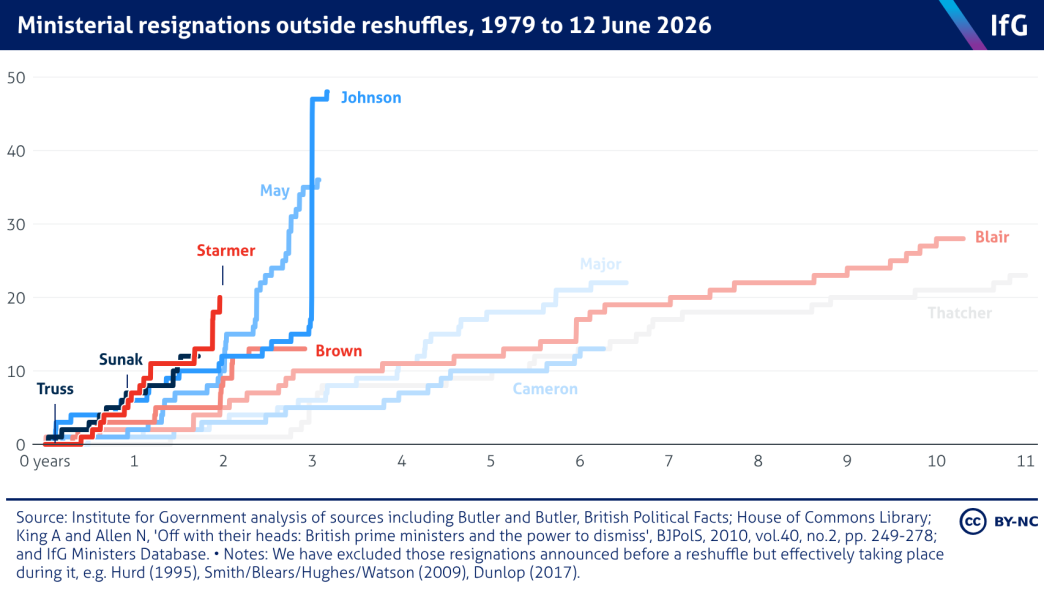
The highest number of total ministerial resignations occurred under Boris Johnson’s premiership. In July 2022, as many as 30 ministers resigned from government in just five days, amounting to a total of 48 resignations across his administration. This series of resignations ultimately made Johnson’s position as prime minister untenable and he himself resigned.
Why do ministers resign from government?
There are broadly three sets of circumstances where a minister might resign from their role in government:
Where a minister does not agree with an aspect of government policy
The convention of collective responsibility allows individual ministers to argue freely in private meetings, but once the government has settled on a position, ministers are expected to support it and maintain a united front in public. When a minister disagrees with the government position, they can choose to resign rather than abide by collective responsibility. For example, Anneliese Dodds chose to stand down as development minister in February 2025 in protest against Starmer’s cuts to the international aid budget.
If a minister’s actions are a significant breach of the ministerial code or other ethical failing
The ministerial code sets the ‘highest possible standards’ that ministers are expected to abide by. The independent adviser on ministerial standards – currently Sir Laurie Magnus – investigates potential breaches of the code. Keir Starmer’s ministerial code recently strengthened the powers of the independent adviser so that he can initiate an investigation without requiring permission from the prime minister.
The code is clear that a range of sanctions, not just resignation, can apply in the case of a breach. In the past prime ministers have accepted an apology or a commitment not to repeat a minor breach rather than a ministerial resignation. During the Johnson government, a 2020 investigation concluded that home secretary Priti Patel had breached the code because it found evidence that she had bullied staff, but Johnson did not ask her to resign.
And sometimes ministers resign even if they are not found to have breach the code. In January 2025, Labour minister Tulip Siddiq (former economic secretary to the Treasury and city minister) was investigated by the adviser for her links to her aunt’s ousted government in Bangladesh. Although the investigation found that Siddiq had not breached the code, she decided to resign, citing concern that the issue would become a ‘distraction’ for the government.
More recently in March 2026, Josh Simons resigned as parliamentary under-secretary of state in the department for science, innovation and technology and the Cabinet Office over reports that the thinktank he used to run paid a PR firm to investigate the backgrounds of journalists who were reporting on its activity. Although the independent adviser found that Simons had not breached the code, he said that he chose to step down because of the ‘distraction’ caused to the government.
Where a minister stands down due to personal reasons
Ministers can also choose to step down from their responsibilities due to personal reasons, such as ill health, caring commitments and retirement.
What is the difference between a minister resigning and being sacked?
When a minister has breached collective responsibility or the ministerial code in a significant way, they are invited to voluntarily offer their letter of resignation to the prime minister. On the rare occasion that a minister refuses to resign voluntarily, the prime minister can decide to sack the minister. In 2021, Johnson sacked the minister for veterans Johnny Mercer after he threatened to resign over lack of legal protections for British troops who fought in Northern Ireland in the Overseas Operations Bill.
What happens after a resignation?
When a minister leaves office, they are entitled to receive a severance payment which is generally equivalent to one quarter of their annual ministerial salary. However, in July 2025 the government announced further amendments to the ministerial code so that ministers who leave office after serving for less than six months, and those who have “committed a serious breach” of the code, are expected to waive their severance payment.
Former cabinet ministers can also retain their ‘Right Honourable’ title after leaving government. Ministers retain their seat in the House of Commons or Lords after resigning their government post, to become 'backbenchers'.
After a minister resigns, the prime minister also has to consider who to appoint to fill the new vacancy. Angela Rayner’s resignation in September 2025 was followed by an extensive reshuffle which saw over half of all ministers either leave government or change roles.
Who has resigned from Starmer’s government and why?
The 20 ministers that have resigned from Starmer’s government are: