Local elections 2026
On Thursday, 7 May 2026, local elections will take place in many parts of England.
Voters across England will elect over 4,850 councillors on Thursday 7 May 2026. Ministers had previously announced plans to delay elections in 30 areas undergoing local government reorganisation - changes which would have reduced the number of councillors elected by over 600. However, the government withdrew its decision on 16 February 2026 “in light of recent legal advice”.
Where are local elections being held?
Local elections are being held for 4,851 council seats across 134 of England’s 317 councils on Thursday 7 May 2026. In addition, ‘shadow elections’ will be held for two new unitary authorities due to be created in Surrey in 2027.
All seats will be contested in:
- 32 London boroughs
- Six county councils
- Six unitary authorities, including the newly-created East Surrey and West Surrey
- 16 metropolitan districts
- Three district councils
A half of seats will be contested in:
- Seven district councils
A third of seats will be contested in:
- 12 unitary authorities
- 16 metropolitan districts
- 38 district councils
In six local areas, including five London boroughs and Watford, voters will directly elect their council leaders, who are also known as local authority mayors (not to be confused with regional or metro mayors who hold a wider set of devolved functions).
Many areas across England will also be electing parish and town councillors.
Where had the government planned to postpone local elections?
On 18 December 2025 the government invited all 63 councils in areas undergoing local government reorganisation to request that local elections be delayed if that could “release essential capacity to deliver local government reorganisation”. 27 McGovern A, ’Letter to leade of councils with elections in May 2026 where proposals for reorganisation have been submitted and decisions not yet taken’, 18 December 2025, https://assets.publishing.service.gov.uk/media/6944196136f089d38be1f31a/lgr-letter-councils-elections-may-2026.pdf This included nine areas where the government had already delayed elections in 2025 (Norfolk, Suffolk, Essex, Thurrock, Surrey, East and West Sussex, Hampshire and the Isle of Wight). 28 McMahon J, ‘Statement: English Devolution and Local Government’, Written Statements, UK Parliament, 5 February 2025, https://questions-statements.parliament.uk/written-statements/detail/2025-02-05/hcws418 The 63 councils were given until a deadline of 15 January to respond.
In their responses, 30 of the 63 councils outlined capacity concerns, although not all made a direct case for postponement. On 22 January 2026, the government announced that they intended to delay elections in 29 areas. On 29 January, ministers announced that Pendle Borough Council would also have its elections postponed. The councils where the government planned to delay elections included:
- 21 of 29 Labour-led councils
- Two of 18 Liberal Democrat-led councils
- Five of 13 Conservative-led councils
- One Green-led council
- One of three independent-led councils
The government’s decision to delay mayoral elections cannot be justified on democratic or fairness grounds
The decision to delay mayoral elections reflects poorly on the government.
Read the comment
Following the announcement of delays, Reform UK launched a legal challenge which was due to be heard in the high court on 19-20 February. 33 Ventura T, ’Reform launches legal challenges over elections‘, 21 January 2026, Local Government Chronicle, www.lgcplus.com/politics/governance-and-structure/reform-launches-legal-challenge-over-elections-21-01-2026/ On 16 February, the government announced it had withdrawn its original decision to postpone elections in 30 areas, following legal advice. 34 Ministry of Housing, Communities and Local Government, ‘Leaders of councils with elections in May 2026 where proposals have been submitted for Local Government Reorganisation’, 16 February 2026, retrieved 16 February 2026, https://assets.publishing.service.gov.uk/media/699328da7da91680ad7f44a9/update_on_secretary_of_state_s_decision_regarding_local_elections_of_may_2026…
Why are there no regional mayoral elections taking place in May 2026?
Mayoral elections had been expected in the six areas on the government’s Devolution Priority Programme (DPP). However, all six of these polls have been postponed.
Following requests from councils, the mayoral elections in Cheshire & Warrington and Cumbria were delayed to May 2027. 35 McMahon J, ’Written statement: Devolution Priority Programme’, 17 July 2025, https://questions-statements.parliament.uk/written-statements/detail/2025-07-17/hcws848 In addition, on 4 December 2025, the government announced that it was “minded to” delay to May 2028 the planned mayoral elections in Greater Essex, Hampshire and the Solent, Brighton and Sussex, and Norfolk and Suffolk. The government’s rationale is that this will give these areas the time to complete “the local government reorganisation process before Mayors take office”. 36 Reed S, ’Written statement: Devolution Priority Programme’, 4 December 2025, https://questions-statements.parliament.uk/written-statements/detail/2025-12-04/hcws1128
Who controls the councils up for election?
Of the 134 county, unitary and district councils holding elections (excluding the shadow elections being held for two new unitary authorities in Surrey), 96 have a single-party majority:
- 66 have a Labour majority
- 16 have a Conservative majority
- 13 have a Liberal Democrat majority
- One council has an independent majority
The remaining 38 councils are under no overall control. In these cases, either a minority administration or a coalition of several parties runs the council. Of these:
- 17 have Labour leaders
- Nine have Liberal Democrat leaders
- Six have Conservative leaders
- One has a Green leader
- Five have independent leaders
In five cases the party with the most seats does not lead the council.
What is the current state of the parties at local government level?
After the May 2025 local elections, the Labour Party held 34% of all council seats in England, down 2% from 2024. The Conservative Party fell to 26%, down 4% from the previous year and the Liberal Democrats held 19%, up 1% from the previous year. The number of councillors represented by ‘other’ parties increased to 12%, up from 11%. The Green Party held 5% of seats - a similar share to 2024. Reform UK increased to 5% up from 0% following the election of 677 councillors.
Local and devolved elections 2026
On Thursday 7 May, voters across Scotland, Wales and England head to the polls in a major set of local and devolved elections. The IfG will be following the campaigns, explaining why these elections matter and analysing the results.
Explore our work
Why do the local elections matter?
Many frontline public services are delivered by local councils. In England, county councils are responsible for functions such as transport, social care and libraries. District councils in two-tier local government areas provide local services such as planning, housing, leisure and recycling services.
Unitary councils and metropolitan boroughs provide the functions of both county and district councils.
In England, local authorities spent £72.1bn (net current expenditure) on public services in 2023/24 (2025/26 prices). 39 This excludes spending on education, public health and police and fire and rescue services which is technically spent by local authorities but is not directly controlled by them. The largest spending areas were adult social care (£27.6bn) and children’s social care (£13.3bn). 40 DLUHC, Revenue outturn service expenditure summary (RSX) 2022 to 2023, 14 February 2024, retrieved 12 April 2024, www.gov.uk/government/statistics/local-authority-revenue-expenditure-and-financing-england-2022-to-2023-individual-local-authority-data-outturn
As the Institute for Government Public Services Performance Tracker shows, many local authorities face financial pressures due to over a decade of funding cuts, recent high inflation and increasing demand for services. These challenges have led several councils depleting financial reserves and requesting emergency funding. These pressures often force local authorities to decide which services to prioritise and causes many to raise council tax by the maximum amount allowed.
Parish councils are the lowest tier of local government and can work on local issues including bus shelters, play areas, community centres, consultation on neighbourhood planning and grants for local organisations.
What might be the implications of the local elections for mayors and strategic authorities?
In areas with a mayoral strategic authority (MSA), local council leaders have voting rights on the MSA board, which decides how devolved budgets and powers should be used. With 32 metropolitan boroughs up for election, the results could shape regional mayors’ ability to pass their proposed budgets and deliver housing, regeneration and transport plans.
Labour currently leads five of the seven constituent councils of the North East Combined Authority (NECA). All five are up for election in 2026, with four holding all-out elections rather than the usual election by thirds due to re-warding – increasing the chances of a shift in the political balance on the NECA board.
Labour is also defending majorities on the combined authority boards in West Yorkshire and South Yorkshire. In West Yorkshire, Labour currently leads all five councils, but all of these are up for election in 2026, with four holding all-out elections. In South Yorkshire, Labour lead all of the four councils, two of which are up for election in 2026.
All councils are up for election in the West Midlands, four of which are led by Labour and the other three by the Conservatives. Five of these seven councils will hold all-out elections in 2026.
In Greater Manchester, all 10 local councils are up for election, with Labour currently leading nine of these councils. These councils will hold elections by thirds, which can limit large political swings, but Labour may still be at risk of losing leadership of councils such as Tameside, Stockport, Bolton and Oldham. Liverpool City Region has four of its six constituent councils up for election. All four are Labour-controlled and two are all-up.
Who can vote in local council elections?
In England all adults aged 18 and over can vote in local elections if they are British citizens, EU citizens, or ‘qualifying Commonwealth citizens’ 44 Gov.uk, ‘Types of election, referendums, and who can vote: Local government’, (no date) retrieved 12 April 2024, www.gov.uk/elections-in-the-uk/local-government (citizens of Commonwealth countries who have leave to enter or remain in the UK, or who do not require that leave). 45 The Electoral Commission, ‘Register to vote’, (no date) retrieved 12 April 2024, www.electoralcommission.org.uk/i-am-a/voter/register-vote-and-update-your-details#commonwealth
Following the passage of the Elections Act 2022, the local elections on 1 May will take place with mandatory voter identification (ID). Voters will need to show an acceptable form of photographic ID, as listed on the Electoral Commission website. Voters without photo ID can apply for a voter identification certificate until 24 April 2024 to enable them to vote. 46 The Electoral Commission, ‘Applying for a Voter Authority Certificate’, (no date) retrieved 12 April 2024, www.electoralcommission.org.uk/voting-and-elections/voter-id/applying-a-voter-authority-certificate
Voter ID requirements only apply to votes cast at polling stations; postal votes use different, pre-existing, signature verification.
How many people vote in local elections?
Fewer people vote in local elections than in general elections. Local turnout tends to be between 30–40% of the electorate. By contrast, turnout for elections to the UK parliament over the past five elections has averaged 65 %. When local elections take place at the same time as parliamentary elections, as last happened in England in 2015, turnout is comparable to that of national elections.
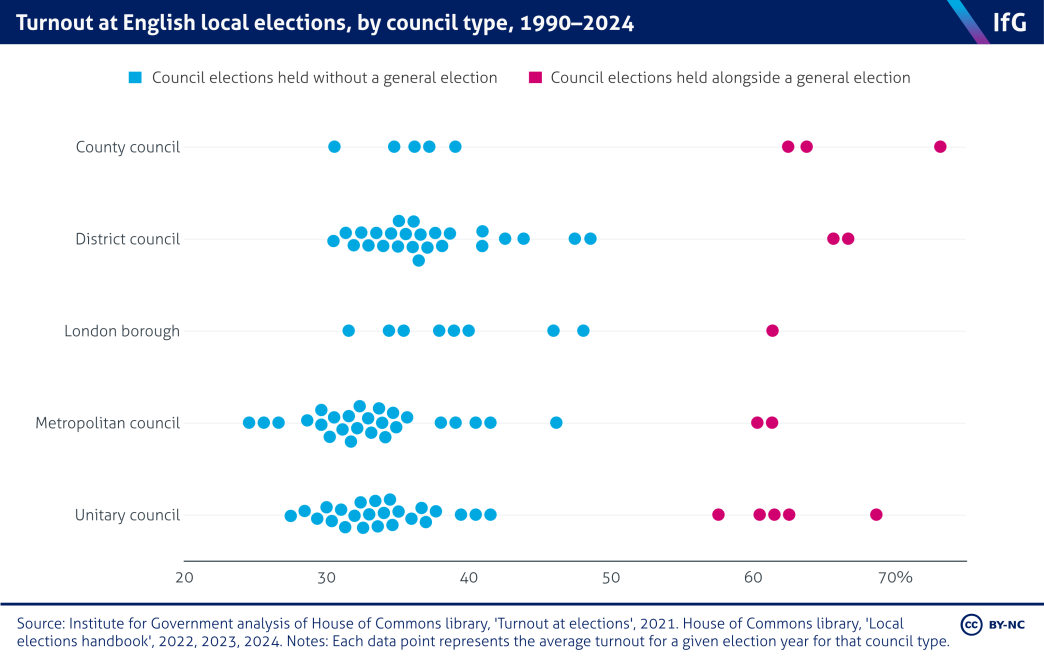
How to vote in the May 2026 local elections
There are three ways to vote in the May 2026 elections:
- In person at your local polling station on polling day – Thursday 7 May 2026 – between 7am and 10pm
- By postal vote
- By proxy vote
To vote in the May 2026 local elections, eligible residents must have registered to vote by Monday 20 April. Registration can be done online or via post and is not needed for every election, only if someone has not registered before or changes their name, address or nationality.
Voters can also apply for a postal vote if they will be unable to get to the polling station on polling day. To do so, voters should submit their application by Tuesday 21 April. Voters can also apply for a proxy vote, where someone they trust casts a vote on their behalf. The deadline to register for a proxy vote is Tuesday 28 April.
Voters in England need to show photo ID to vote at a polling station. Voters without an accepted form of ID can apply for free voter ID by Tuesday 28 April. Voters in Scotland and Wales do not need ID to vote in person in the Scottish Parliament or Senedd elections on 7 May.
More information on registration and voting can be found here
Will the Representation of the People Bill impact the May 2026 elections?
No. The reforms included in the Representation of the People Bill will not affect the May 2026 elections. The new legislation is expected to be in place in time for the next general election. 48 Ministry of Housing, Communities and Local Government, ‘Explainer: Everything you need to know about changes to elections and voting’, 12 February 2026, retrieved 13 February 2026, https://mhclgmedia.blog.gov.uk/2026/02/12/explainer-everything-you-need-to-know-about-changes-to-elections-and-voting/
The bill, which was introduced to parliament in February 2026, contains a range of electoral reforms including changing voter eligibility and registration, changing the voting age to 16 in England and Northern Ireland (in line with Scotland and Wales), election finance and conduct.
- Topic
- Devolution
- United Kingdom
- England
- Position
- Metro mayor
- Publisher
- Institute for Government