How do Labour Party leadership contests work?
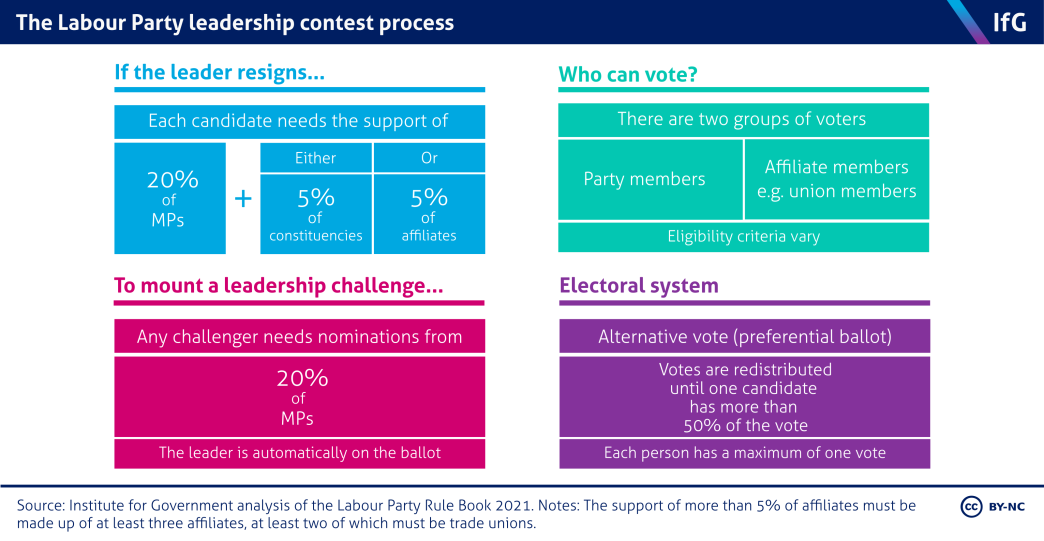
A Labour leadership election can only be triggered if the leader resigns, or if 20% of MPs nominate a challenger.

Chaos returns to Westminster: What next for Keir Starmer and the government?
An expert IfG webinar on the impact on government of Wes Streeting's resignation and Andy Burnham's Westminster ambitions.
Watch the event
What is the process for electing the Labour leader?
Any candidates for the Labour leadership need to be:
- nominated by 20% of Labour MPs; and
- nominated at least three affiliates 4 Affiliates are groups or organisations which have interests consistent with those of the Labour Party – they include trade unions, co-operative and socialist societies (two of which must be trade unions), which represent a minimum of 5% of the affiliated membership, or by at least 5% of constituency parties.
If only one candidate receives enough nominations, they become the party leader.
If more than one candidate receives enough nominations, a period of voting follows. Two groups are able to vote in Labour leadership elections: party members and members of affiliate organisations. Members of the Parliamentary Labour Party vote too, but only have one vote, so are vastly outnumbered by other voters. Members of affilliate organisations, such as trade unions, have to opt in to be affiliated members of the Labour Party.
How does the voting system work?
The Labour Party has used a one-person-one-vote system for leadership elections since 2015. This system ensures that the same person cannot vote both as a party member and as an affiliate member.
Voting takes place using the alternative vote system (a preferential ballot). If one candidate gets more than 50% of the vote, they are elected. If no candidate manages this, then the candidate who came last is removed and their votes are redistributed to voters’ second preference candidates. This process is repeated until one candidate has more than half of the votes.
The process is similar where a Labour MP initiates a leadership challenge, rather than the leader resigning. Where the Labour party is in opposition, election of a leader usually takes place at the annual party conference.
Has the process always worked this way?
Before October 2021, candidates only needed to be nominated by 10% of the combined ranks of Labour MPs, and until the UK left the EU, MEPs. The rules were changed during the party’s 2021 conference, however, to require the backing of 20% of Labour MPs. The rules about nomination by constituencies or affiliates were brought in in 2018, though these groups earlier used to take part in the voting process.
In the voting stage, until October 2021, it was also possible for ‘registered supporters’ to vote without becoming a full party member, however, this is no longer the case. This followed controversy during Labour’s 2015 leadership election, when 105,000 people paid £3 to become a registered supporter.
Can Labour MPs remove a leader through a vote of no confidence?
Unlike the Conservative Party, there is no formal role for a vote of no confidence as part of the process of a leadership challenge. When the Parliamentary Labour Party held a no confidence vote in the leader in 2016, Jeremy Corbyn refused to resign and argued that his support among party members outweighed his lack of support from Labour MPs.
How does procedure differ if the party is in opposition or in government?
When in opposition, election of a leader usually takes place at the annual party conference. While there is no official mechanism to call an emergency conference before an annual conference, the NEC has the power to do so.
If the leader becomes permanently unavailable when in opposition, the deputy leader automatically becomes party leader on a temporary basis until the NEC decides whether to hold an immediate ballot, or wait until the next party conference. The NEC also decides what powers are available for an acting leader to use.
If the leader becomes permanently unavailable while the party is in government, the Labour rules state that the Cabinet shall, in consultation with the NEC, appoint one of its members to serve as party leader until a ballot can be carried out.
Does resigning as leader also mean resigning as prime minister?
If Labour is in government and the party leader resigns, this ultimately means that they also resign as prime minister. But this does not have to happen immediately.
The roles of party leader and prime minister are separate, though linked. Prime ministers are normally leaders of their parties, as this is the clear indication of their ability to command the confidence of the House of Commons.
However, it is normal for party leaders who are resigning to stay on as prime minister until a new leader has been elected.
Under the many recent Conservative changes of prime minister, all remained as PM until the leadership contests had concluded. And in 2007, after Blair announced his intention to step down, Gordon Brown launched a leadership contest on 11 May, but did not replace Blair as leader until 24 June and as prime minister until 27 June, even though he was uncontested.
Will there be a general election after a new leader is appointed?
The ability to request a dissolution of parliament and call a general election rests with the prime minister. As such, while there may be calls for a general election, it is up to the incoming leader of the Labour Party to decide whether to call one. The next general election does not need to happen before August 2029.