Working to make government more effective

Comment

Empty classrooms present government with a challenge and an opportunity

The government needs to show strategic direction on school places.

schools

As demand rises for most public services, Amber Dellar says falling pupil numbers give the government a rare opportunity
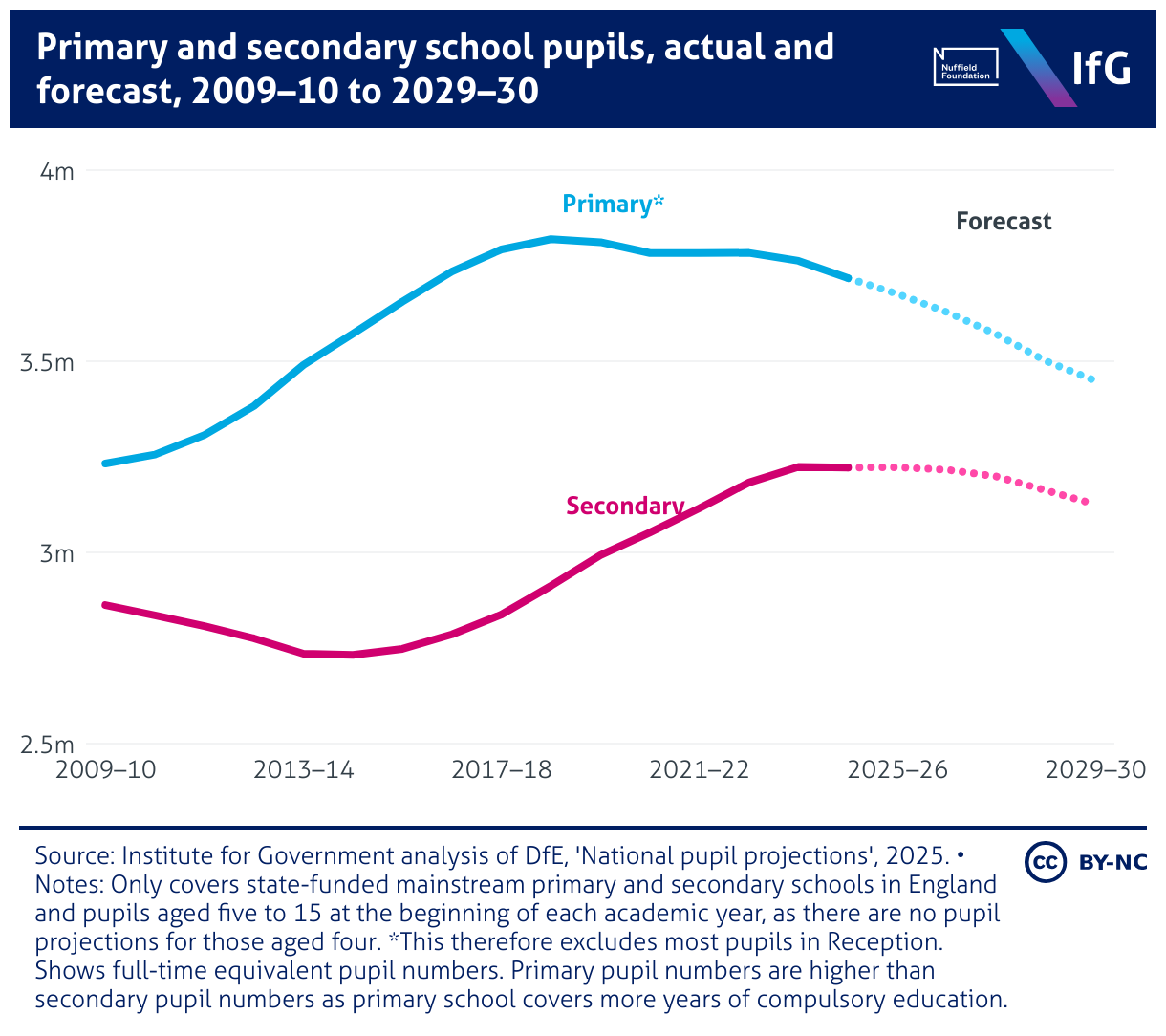
Walk into many English primary schools today and you’ll notice more empty desks than you might expect. Since 2018–19, the number of pupils in primary schools has fallen by 3%, leaving the equivalent of 23,000 classrooms, or nearly one in every eight, sitting vacant. Because funding follows pupils, these unfilled places cost money – and that means schools are facing a growing financial headache. However, if managed well, falling pupil numbers could create space to address the shortage of special educational needs provision. 

Falling pupil numbers are leaving mainstream schools with space they can’t afford

After years of growth fuelled by a baby boom in the late 2000s and early 2010s, England’s pupil numbers are now firmly in decline. Primary enrolment, which peaked in 2018–19, has already fallen by around 100,000, and secondary schools are just starting to follow the same path. 24 Department for Education, ‘Schools, pupils and their characteristics’, 5 June 2025, https://explore-education-statistics.service.gov.uk/find-statistics/school-pupils-and-their-characteristics/2024-25  In some parts of London, primary pupil numbers have fallen by more than 15% in the last six years. 

But school places have not adjusted to this new reality – in fact, they are still increasing.  As a result, the number of unfilled primary places hit a record 611,000 in 2023–24, equivalent to around 23,000 empty classrooms nationwide. 27 Department for Education, ‘School capacity, academic year 2023/24’, 27 March 2025, https://explore-education-statistics.service.gov.uk/find-statistics/school-capacity/2023-24

That imbalance is taking a toll on school finances. With funding largely tied to pupil numbers, schools with fewer children often face the same costs – buildings to heat, staff to pay – but with less money coming in. The share of local authority-run primaries  in debt rose from 7.9% to 14.7% over the last six years, 28 Department for Education, ‘LA and school expenditure, financial year’, 12 December 2024, https://explore-education-statistics.service.gov.uk/find-statistics/la-and-school-expenditure/2023-24  and we estimate that empty school places account for almost two-fifths of that rise. 

Performance Tracker 2025: Schools

It will be extremely difficult for the government to meet its education priorities within the budget it has set for the coming parliament.

Read the report
A school bus

Rising demand is leaving special schools without the space they need

While mainstream schools are struggling to fill classrooms, special schools can’t find space fast enough. Demand for specialist support has exploded, with the number of children holding education, health and care plans (entitling them to tailored support for special educational needs) doubling in less than a decade to almost half a million in 2025 – more than one pupil in every class in England. 30 Department for Education, ‘Special Educational Needs in England’, 12 June 2025, https://explore-education-statistics.service.gov.uk/find-statistics/special-educational-needs-in-england/2024-25  

This has pushed special schools to the limit. Enrolment has jumped 90% since 2010–11, while mainstream enrolment has risen by only 14%. 38 Department for Education, ‘National pupil projections’, 17 July 2025, https://explore-education-statistics.service.gov.uk/find-statistics/national-pupil-projections/2025  Around two thirds of state special schools are now operating over capacity, and in some areas there are nearly three pupils for every two places. 39 Department for Education, ‘National pupil projections’, 17 July 2025, https://explore-education-statistics.service.gov.uk/find-statistics/national-pupil-projections/2025  This can leave some children without the care, facilities or space they need – and in some cases, without a place in special school at all. 

Government could ease both pressures by providing some strategic direction

These pressures will not go away very quickly on their own. The rise in the number of education, health and care plans – up by 11% in the last year alone 40 Department for Education, ‘Special Educational Needs in England’, 12 June 2025, https://explore-education-statistics.service.gov.uk/find-statistics/special-educational-needs-in-england/2024-25  – shows no sign of slowing. At the same time, the strain on mainstream schools is also set to grow – according to the latest data, the number of primary places is expected to keep rising until at least 2026–27, by which point enrolment will be 5% lower than it was in 2018–19. 41 Department for Education, ‘School capacity, academic year 2023/24’, 27 March 2025, https://explore-education-statistics.service.gov.uk/find-statistics/school-capacity/2023-24; Department for Education, ‘Schools, pupils and their characteristics’, 5 June 2025, https://explore-education-statistics.service.gov.uk/find-statistics/school-pupils-and-their-characteristics/2024-25

The fragmented governance of the schools system is a key barrier to addressing these mismatches in supply and demand. Oversight of an area’s schools is split between local authorities 42 House of Commons Education Committee, Solving the SEND Crisis (HC 492), The Stationery Office, 18 September 2025, https://committees.parliament.uk/publications/49536/documents/265373/default  and academy trusts (not-for-profit companies that run academy schools), and neither has both the responsibility and the power to ensure that the supply of school places aligns with demand. The Children’s Wellbeing and Schools Bill, now making its way through parliament, will help, but it will remain difficult to balance demands on the mainstream and special school systems without further strategic direction from central government. 

The government intends to rebalance special educational needs and disabilities (SEND) provision between mainstream and special schools. It has, for example, committed to “improving inclusivity and expertise in mainstream schools”, 43 Department for Education, Written Evidence Submitted by the Department for Education (SEN0887), https://committees.parliament.uk/writtenevidence/137777/pdf/  but, without an official definition of ‘inclusive mainstream’ education, the wider sector is left guessing what that should look like in practice. More fundamentally, the government itself is not confident how many pupils with special educational needs mainstream provision can realistically support. 44 Comptroller and Auditor General, Support for Children and Young People with Special Educational Needs, Session 2024–25, HC 299, National Audit Office, 24 October 2024, www.nao.org.uk/reports/support-for-children-and-young-people-with-special-educational-needs  And it has now delayed wider plans for reform of the SEND system until 2026, leaving future demands on each setting unclear.  

The education secretary has an opportunity to use falling pupil rolls to the government’s advantage and free up resources for desperately needed SEND provision. And the opportunity is a rare one – demand for other public services is generally rising, but the spare capacity in mainstream schools gives the government some leeway to redesign the SEND system on its own terms.  

Political party
Labour
Public figures
Bridget Phillipson
Publisher
Institute for Government

Related content