Could London’s fragmented councils offer lessons for Westminster?
A hung parliament is a real possibility after the next general election.
Six months on from the local elections, London offers an early indication of how councils are adapting to increasingly fragmented politics, writes Megan Isaac
Recent polling has raised the prospect of the next general election resulting in a hung parliament, prompting renewed interest in previous minority and coalition governments – in particular the 2010 coalition agreement between the Conservatives and Liberal Democrats and the 2017 confidence-and-supply agreement between the Conservatives and the DUP.
But Westminster can also draw lessons from local government. Throughout England, where governing without a majority is increasingly common, a range of models of multi-party governance are proliferating across local government.
These arrangements are potentially fragile, as demonstrated by this week’s collapse of Labour-Green power-sharing arrangements in 11 councils, but the UK parliament’s comparative lack of experience with minority government means looking local could be vital preparation ahead of the next general election.
No overall control is increasingly common in local government
Held against the backdrop of an increasingly fragmented political landscape, the May 2026 local elections saw more councils in England fall to no overall control (NOC) than were won outright by individual parties, pushing the share of councils across England without a majority to over 50%.1 BBC News, ‘England local election results 2026’, https://www.bbc.co.uk/news/election/2026/england/results
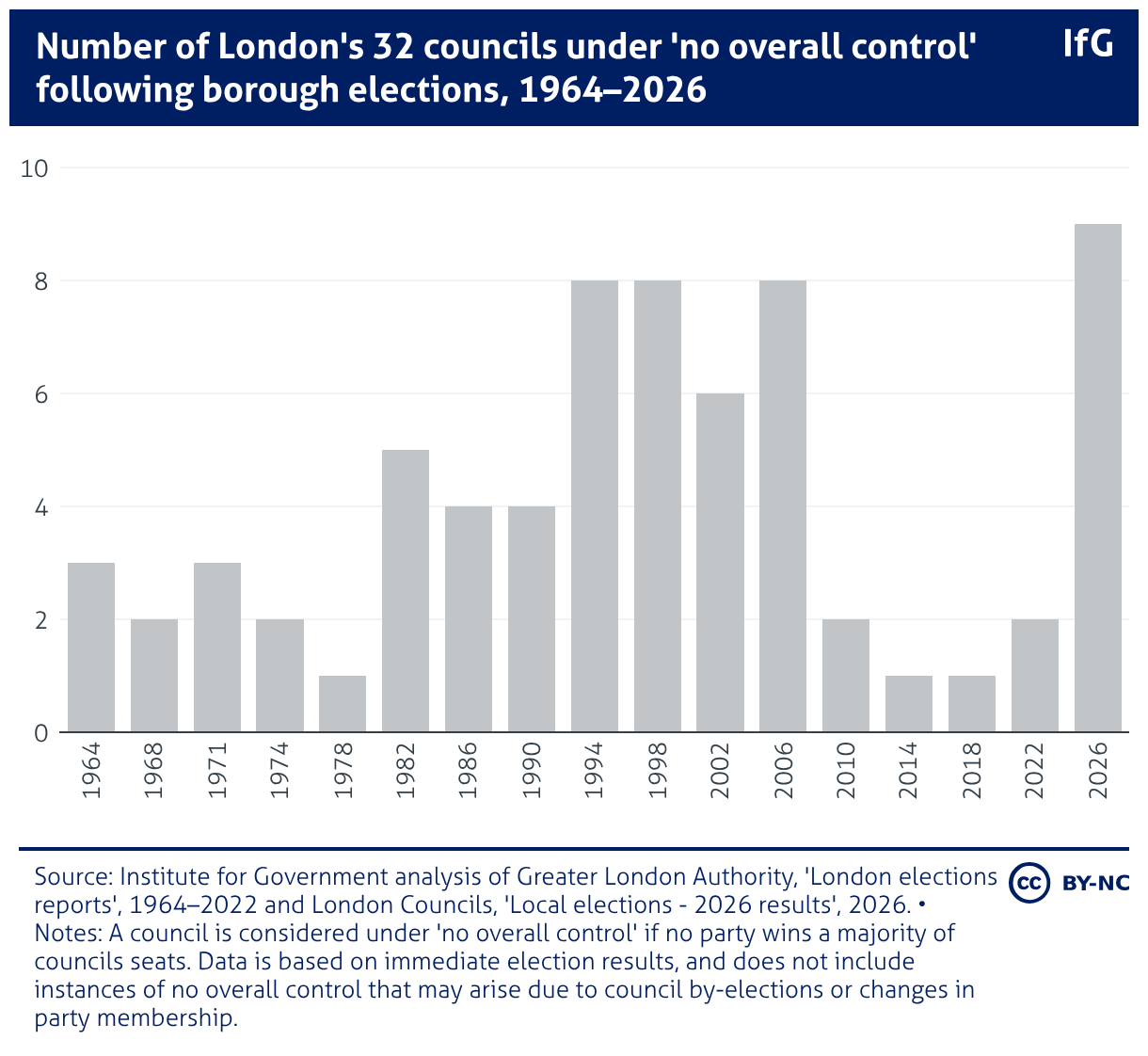
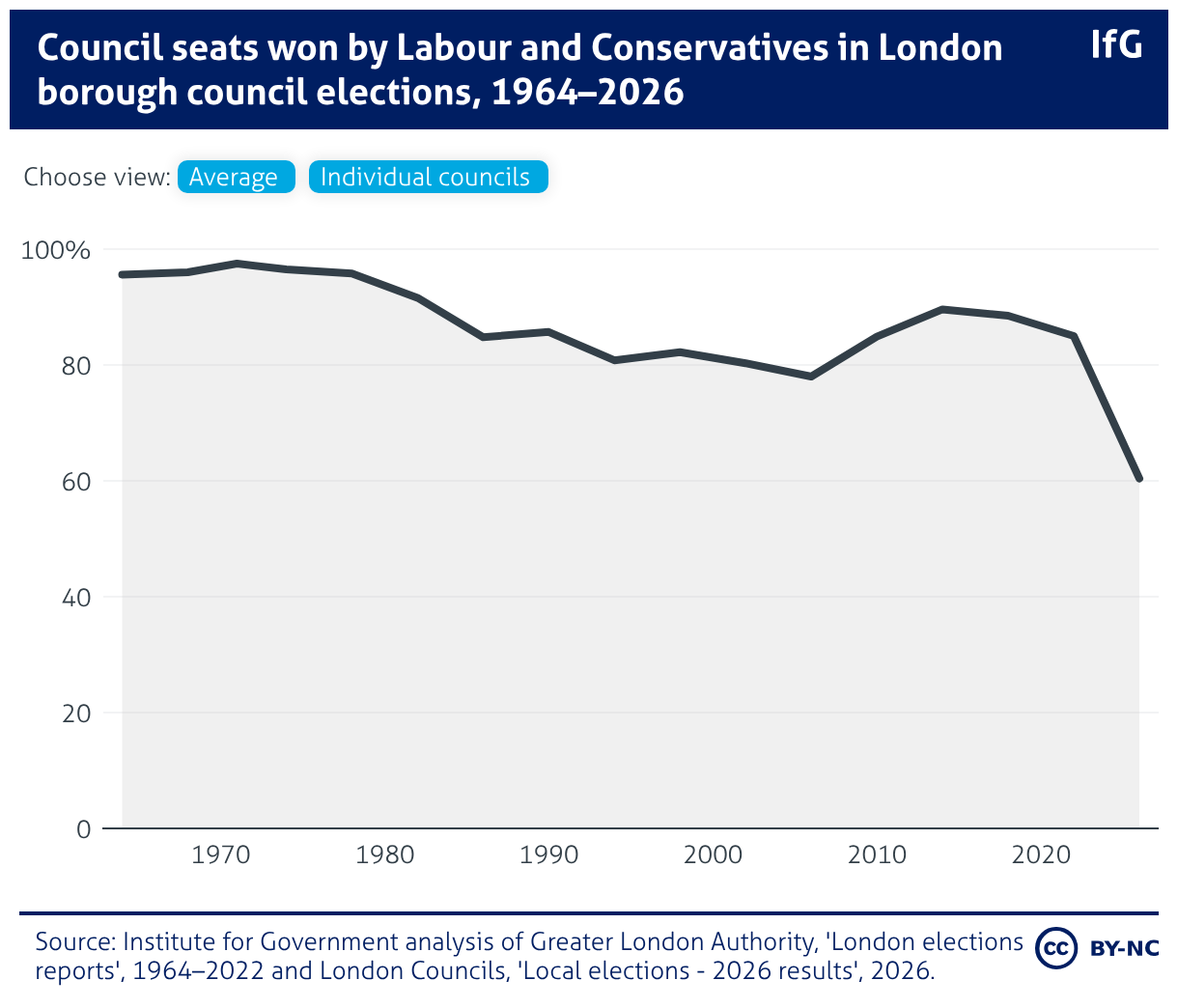
This pattern also emerged in London, where a record nine of the capital’s 32 councils fell to NOC. Political fragmentation also increased, with the proportion of London’s council seats won by Labour and the Conservatives falling by almost 25 percentage points from 2022 to a low of 60%. The remaining 40% are split between the Greens, Liberal Democrats, Reform UK, other parties and independents.
There is no single model for governing without a majority
London illustrates that there are a wide range of ways to govern without a majority and that a hung parliament in Westminster would not necessarily lead to a coalition.
The nine NOC councils in London have adopted a range of models, from formal coalitions and confidence-and-supply agreements to minority administrations that rely on building support on an issue-by-issue basis. The options available depend not only on the arithmetic of the council chamber and the relationships between parties, but also on the council’s executive arrangements, which determine where political power sits and what parties can negotiate over.

Seven of the nine councils have formed minority administrations. In most cases, the largest party has formed the administration, relying on opposition parties to support or at least not block its key decisions.
Elsewhere, councils have agreed more formal cross-party arrangements. In Southwark, the Greens and Liberal Democrats have formed a coalition, ending 16 years of consecutive Labour control.1 Southwark Council, ‘Southward Green Party and Southwark Liberal Democrats form joint administration’, 28 May 2026, https://www.southwark.gov.uk/news/2026/southwark-green-party-and-southwark-liberal-democrats-form-joint-administration In Wandsworth, the Conservatives and Labour were separated by just one seat, with an independent councillor holding the balance of power and agreeing a confidence-and-supply arrangement with the Conservatives.2 Wandsworth Council, ‘Wandsworth Council leader-elect sets out first steps’, 18 May 2026, https://www.wandsworth.gov.uk/news/news-may-2026/wandsworth-council-leader-elect-sets-out-first-steps/
The largest party need not lead the administration
When no party wins a majority, the largest party is not the only one that can lead the administration. This is a rare occurrence in Westminster politics – occurring just once in the past century – but it is much more common in local government.
Two of London’s NOC councils are not led by the largest party. In Croydon, Labour is the largest party but the directly elected Conservative mayor leads the council and exercises significant executive power due to the requirement of a two-thirds majority to amend or overturn the mayor’s budget and policy framework.3 Croydon Council, ‘The elected mayor of Croydon’, https://www.croydon.gov.uk/council-and-elections/mayors-croydon/elected-mayor-croydon/role-elected-mayor-0 In Southwark, Labour is again the largest party but the council is run by a Green-Liberal Democrat coalition.
Leadership is not the only thing up for negotiation
In NOC councils, several sources of influence are ‘tradeable’ in the negotiations to form an administration. Parties can seek commitments on policy, institutional influence and, in some cases, changes to the rules under which the council operates.
In Barnet, where Labour and the Conservatives won 31 seats each and the Green party won one seat, the Conservatives allowed Labour to form a minority administration in exchange for increased scrutiny, including the Conservative opposition leader attending cabinet as a non-executive member.4 Barnet Council, ‘Local elections 2026: Labour retains control of Barnet Council’, 19 May 2026, https://www.barnet.gov.uk/news/local-elections-2026-labour-retain-control-barnet-council
Chairs of key committees and the role of civic mayor – who chairs council meetings and has a casting vote when council votes are tied – can also be prized positions in negotiations. In Haringey, the Greens are the largest party and formed a minority administration, but Labour and the Liberal Democrats worked together to distribute the civic mayoralty and most committee chairs between themselves.
Polarisation can make power-sharing fragile
Power-sharing requires enough common ground on policy red lines for parties to govern together. Fragmentation can increase the number of potential governing combinations, but polarisation can make it harder to construct a majority that is both viable and stable, particularly if some parties are viewed as unacceptable partners.
There are several examples of this outside of London. In Birmingham, Reform UK is the largest party on the council but could not form an administration due to the unwillingness of other parties to work with them. Meanwhile in Oldham, the council has failed to form an administration following four failed attempts to elect a leader. Officers are exercising executive powers under emergency measures, and the council is currently unrepresented on the Greater Manchester Combined Authority board.
Arrangements can also be fragile once in place. Labour’s recent decision to end power-sharing with Green councillors that failed to reject the party’s ‘Zionism is racism’ motion has led to the collapse of 11 NOC administrations in England. This decision also closes off a straightforward Labour-Green alliance in any future hung parliament, and highlights the pressure on parties – which will intensify if fragmentation continues – to set out the policy red lines they are, and are not, willing to compromise on.
Fragmented politics may require institutions to adapt
More fragmented politics may require institutions to adapt as well as politicians. In Brent, the new political balance prompted a review of constitutional arrangements, including how questions and motions are allocated between political groups.5 Brent Council, ‘Annual council meeting’, 20 October 2026, https://democracy.brent.gov.uk/ieListDocuments.aspx?CId=180&MId=8374&Ver=4 Meanwhile, Lambeth has agreed to introduce a hybrid committee model following the formation of a Green minority administration, aiming to increase scrutiny and cross-party working.6 Lambeth Council, ‘Adjourned meeting (AGM 27 May), council’, 1 June 2026, https://moderngov.lambeth.gov.uk/ieListDocuments.aspx?CId=142&MId=18974
Westminster may need to adapt too. Parliamentary procedures and structures are designed around an adversarial two-party system that no longer reflects the reality of British politics and sits uneasily with an increasingly fragmented political landscape.
With recent British political history offering just a handful of lessons for how minority governments can function, and with Westminster yet to adjust to the reality of a multi-party parliament, it would be wise to pay close to attention to the range of models currently on display across local government.
- Topic
- Devolution
- Keywords
- Local government
- Political party
- Labour
- Administration
- Burnham government
- English Regions
- Greater London
- Publisher
- Institute for Government