How to deliver digital transformation in public services: Seven lessons from past programmes
A practical guide to improve the design and delivery of digital transformation programmes in public services.

Introduction
The government has declared its ambition to deliver “next-generation digital public services in the UK… unlock[ing] entirely new ways to offer goods and services”. 42 Cabinet Office, ‘Making public services work for you with your digital identity’, 2026, retrieved from www.gov.uk/government/consultations/making-public-services-work-for-you-with-your-digital-identity But this is far from a new ambition: there has been a succession of digital transformation strategies, plans and roadmaps dating back even before the Government Digital Service was founded in 2011. Many of these have focused on public services and new opportunities for delivery, and there have been a number of major digital transformation programmes in public services; some notably more successful than others.
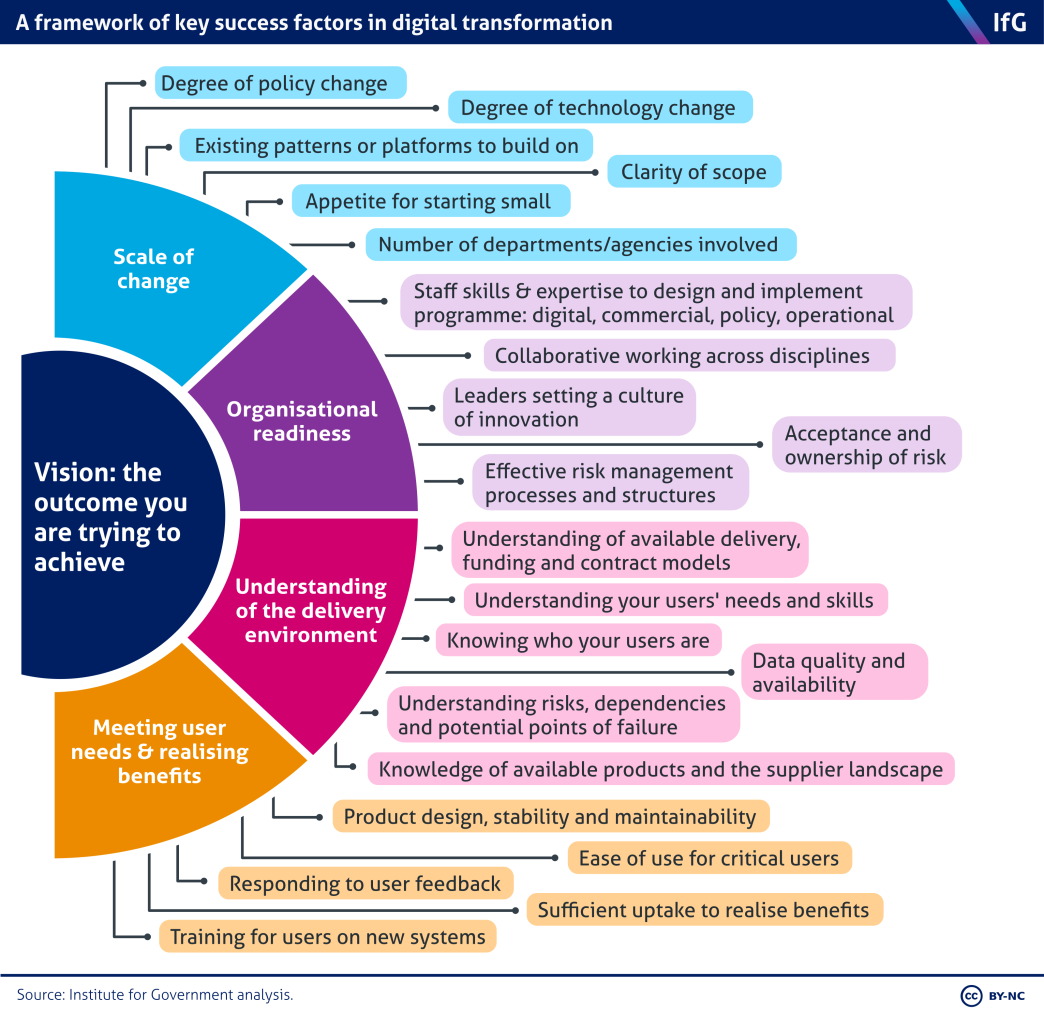
This report is intended as a practical guide to help us get beyond ambition and improve the design and delivery of digital transformation programmes in public services. It sets out seven lessons from past programmes, based on engagement with digital specialists, front-line public sector workers, senior civil servants and those outside the public sector working in or alongside services. It then concludes with a framework of key success factors in digital transformation programmes.
By digital transformation, we do not mean simply replicating existing analogue services online. Rather, it is about using digital tools to deliver a more fundamental shift in how public services are run, accessed and delivered. Many of our lessons apply to transformation programmes more broadly, and indeed plenty of digital transformation programmes are broader business transformation with a digital element. But there are often particular challenges with digital transformation that are worth drawing out specifically.
The lessons we set out here will not solve all problems for digital transformation in public services. In particular, there are three key fundamentals that can make or break a programme: funding, political buy-in and realistic timescales. Where those don’t exist, successful transformation is impossible. But within those constraints, these lessons should help you set the best foundation for success.
It’s also important to think about your role within the system. Factors such as how the civil service recruits and programme funding models – both common barriers to delivering effective digital transformation – are not within your direct control. But that doesn’t mean throwing up your hands and giving up. Part of your role is to communicate where the system causes you problems and to do your best to mitigate them, including making the case for exceptions to standard processes where you think that’s necessary. Without you flagging those issues, ministers and other senior leaders won’t have the information they need to identify or address systematic barriers.
Our seven lessons are:
- Anchor the programme in a clear, shared vision of the outcomes you want to achieve
- Show leadership: take accountability and own risks and decisions
- Cultivate the right mix of skills and collaborative ways of working
- Build a picture of who your users are and what they need
- Get your scoping right: work out where to start, what to prioritise and what to exclude
- Prioritise the needs that are most critical to achieving your vision
- Get to grips with the commercial environment and different delivery and funding models
This report was kindly supported by Scott Logic.
1. Anchor the programme in a clear, shared vision of the outcomes you want to achieve
| What it is | A clear, specific vision of the outcomes you want from the programme that is shared among all leaders and sustained over time, based on a shared understanding of the problem you’re trying to solve. |
| Why it matters | Guides decision making, prioritisation and scope throughout the programme. |
| What stops it happening |
|
| How to fix it |
|
The most critical factor for a successful digital transformation project is having clarity of purpose and an understanding of the outcomes you are trying to achieve. Why are you undertaking this project? What problem are you trying to solve? Crucially, the answer must be about the benefits the programme will achieve, rather than the system or tool you’re trying to build, or a general desire for a digital or ‘modern’ service. And it must be a shared, sustained commitment, not something that changes over time.
For some programmes, this may be a very broad, long-term goal that involves major policy and organisational change alongside digital transformation; the vision for Universal Credit was a simpler, more coherent and more efficient benefits system. Some programmes will have much narrower and more technical aims, such as reducing the number of unused GP appointments or enabling interoperability between different systems. But whatever the scale of the goal, it must be based on outcomes, not process.
It may seem obvious that it is helpful to know what you’re trying to achieve. But it is worth spelling out exactly why this shared vision is so critical and how it should be used. Your vision should provide a guiding ‘north star’: everything you do should ultimately be in pursuit of that goal.
A good vision should set the direction of the programme and inform the success criteria you decide to measure progress. It also determines your risk appetite: what risks are worth taking to achieve your end goal? Rooting this in your vision will help get everyone aligned on the acceptable level of risk, which provides clarity and confidence for people working on the programme. Your vision should guide your transformation priorities and help you define the scope: where you start, and where you stop (see scoping, below). It explains why you want to make this change and should provide the basis of the business case for the funding required.
Without a clear and agreed-on vision for what you want to accomplish, programmes can stall, get side-tracked or try to do everything all at once. Or they can end up being de-scoped so significantly – due to cost, delays or other problems that crop up – that they no longer achieve the vision or deliver real improvements, wasting time, money and effort.
A clear sense of purpose is also motivating for people working in the system. Any kind of major change causes disruption and it takes time for the kinks to be ironed out. This often poses a real burden on staff trying to get on with ‘business as usual’, who can feel like they’re fighting the new system rather than benefiting from it. Knowing what the ultimate benefits will be and why the short-term pain is worth it can really help to ease this – and can also provide you with helpful feedback from the front line as issues emerge. Just having the vision isn’t enough for this – you also need effective leadership to communicate it and engage with staff. But it is a necessary starting point.
So far, so good. But what stops programmes from having this shared vision of what they want to achieve? The most common major obstacles are trying to do too much with a single programme, conflicting goals among different stakeholders and high levels of churn among responsible ministers and senior officials (partly because of the length of time major transformation programmes take). Most programmes will have more than one goal. But the vision needs to provide a means of prioritising among them and balancing trade-offs. This is particularly crucial where you have different stakeholders who want different things from the programme, especially across multiple departments or ministers.
The creation of Common Platform, a shared case management system in the criminal courts, is a clear example of this. Common Platform was developed to bring together a range of people interacting with the courts on to a single shared system: the police, lawyers, court staff and the judiciary, among others. 47 HM Courts and Tribunals Service, 'Justice connected: Inside Common Platform', 2025, retrieved from: https://insidehmcts.blog.gov.uk/2025/07/31/justice-connected-inside-common-platform/ [Accessed 31/07/2025 2026]. But the courts are accountable to both the Ministry of Justice and to the judiciary, who each had their own view of what problem the programme was trying to solve: one focused on efficiency, and the other on improving access to justice. 48 Institute for Government roundtable, 2026. Disagreement over which to prioritise meant that rather than working together on a shared vision, they ended up working against each other. This caused serious problems in development and delivery.
These are ultimately political challenges and require clear direction from ministers to resolve. Ministers are rarely digital specialists and do not need to be familiar with the technical details of programmes, but they must weigh competing political goals and set out their priorities. Senior civil servants, in turn, need to seek those clear steers from ministers and provide the appropriate operational, policy, digital and commercial input to inform ministerial decision making. This requires senior officials with the right skillset to determine an ambitious and realistic vision for change.
Leaders, both officials and ministers, also need to grasp the nettle and actively choose between competing goals when they arise, rather than wishing away trade-offs or hoping that a technological solution to them will emerge. Involving people who will be developing and implementing the system in your thinking at an early stage will help with this, as they are often best placed to assess which goals truly cannot be reconciled.
Existing funding models can also discourage programmes from taking an outcome-driven approach; for instance, because of the level of detail and certainty required for business cases. 49 HM Treasury, Department for Science, Innovation and Technology and Government Digital Service, Performance review of digital spend: enabling strategic investment and innovation, 2025, retrieved from www.gov.uk/government/publications/performance-review-of-digital-spend/performance-review-of-digital-spend-enabling-strategic-investment-and-innovati… The roadmap for modern digital government 50 GOV.UK, Changing how we fund digital work to focus on outcomes, https://roadmap-for-modern-digital-government.campaign.gov.uk/funding-procurement/changing-how-we-fund-digital-work/ includes pilots of new funding models that are more iterative and more closely linked to outcomes, and you should consider taking advantage of these where you can.
Stable programme leadership, both among ministers and officials, makes sustaining a long-term vision much easier. Given the length of many public service transformation programmes, some turnover is inevitable. But it should be minimised and wherever possible, there should be continuity in the ultimate ambition.
2. Show leadership by taking accountability and owning risks and decisions
| What it is | Leaders own programme decisions and risks, have appropriate technical knowledge to manage delivery and set realistic ambitions, take accountability for outcomes, and operate in a supportive organisational environment. |
| Why it matters | Creates an empowered team with a clear shared vision and purpose that has the confidence and space to deliver. |
| What stops it happening |
|
| How to fix it |
|
Good leadership – from an organisational and individual level – is an important enabler. It means that you are able to manage uncertainty and risk of the programme to create an empowered and energised team. At all levels of an organisation, this comes from being transparent about where accountability sits and how decision making happens – especially when the scale of the transformation is extensive.
At an individual level, leaders of digital transformation programmes must have the capacity and capability to manage the programme. You must show your team that delivering the programme is your priority and you will be accountable for its successes and failures, including owning decisions and risks.
The right knowledge and skillset is also essential. Leaders in digital transformation projects do not need to be digital specialists, but you do need a strong understanding of both technical digital work and common digital ways of working. This expertise allows you to anticipate the skills you need in your team to deliver the programme’s desired outcomes and to set realistic ambitions and timelines for the team. You also need to communicate those to other senior leaders and ministers, including potentially in other departments, and be able to push back on unrealistic ambitions or provide clarity when problems arise. All of these elements together create a culture in which your delivery team will feel they have the space to make decisions and are permitted to innovate.
A lack of good leadership, individually and organisationally, means that your delivery team will not feel enabled to deliver. They might become more risk averse and reluctant to experiment. They might feel as if they would face negative consequences for raising problems and avoid mentioning them. At worst, the programme might come to a standstill or become mired in delivery problems and need a ‘reset’ – or multiple resets.
For Universal Credit, the leadership of Neil Couling, its sixth senior responsible owner, and Ian Wright, its seventh programme director, is widely considered one of the reasons behind the programme’s turnaround from disaster to eventual success. 55 Timmins N, The 15-year story of Universal Credit: From disaster to completion, Institute for Government, 2026, www.instituteforgovernment.org.uk/publication/universal-credit-disaster-completion. Supporting Couling and Wright was a new independent chair of the programme board, Sir Robert Walmsley, a vice admiral who had been chief of defence procurement. Sir Robert provided more robust challenge to the programme; Couling and Wright provided stable and knowledgeable leadership, remaining with the programme for 10 years.
Two major barriers to effective, high-quality leadership in digital transformation programmes are a lack of digital and programme management expertise among senior civil servants, and poor risk management, including governance and oversight models that are too focused on risk.
There are not enough senior officials sufficiently experienced in managing transformation programmes in general. Digital programmes face particular problems because there is a shortage of senior officials who understand digital concepts and methods. Without an adequate grasp of the technical skills and ways of working being used, scoping and managing a digital programme is all but impossible, because you can’t understand enough of the day-to-day work of the team.
Standard accountability structures and expectations are also typically based on traditional ‘waterfall’ approaches to project delivery. These approaches are unsuited to digital projects that use agile project management methods 56 GOV.UK, Agile methods: an introduction, www.gov.uk/service-manual/agile-delivery/agile-methodologies , a more incremental and iterative process of delivery and planning. This lack of familiarity with the tools, methods and systems being used can contribute to risk aversion, or conversely mean that programme ambitions and timelines are not sufficiently interrogated by leaders.
Compared to business as usual, transformation programmes typically require a higher risk tolerance – as well as risk awareness – and openness on the part of organisations to new processes and ways of working. You should avoid process-heavy governance mechanisms, like mandating excessively detailed and too frequent reporting, which can slow decision making and dissuade people with the right leadership skills from working on programmes. It might also mean that such people leave and teams lack stable and consistent leadership.
As a leader in a digital transformation programme, you must hold yourself accountable for delivering the benefits of the programme, and encourage your team to feel a similar sense of ownership for programme outcomes. This does not mean taking everything on yourself. It means setting clear roles and responsibilities for different people involved in the programme, and giving people the autonomy to experiment and solve problems within their own areas of responsibility. It also means accepting an appropriate level of risk and feeling responsible for managing it, rather than either trying to remove all risk or passing it on to others.
Taking accountability for outcomes may also mean working to change the system you are operating in. Programmes often run up against systemic barriers to achieving effective transformation, including recruitment challenges and funding models that are poorly suited to digital delivery. Good leadership includes highlighting blockers and lobbying for change where these are causing serious problems for your programme, rather than accepting systemic barriers as irresolvable.
Good leadership is only possible if you as an individual feel that you have strong organisational leadership supporting or constructively challenging – rather than obstructing – your and your team’s decisions, usually through governance and oversight mechanisms. In addition, programmes often hit structural or procedural barriers that you will not be able to resolve alone. You will need mechanisms through which you can report and escalate delivery risks and problems, and trust that you will receive the support to manage or unblock them. It is important not to get caught up in the exact mechanism and detail in which risks are reported. Risk management is not risk reporting; managing risk means identifying and communicating the most critical risks, putting in place appropriate mitigations where possible, and making sure less critical risks are noted and actively monitored.
Improving leadership in digital transformation programmes requires both better programme management skills in government and upskilling senior civil servants in digital concepts. 57 House of Commons Science, Innovation and Technology Committee, Oral evidence: Digital centre of Government (HC 790), 13 May 2025, Q101, Q102 and Q103, https://committees.parliament.uk/oralevidence/15899/html/ 58 Keenan H, Dunlop H, Worlidge J and others, Whitehall Monitor 2026, Institute for Government, 16 January 2025, www.instituteforgovernment.org.uk/publication/whitehall-monitor-2026/part-2-state-civil-service#digital-transformation You should work on developing your own skills, particularly in disciplines that are less familiar to you – whether that is digital and policy skills as an operations expert, policy and performance management as a digital expert, and so on. You should also encourage and provide incentives for your team to do the same, particularly encouraging those who are not digital specialists to become more familiar with and understand technical concepts.
3. Cultivate the right mix of skills and collaborative ways of working
| What it is | The team has the skills and expertise necessary to deliver the programme, across different disciplines, and collaborates effectively with stakeholders within and across organisations. |
| Why it matters | The team will work well together and with affected stakeholders and provide different ways to tackle – and anticipate – problems in order to encourage innovation. |
| What stops it happening |
|
| How to fix it |
|
Delivery of your programme’s desired outcomes depends on having the right team in place, with members who can collaborate well. Digital transformation does not take place in a vacuum: it exists in and interacts with a complex policy and legislative environment and often cuts across organisational boundaries. This requires the right skills and understanding across the entire programme, from the most senior leaders to those responsible for the technical delivery. The desired outcome of the programme should inform what skills you need and therefore who you need to include in the programme’s delivery, whether those be policy, operational, commercial, data protection or other officials.
Lack of understanding and siloed working across different professions and functions in government is a major barrier to successful digital transformation. In particular, unfamiliarity with digital concepts and ways of working among policy specialists, digital teams’ discomfort with policy questions and disconnects between policy, digital and operational teams all cause serious problems.
To address this, your delivery team should be multidisciplinary. You should combine technical digital specialists with these other roles from the start, reflecting the complexity of the programme environment. Including the necessary expertise to deliver each stage of programme from the start will mean it is easier to make realistic assessments of what is feasible to deliver and when – and also anticipate any problems that might come up in areas of government that some team members might be less familiar with.
Then, your team needs to be able to work effectively together. You need to give your team enough time to understand each other and develop the best way of working for them. This might mean adopting one delivery or management method (e.g. agile project management), combining them or moving from one method to another depending on the needs of the programme at the time. It will depend on the relative strengths and weaknesses of different approaches for your particular programme, given the context you’re working in and the people or processes you’re trying to serve.
While your team needs to include the right skills and ways of working to deliver the programme, collaboration is not confined to the delivery team. It also includes other stakeholders affected by the programme, especially when the programme cuts across organisational boundaries or involves big public-facing changes, like Universal Credit or digital ID. Everyone in a leadership position, including ministers and special advisers, needs to have a shared understanding and ownership of how the programme will be run and prioritised (see scoping, below). Leaders from other affected teams need to have a clear view of how your programme’s plans will impact them and be signed up to the change the vision proposes. And you also need to engage with external stakeholders, including civil society and the public, to understand their perspective and refine your vision.
It is difficult for leaders to bring different disciplines into the same team and foster a culture where they can work effectively. There is a particular lack of understanding between the policy and digital and data professions, as the government’s own State of digital government review acknowledged. Leaders of digital transformation programmes need to be able to support officials to bridge this gap; 60 Keenan H, Dunlop H, Worlidge J and others, Whitehall Monitor 2026, Institute for Government, 16 January 2025, www.instituteforgovernment.org.uk/publication/whitehall-monitor-2026/part-2-state-civil-service#digital-transformation they need the capability to create the space for the team to set themselves up well, and to manage the programme well (see above).
There are structural problems in the civil service with recruitment and onboarding processes that can make it harder to bring together a team. It is important to be aware of them and, even if it is not within your power to resolve, to mitigate the risks they pose to setting up your team as much as possible. Recruitment is time-consuming and complicated for non-civil servants to understand, which can make it challenging to hire external specialists (if you need them). It can also be difficult to create cross-departmental or intra-departmental multidisciplinary teams because of strict resourcing models. If these are causing problems for your programme, or are likely to, you should push back, including advocating for new processes or exceptions to standard ways of working where necessary.
4. Build a picture of who your users are and what they need
| What it is | Identifying the range of people using your service, how and what for, and what they need from the programme or system. |
| Why it matters | Necessary to design a system that works and people can use, and to grapple with trade-offs between different users. |
| What stops it happening |
|
| How to fix it |
|
Delivering any effective system or programme requires knowing who is going to be using it, how and what for. Some of those users will be obvious: people who request a GP appointment through the NHS app or apply for a new passport online are using those services. But they are not the only users. Within the service, there are ‘back-end’ users who list the available appointments or process the application based on the information provided. And there will be other public sector workers, private sector suppliers, politicians and members of the public who use data gathered through the system for strategic planning, performance management, public scrutiny and so on.
Identifying as comprehensive a list of potential users as you can will help you understand how what they need from the programme will differ. When you’re doing this, you should think about the service as a whole service, not only the digital element. A nurse, a parent and a school administrator will all need different types of information and functionality from a system to organise vaccinations in school. They may have different levels of digital literacy or access needs. They may be using different kinds of devices to access the service. And they may need different communication channels to resolve any problems that come up, like a contact email or a helpline.
The main barrier to understanding who your users are and what they need is not investing enough time in working it out, particularly early on in the process. User research is critical to understand how people actually use a service day to day and the stumbling blocks or missing pathways that may not be visible from the outside. Digital teams in government typically include experts in user-centred design, but this expertise is often not brought into early policy conversations about digital transformation programmes. Similarly, operational teams often do not have enough input into programme development at early stages. This can lead to problems or drawbacks that are obvious to operational staff not being spotted until late on in the process, or potential easy wins being missed.
Overcoming these problems relies on the integrated, collaborative ways of working and the right mix of skills within the programme team, as discussed above. It also requires commitment from ministers and senior officials to invest enough time during the scoping stages to understand users and their needs, and maintaining a focus on service users throughout the programme.
Understanding the needs of your various potential users does not mean committing to meeting all of them. But it will help you prioritise and work out the right scope for the programme – based on the ‘north star’ of your ultimate vision. Whose needs, and which needs, are most critical to achieving your desired outcomes?
5. Get your scoping right: work out where to start, what to prioritise and what to exclude
| What it is | Agreed boundaries on what the programme will and will not cover, and in what order, especially on where to start. |
| Why it matters | This allows teams to plan, prioritise and set achievable aims and provide visibility to senior leaders – and show when the team is successful. |
| What stops it happening |
|
| How to fix it |
|
Your scope sets out the limits on what you will and will not do in your transformation programme. Scoping well relies on a strong understanding of the ultimate vision for the programme, which sets out how ambitious the scope can be. Scoping brings together the vision and desired outcomes with the complexity of delivery and risk appetite, and sets boundaries around the programme. It sets out how you will sequence delivery, what activities are included and, crucially, what is excluded. Securing buy-in from different people affected by the programme is crucial, including other senior officials, ministers, other relevant departments and external stakeholders. This means engaging them early and using your vision to help resolve conflicts.
You don’t need to work everything out to have your scope. You should have enough for you, your team and the most senior leaders to understand where you are starting from, what activities you will be doing, and how you will measure whether your programme is on track. That means establishing what the requirements of the new service will be, any interdependencies, and where trade-offs might need to be made, based on the vision that has been developed.
Once you understand your scope, you should be able to plan ahead and set achievable aims during the programme. It gives your team an idea of what is coming up and what different people are responsible for. And a clear scope will also give other senior officials, ministers and special advisers confidence in your team’s ability to deliver the programme.
Scoping – especially in programmes using agile methods – is a skill that is more an art than a science. This makes it difficult to do well. You need to define and agree the minimum requirements for your programme to deliver improvements with your team and the most senior leaders of the programme. You also need to prioritise your other objectives. Defining objectives and requirements should be rooted in an understanding of the needs of your users and what the vision is, not a target to implement a specific technical solution. These requirements should not be exhaustive, but they should provide enough definition for your team to start and for you to plan ahead.
Often, it can be hard to know where to stop and you may want to ‘be certain’. But your scope is a guide, not a law. Transformation creates an inherently uncertain environment that will be constantly changing as the programme progresses. As a result, it is important that your scope is able to adapt and change throughout the course of the programme and that it does not become too prescriptive or inflexible. In digital transformation programmes in particular, the designs and systems being developed may need continuous iteration and discovery (or re-discovery). You should consistently engage stakeholders as the programme evolves. For major or long-term projects, it is worth building in an explicit process for adjusting your scope, potentially linked to specific phases or milestones, to provide the right balance between flexibility and clear boundaries.
6. Prioritise the needs that are most critical to achieving your vision
| What it is | Delivering a system or service that works and prioritises the needs of its most critical users, based on the desired benefits. |
| Why it matters | If the service does not meet critical needs for essential users, the programme will not be able to meet its goals. |
| What stops it happening |
|
| How to fix it |
|
Your scope also links to how, and how far, you meet the needs of your different users. No system can meet all of its users’ needs, and there is always a balance to be struck between maximising usability and the time, funding and effort required to develop a digital service. But if a service falls too far short, it cannot fulfil its purpose: either it simply doesn’t work, or people will stop using it, finding workarounds or popping up as ‘failure demand’ elsewhere. Critically, unlike private sector services, public services cannot decide only to serve ‘customers’ with a smartphone, or an internet connection, or a certain level of digital literacy. They must be accessible to everyone – though not necessarily in the same way or through the same pathway.
Delivering an effective digital service requires identifying which user needs are most critical to achieve your vision. These will be defined by the nature of the service, and include both government needs and the public’s. The core functionality of a service to apply for a passport online, for example, is that it gathers the information that the Passport Office needs to issue (or refuse) a passport. That means it needs to make sure it asks the right questions and requests the right documents, in a way that people applying for a passport can understand and answer easily and accurately, and that the web page is stable, secure and reliable.
A successful digital service doesn’t need to meet all needs for everyone, particularly not initially. Some people may struggle with online forms, or have particular circumstances that mean more information or verification is required. Achieving your vision will rely on a minimum uptake level for any new system put in place, but that level will vary significantly depending on what you’re aiming for. If your ambition is to create an easier, faster process to apply for a passport, you can achieve that with a digital service that is understandable and useable for most people, running alongside offline support and existing channels.
Meeting user needs in a targeted way requires quick feedback mechanisms to identify problems and points of friction as they arise, before systems are scaled and problems get baked in. While user research is crucial to set your service up for success, there are things you can only find out through ongoing testing. You can provide a way for users to submit feedback through the service, when it is accessible to its users. Tracking metrics like drop-off rates and points can be an informative and light-touch way of achieving the same goals, without requiring any additional effort from your users. These are also automatic and ongoing, so are especially valuable for tracking changes over time and getting real-time information in response to any changes you introduce. The more you use these automatic sources of feedback, the more responsive you can be to emerging problems or changing needs.
The Common Platform programme in the criminal courts provides a clear illustration of the negative consequences if digital transformation doesn’t sufficiently meet users' needs. At least in the short and medium term, Common Platform was less successful in meeting its users’ needs than the systems it was designed to replace. 62 Comptroller and Auditor General, Progress on the courts and tribunals reform programme, Session 2022-23 (HC 1130), The Stationery Office, 2023. It suffered from major technical glitches and reliability problems, it had more limited functionality that meant some cases had to be re-entered on the old systems, and it was clunky and frustrating to use. Crucially, all of these were not just issues for the users: they meant that the needs of the system of the criminal courts were not met, because the usability was so poor.
No one set out to develop a system that was worse than its predecessors. But failures to understand the needs of different users, a lack of adequate feedback pathways and choosing the most ambitious – and riskiest – scope for the programme all added up to serious problems when it came to delivery. Crucially, the programme aimed initially to replace multiple existing systems with a single platform, rather than focusing first on the core functionality needed to solve the problem it was trying to fix. Ultimately, major delivery problems led to Common Platform being substantially de-scoped, significantly reducing the overall benefits of the programme.5
This is where meeting enough user needs interacts with scoping and vision. A clear consensus on what you’re trying to achieve lets you work out which are the most critical needs for your most essential users, and which parts of a programme are optional ‘nice to haves’, which can potentially be built out later. This lets you define a minimum valuable product – the minimum that needs to be delivered to improve the status quo, measured against your vision.
Crucially, not meeting the needs of a particular set of users (or not meeting all of them) through the digital service does not mean not meeting them at all. This is a critical difference between digital transformation in public services compared to the private sector: a private sector organisation can decide not to offer a non-digital service, and accept that limits its potential market. Public services need to be accessible and work for everyone, and the stakes of failure if people ‘fall through the gaps’ are often much higher. But this can – and should – be done through a range of pathways, rather than trying a ‘one size fits all’ approach.
Meeting user needs is an ongoing process, not something that you do once. Your service will outlive the transformation programme, and users and their needs may change over time, in response to changing policy or circumstances. New opportunities may come up through technological innovation or transformation programmes in partner organisations. And you may want to build out from your minimum valuable product over time, expanding the pool of people using the digital service rather than legacy systems.
7. Get to grips with the commercial environment and potential delivery and funding models
| What it is | Knowledge of the available commercial products, including bespoke options, and an understanding of the range of procurement and contract approaches. |
| Why it matters | Allows you to be an informed customer and accurately assess trade-offs between different delivery and procurement options, and among suppliers. |
| What stops it happening |
|
| How to fix it |
|
Most digital transformation programmes involve external suppliers or contractors, sometimes dozens of them. Commercial expertise, including in tendering and contract management, is invaluable but too often missing from programme teams, and procurement processes are often seen as intimidating hurdles to clear rather than helpful means of setting a programme up well.
Technology and technology markets shift and change at an incredibly rapid pace, and are often subject to exaggerated claims about what they can do. Your team needs to have the right skills and knowledge to make an informed decision about what the right option for your programme is. This involves bringing in both technical specialists and commercial expertise at the start to assess the commercial environment and determine whether you should be going out to procurement, developing a solution in-house, or a combination of these.
If you do decide to procure, there are many options available for the technical solution: off-the-shelf, bespoke, or hiring contractors or consultants to support in-house delivery. You need to consider all the options. Rushing into something to get it done quickly risks you not adequately weighing the benefits and trade-offs of procurement. Your technical and commercial specialists must agree on what ‘good’ looks like and create terms that are set according to the vision for the digital transformation programme. Technical specialists should speak to potential suppliers to assess the technical feasibility of their product or approach and understand how it might interact with the existing technology landscape. Not clearly understanding the product or service that you are procuring can result in more problems down the line, such as becoming ‘locked in’ to the specific supplier or the technology quickly becoming obsolete.
You also need to consider your approach to contract and programme management. Do you want an agile contract, based on outcomes and processes, or a more traditional waterfall contract that specifies particular outputs and deliverables? There are strengths and weaknesses to both. Outcomes-led procurement has real benefits, 72 Paxton B and Davies N, The role of procurement in delivering mission-led government, Institute for Government, 2025. especially for digital programmes, but agile contracts require active and collaborative contract management, a leadership team with a strong understanding of agile principles and clear, agreed-on objectives and success criteria.
Common Platform was delivered using agile methods, but HM Courts and Tribunals Service and the Crown Prosecution Service did not adequately understand what it meant to work in an agile way and lacked the skills to manage the programme effectively. 73 Comptroller and Auditor General, Progress on the courts and tribunals reform programme, Session 2022-23 (HC 1130), The Stationery Office, 2023. Agile was seen as ‘figuring it out as you go’, 74 Institute for Government roundtable, 2026. which meant that the end goals weren’t sufficiently defined and minimum standards for rollout were not clearly articulated. 75 Comptroller and Auditor General, Progress on the courts and tribunals reform programme, Session 2022-23 (HC 1130), The Stationery Office, 2023. Choosing the right contracting approach for your programme relies on an honest assessment of both the requirements of the programme and the readiness of your organisation to adopt a given method. The guidance on contracting for agile is a valuable resource to support this decision. 76 GOV.UK, Contracting For Agile Guidance Note (HTML), www.gov.uk/government/publications/the-digital-data-and-technology-playbook/contracting-for-agile-guidance-note-html
As part of thinking about your delivery model, you should also consider the right funding model. Transformation programmes are often run as one-off, time-bound investments, without sufficient funding for ongoing delivery and continuous improvement. 77 HM Treasury, Department for Science, Innovation and Technology and Government Digital Service, Performance review of digital spend: enabling strategic investment and innovation, 2025, retrieved from www.gov.uk/government/publications/performance-review-of-digital-spend/performance-review-of-digital-spend-enabling-strategic-investment-and-innovati… This means services aren’t adequately maintained and don’t adapt to changing circumstances – simply becoming new legacy technology. When you develop your business case, you should assess different options and take into account the need to maintain a digital service once it has been delivered, including evaluating the potential risk of vendor lock-in.
Proactive supplier engagement and understanding the commercial environment are also crucial to getting the most out of procured solutions. This allows you to be an informed consumer, figuring out what is possible and different potential approaches. Civil servants are often anxious about the risk of legal challenge if they are seen to favour particular suppliers through pre-contract engagement. But as long as the process is transparent and open, this caution is rarely justified. 78 Paxton B and Davies N, The role of procurement in delivering mission-led government, Institute for Government, 2025.
The Bank of England’s successful transformation of its real-time gross settlement renewal programme, which underpins all of the UK’s sterling payment systems, demonstrates how upfront technical engagement with suppliers can work effectively. 79 House of Commons Committee of Public Accounts, The Bank of England’s Real Time Gross Settlement Renewal Programme (HC 1732), 20 April 2026, https://committees.parliament.uk/publications/52865/documents/294873/default/ Initially, the Bank brought together input from payments, technical and procurement specialists to set out a scope and objectives for the new system. This was complemented by consulting with industry and other central banks, as well as commissioning independent external experts.
The Bank also ran a ‘competitive dialogue’ procurement process, where potential bidders proposed designs in consultation with the Bank, which paid them to design and build a simplified payment system. Throughout the process, it took the approach of framing its desired solution as one that could meet its future needs, rather than simply trying to “patch up” its legacy technology. 80 House of Commons Committee of Public Accounts, The Bank of England’s Real Time Gross Settlement Renewal Programme (HC 1732), 20 April 2026, https://committees.parliament.uk/publications/52865/documents/294873/default/ This, in combination with its supplier engagement, allowed it to set out its desired design intentions clearly.
This was clearly an extensive and time-consuming endeavour, which matched the scale of the transformation the Bank was proposing to undertake. This is not feasible for all digital transformation programmes, some of which will be on a smaller scale and not include such a critical piece of national infrastructure.
The challenges the Bank faced, though, are applicable to other digital transformation programmes: there was some uncertainty about what the technical solution would be, and there was a challenging legacy technology landscape to navigate. This means that the lessons the Bank took from its experience are also applicable: bring in specialists – both technical and commercial – early in the process, engage suppliers, understand what future needs you have from the technology, and how to improve upon your legacy technology, rather than keep fixing it indefinitely.
How to set programmes up for success
Delivering transformation is always challenging, and digital transformation can be particularly difficult because of the intersection of technical, policy, commercial and operational challenges. But it is not impossible, and it can have genuinely transformational benefits as well. Though few could have foreseen it during development, the Universal Credit system proved to have a huge advantage in responding to the Covid pandemic. At the more everyday level, applying to renew your driving licence or your passport is now quick and requires minimal effort in most cases.
The lessons set out above offer solutions to some of the biggest challenges digital transformation programmes in public services tend to face. Setting programmes up for success from the start reaps huge rewards, and much depends on having the right teams and leaders in place who are willing to own the design and delivery of the programme. But these lessons don’t only apply at the beginning of a programme: they should be helpful guides to your thinking throughout the whole project.
We have developed a framework that sets out the key success factors in digital transformation programmes, which sits behind these lessons. This is intended to be a useable tool to help you set your programme up for success – this is shown in Figure 1.
This framework is intended to be a useful tool to assess your programme. It sets out the key success factors for digital transformation, broken down by theme. Your vision sits at the centre. Flowing out from that are four key areas of challenge:
- the scale of the change you’re trying to achieve
- the readiness of your organisation to implement digital transformation
- your understanding of the delivery environment
- meeting the needs of your users and delivering the benefits you’re aiming for.
Underneath each of these sit your key determinants of success. These aren't an exhaustive list of potential challenges. But they should help you think through your programme. What are the relative strengths and weaknesses? Where are problems likely to crop up, and when? Identifying these in advance will let you set your programme up for the best chance of success.
This report was kindly supported by Scott Logic.

- Topic
- Public services Civil service
- Publisher
- Institute for Government