Working to make government more effective

Explainer

The UK Covid-19 Inquiry

What is the UK Covid-19 inquiry? What powers does it have? How long will the Covid Inquiry last and how much will it cost?

The National Covid Memorial Wall. On the wall are red and pink hearts to commemorate the victims of the Covid-19 pandemic.
Like other public inquiries, the inquiry will listen to the accounts of victims and their families, as well as seek to establish facts, find fault, and learn lessons.

What is the Covid-19 Inquiry?

The Covid-19 Inquiry is a public inquiry established in May 2021 by the then prime minister Boris Johnson to examine ‘the UK’s response to and impact of the Covid-19 pandemic.’ It is being held under the terms of the Inquiries Act 2005.

What powers does the Covid-19 Inquiry have?

As a statutory inquiry, under the powers of the Inquiries Act 2005, the inquiry chair has the power to compel documents and call witnesses to give evidence under oath 31 https://www.legislation.gov.uk/ukpga/2005/12/contents .

Who is running the inquiry?

Baroness Heather Hallett, a retired judge and crossbench peer, was announced as the inquiry chair in December 2021. She previously led the inquest into the deaths of the victims of the 7/7 bombings.

She is supported by a team of lawyers and seconded civil servants, led by the inquiry counsel, solicitor and secretary.

What is the purpose of the Covid-19 Inquiry?

Like other public inquiries, the inquiry will listen to the accounts of victims and their families, as well as seek to establish facts, find fault, and learn lessons.

In his speech announcing the inquiry in May 2021, Boris Johnson said it would seek to scrutinise and learn lessons from “all key aspects of the UK response” to the pandemic. 32 https://www.gov.uk/government/speeches/pm-house-of-commons-statement-on-covid-12-may-2021

The inquiry’s terms of reference, published in June 2022, set out a series of aims including:

The inquiry undertook an extensive listening exercise, Every Story Matters, which gathered stories from members of the public of their experiences of the pandemic. The listening exercise launched in June 2023 and closed in May 2025 34 https://covid19.public-inquiry.uk/every-story-matters/ . It gathered over 58,000 testimonies which have been recorded and submitted as formal evidence for the inquiry.  

How is the inquiry structured?

The Inquiry is divided into a series of modules looking at different aspects of the Covid pandemic. Ten modules have been announced, covering:

  1. Resilience and preparedness (completed)
  2. Core UK decision-making and political governance  

              A. Scotland  

              B. Wales

              C. Northern Ireland

    3. The impact of the pandemic on the healthcare systems in the 4 nations of the UK  

    4. Vaccines and therapeutics

    5. Procurement

    6. Care sector

    7. Test, Trace and Isolate

    8. Children and young people

    9. Economic response

   10. Impact on society  
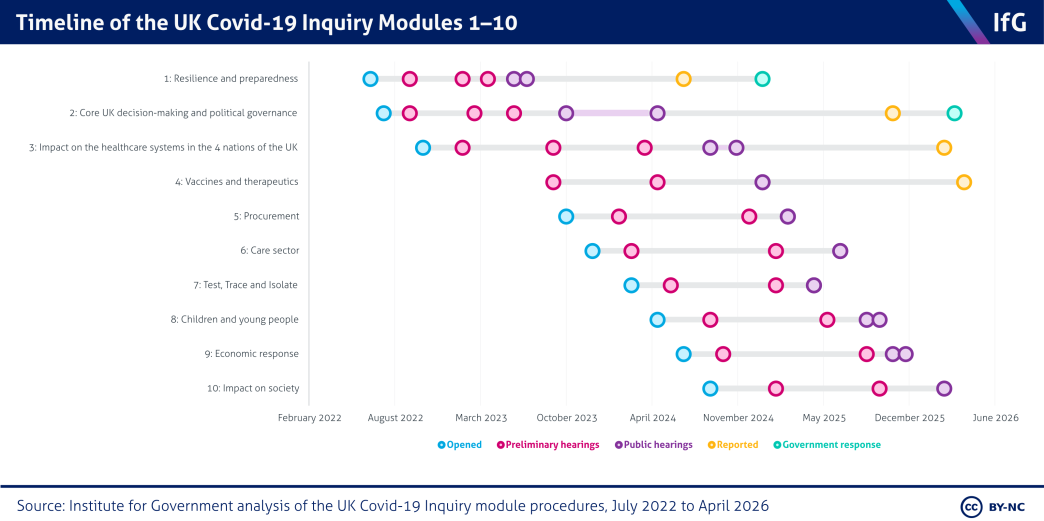
timeline of the UK Covid-19 Inquiry Modules 1-10

Public inquiries

Our work explores how inquiries are established and managed – and how these processes can be improved to ensure they serve the public interest.

Find out more
People hold up the Infected Blood Inquiry report outside Central Hall in Westminster, London, after it's publication.

Hearings for different modules of the inquiry are opened in sequence. Modules 1 – 7 have concluded their public hearings, Modules 8–10 have had preliminary hearings with public hearings for Module 8 due to start 29 September 44 https://covid19.public-inquiry.uk/modules/ .  Preliminary hearings are procedural, whereas public hearings hear formal evidence from witnesses. The inquiry is due to hold nine roundtables for Module 10 45 https://covid19.public-inquiry.uk/modules/impact-on-society-module-10/ .  

Groups or individuals with interest or expertise in, or with experience of, the inquiry’s subject matter can apply for Core Participant status. This gives them the right to access evidence, make opening and closing statements, suggest lines of questioning, and apply to ask questions during witness testimony.  

The inquiry invites applications for Core Participant status when each module is opened. Core Participants for Module 1 included the victims group Covid-19 Bereaved Families for Justice and several Westminster and devolved government departments 46 https://covid19.public-inquiry.uk/modules/resilience-and-preparedness/ .  

Not all witnesses have Core Participant status. The inquiry will hear witness testimony from those with a variety of different experiences of the pandemic, including politicians, scientific experts, and victims’ groups. The inquiry has heard from former prime ministers David Cameron and Boris Johnson as well as former chancellor George Osborne and former secretary of state for health Matt Hancock.  

What is the timetable for the inquiry?

The inquiry formally commenced on 28 June 2022, with the publication of its terms of reference 47 https://covid19.public-inquiry.uk/documents/terms-of-reference/ .  A key aim of the inquiry, published in its terms of reference, is to “produce its reports… and any recommendations in a timely manner.”

Preliminary hearings began in October 2022, full public hearings began on 13 June 2023.   Hearings are currently expected to continue until 2026, there are currently public hearings scheduled up to December 2025 (for Module 9). The inquiry will publish interim reports throughout, the Module 1 report on resilience and preparedness was published on 18 July 2024 and the government responded to it in January 2025 48 https://covid19.public-inquiry.uk/modules/resilience-and-preparedness/ .  

Will the inquiry cover the whole of the UK?

The inquiry will consider the Covid response across the UK, including reserved and devolved matters. However, it will “seek to minimise duplication” of investigations being carried out by devolved governments.  

The Scottish government has established its own Covid inquiry to “investigate aspects of the devolved strategic response to the pandemic.” The inquiry was officially established in February 2022 and is still ongoing 49 https://www.covid19inquiry.scot/ . Under the terms of the Inquiries Act 2005, the Scottish Covid-19 Inquiry may not “determine any fact or make any recommendation that is not wholly or primarily concerned with a Scottish matter.” 50 https://www.legislation.gov.uk/ukpga/2005/12/section/28

What challenges has the inquiry faced?

The inquiry has faced challenges in its attempts to gain access to WhatsApp and diary records held by Boris Johnson and the Cabinet Office, which the government argues it can only provide in redacted form. During the preliminary hearing for Module 1 held on 6 June, the chair named the Foreign Office as a second department which had failed to comply with requests for unredacted messages. She also said some deadlines for government witness statements had been missed.

On 1 June, the Cabinet Office launched a judicial review objecting to Baroness Hallett’s request for unredacted records. Some records have also been handed directly to the inquiry by former prime minister Boris Johnson.  

How much will the inquiry cost?

Inquiries can run up enormous bills. According to IfG research, the UK and devolved nations spent at least £630m on public inquiries between 1990 and 2017.

As of 30 June 2025 the cumulative inquiry costs had reached £177.2m 51 https://covid19.public-inquiry.uk/documents/uk-covid-19-inquiry-financial-report-for-quarter-1-2025-26/ .  Its costs are likely to surpass those of the most expensive inquiry ever, the Saville Inquiry into Bloody Sunday, which cost almost £200m. Over half of the costs have been spent on legal costs to the counsel and solicitors (£101.7m).  Every Story Matters, the public listening exercise has cost £14.7m.  

How does the inquiry compare to international Covid inquiries?

Some Covid inquiries have already reported; the Swedish and Australian inquiries have already published their final reports. The Dutch equivalent, run by the Dutch Safety Board, was split into three parts published its final report in October 2023. The Dutch Parliament is now running its own inquiry looking specifically at how public health interests were balance with other societal interests during the pandemic and is expected to complete in December 2026 52 https://www.houseofrepresentatives.nl/members_of_parliament/committees/pec .

The Covid Inquiry: What does Module II say about government decision making and political governance?

Join our IfG experts webinar to unpack the Covid Inquiry's findings and explore their implications for future governance.

Register to attend
From left to right: Sir Chris Whitty, Boris Johnson and Lord Vallance during a Covid press conference

Related content

06 JAN 2026 Explainer

Public inquiries

There are 27 ongoing or announced inquiries. But what exactly is a public inquiry?