The government should abolish outdated ‘by thirds’ council elections
Next week’s local elections should be the last to feature by-thirds votes

Ministers should take the opportunity of local government reorganisation to introduce all-out elections for all councils in place of elections by third and halves, say Megan Isaac and Akash Paun

Successive governments have signalled a clear preference for all-out elections – and every new unitary authority created since 2009 holds all-out elections as the default. But ministers have stopped short of requiring all councils to adopt them.
Instead, councils that currently elect by halves or thirds are permitted to move to all-out elections, but not the other way round (unless an all-out council has previously used by halves or thirds).
25
Local Government and Public Involvement in Health Act 2007, part 2
This has led to an inconsistent pattern of electoral cycles described by the Electoral Commission as a “historical accident”.
26
The Electoral Commission, ‘The cycle of local government elections in England: Report and recommendations’, January 2024, https://wokingham.moderngov.co.uk/documents/s53747/Appendix%20A.pdf
There are also potential cost savings from holding elections only once in four years – as much as an estimated £25m, had all by-halves and -thirds councils used all-out elections between 2021 and 2024.
But the benefits go beyond cost savings, and in retaining the current system the government has neglected the broader implications for stability, turnout and engagement.
Elections by thirds can undermine stability and decision making
Electing one third of councillors three years out of four can weaken the ability of councils to take a long-term view of local problems. Leadership and control can change almost annually, especially where councils have narrow majorities or are under no overall control.
These risks were identified in a 2021 governance review of Peterborough City Council, commissioned by the Department for Levelling Up, Housing and Communities. The review warned that the combination of no overall control and election by thirds risked a “short-term approach to local government” as “the political groups have an eye to the forthcoming elections every year”, creating heightened political sensitivity around budget decisions and undermining strategic policy making. The review recommended that the council consider all-out elections (the council chose to retain by-thirds). 27 Peterborough City Council, External assurance review – governance element, November 2021, https://assets.publishing.service.gov.uk/media/61812a188fa8f5297a62a324/Governance_Review_Peterborough_City_Council.pdf
This instability has implications beyond individual councils. In regions with mayoral strategic authorities (MSAs), leaders and other councillors sit on the board that decides how devolved budgets and powers should be used, meaning turnover in council leadership can also create instability at the regional tier, undermining long-term decision-making at precisely the moment these institutions are being tasked with expanded strategic responsibilities, for instance over spatial planning and housing.
Moving to all-out elections every four years would enable councils to focus on delivery over a full electoral cycle, while also giving strategic authorities greater stability.
Elections every four years could boost voter engagement and turnout
Turnout in English local elections remains stubbornly low, typically between 30% and 40% (when not combined with a general election). It is hard to conceive that the disjointed and inconsistent pattern of local electoral cycles helps this.
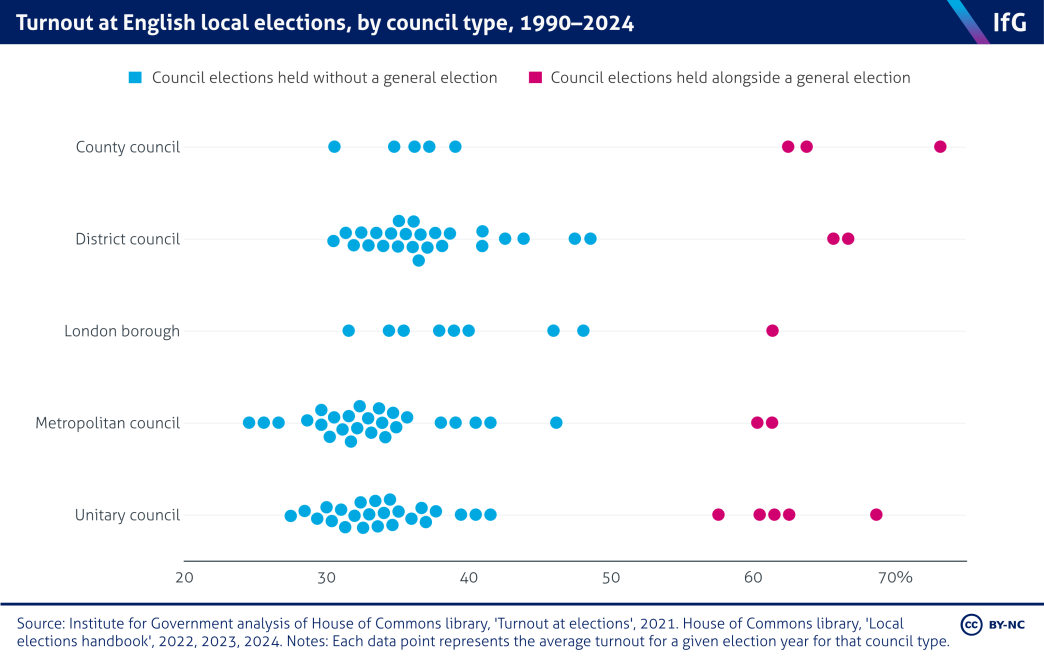
Election by thirds can dent turnout in at least three ways. First, it reduces the stakes of each electoral moment. Second, regular elections can contribute to voter fatigue. 28 Rallings C, Thrasher M and Borisyuk G, ‘Seasonal factors, voter fatigue and the costs of voting’, 2003, Electoral Studies 22, p.65-79. Third, the patchwork of cycles across England leads to a lack of clarity about who can vote when, and for what.
A 2001 government white paper recognised that the current cycle is “confusing”, that “it is too easy for electors to lose track of when elections are to be held”, and that it “can lessen the immediate impact of voters’ behaviour on council control.” 29 Department for Transport, Local Government and the Regions, ‘Strong Local Leadership – Quality Public Services’, CM5237, December 2001
By contrast, one academic study found that turnout in all-out elections is around 4 percentage points higher than in elections by thirds (although there are confounding factors that make causation difficult to prove). 30 Chris Hanretty, ‘Unitarisation and learning to vote without staggering’, 20 December 2024, https://chrishanretty.co.uk/posts/staggered_elections/
The government has a window of opportunity to modernise the system
The case for a more uniform system of local electoral cycles has been made as far back as the Widdicombe Committee report in 1986, and in 2004 the Electoral Commission recommended a national system of all-out elections. 31 Electoral Commission, ‘The cycle of local government elections in England: Report and recommendations’, January 2004
The government rejected this approach in 2007, 32 Local Government and Public Involvement in Health Act 2007 but the context has now changed. England’s political landscape is growing more fragmented, increasing the likelihood that near-annual elections will produce political instability at both local and regional levels.
Once LGR is implemented, election by thirds will be very much the exception to the rule. Ministers should take the logical next step and complete the job by legislating for a national system of all-out elections. For regions with MSAs, local council elections should be held mid-way through the four-year mayoral electoral term.
This move is not about uniformity for its own sake, but rather about strengthening democratic engagement, improving institutional stability and ensuring that England’s local and regional governance is fit for the future.