Mayor of Greater Manchester
On 30 July 2026, Bev Craig was elected as mayor of Greater Manchester.
On 30 July 2026, Bev Craig was elected as mayor of Greater Manchester. After winning 47% of first preference votes, she went on win the election, gaining the most second preference votes and securing the highest overall total.
Craig leads the Greater Manchester Combined Authority (GMCA), which is formed of 10 local authorities and controls a budget of over £3bn. 35 GMCA, ‘Greater Manchester sets out £3bn spending plans to deliver next year of good growth’, February 2026, https://www.greatermanchester-ca.gov.uk/news/greater-manchester-sets-out-3bn-spending-plans-to-deliver-next-year-of-good-growth/
What was the result of the 2026 Greater Manchester mayoral by-election?
Bev Craig was the winner of the July 2026 Greater Manchester mayoral by-election. She represents the Labour Party and was previously leader of Manchester City Council and GMCA deputy mayor economy, business and inclusive growth. 36 Waddington M, ‘Labour announces Manchester council boss as metro mayor candidate’, BBC News, 23 June 2026, retrieved 24 June 2026, www.bbc.co.uk/news/articles/c30y6dmzmqpo
Craig was elected under the supplementary vote (SV) system. She won 47% of first-preference votes, falling short of the 50% needed to win outright. As a result, the election proceeded to a second count involving the two leading candidates, Craig and Sian Astley from Reform UK, who had received 21% of first preference votes. Ballots cast for eliminated candidates were counted for second preference votes for either Craig or Astley. These votes were then added to the first preference votes. Craig secured the higher number of second preference votes, increasing her lead and securing her the highest overall total.
Craig’s highest share of first preference votes was 54% in Manchester, and her lowest was 40% in Bolton.
The turnout across the region was 25%, lower than the 2024 election where turnout was 32% and the lowest turnout in the region’s four mayoral elections since 2017.
The Reform UK candidate was Sian Astley, who is the leader of the Reform UK group on Manchester City Council. 42 ‘Reform announces candidate for Greater Manchester mayor’, BBC News, 29 June 2026, retrieved 30 June 2026, https://www.bbc.co.uk/news/articles/c5yz22pjq9jo The Green Party candidate was Geraldine Coggins, a Trafford Councillor. 43 Boyd R, Walker P, ‘After Burnham’s reign, battle begins for Greater Manchester’s mayoral crown’, Guardian, 22 June 2026, retrieved 22 June 2026, www.theguardian.com/uk-news/2026/jun/22/battle-begins-for-burnham-greater-manchester-mayoral-crown Phil Eckersley, also a Trafford Councillor, was the Conservative party candidate. 44 Docker G, ‘Conservatives name Greater Manchester mayoral candidate’, BBC, 28 June 2026, retrieved 29 June 2026, https://www.bbc.co.uk/news/articles/c30y13813v6o Richard Kilpatrick, a Manchester City Councillor, ran as the Liberal Democrat candidate. 45 Wareing D, ‘Lib Dems name Greater Manchester mayoral candidate’, BBC, 25 June 2026, retrieved 30 June 2026, https://www.bbc.co.uk/news/articles/cj4g15lg40vo Marlon Scott West was the Restore candidate. 46 Gotleib O, ‘Exclusive: Restore’s mayoral candidate revealed’, The Mill, 19 June 2026, retrieved 22 June 2026, https://manchestermill.co.uk/exclusive-restores-mayoral-candidate-revealed/
Why was there a mayoral by-election in Greater Manchester?
On 18 June 2026, then mayor of Greater Manchester Andy Burnham was elected as Labour MP for Makerfield in a parliamentary by-election.
The mayor of Greater Manchester cannot simultaneously serve as an MP, as mayors with police and crime commissioners (PCC) powers are automatically disqualified as mayor if they become an MP. 48 Police Reform and Social Responsibility Act 2011, section 67, www.legislation.gov.uk/ukpga/2011/13/section/67 As a result of Burnham becoming MP for Makerfield, the post of mayor of Greater Manchester became vacant and a mayoral by-election was held.
What is the history of devolution to Greater Manchester?
The Greater Manchester Combined Authority (GMCA) was established in April 2011 using powers under the Local Democracy, Economic Development and Construction Act 2009. As a combined authority, GMCA has the ability to take certain collective decisions across council boundaries.
In November 2014, a ‘devolution deal’ was agreed between the UK government and GMCA. This led to the transfer of functions from Whitehall, including over transport, planning, skills and economic regeneration. As part of the deal, GMCA agreed to the creation of the new post of mayor, who became its chair. Several subsequent deals have led to further functions being conferred on GMCA. 50 Greater Manchester Combined Authority, ‘Greater Manchester’s Seven Devolution Deals’, Greater Manchester Combined Authority, no date given, https://www.greatermanchester-ca.gov.uk/media/4695/greater-manchesters-seven-devolution-deals.pdf
What is the Greater Manchester Combined Authority?
GMCA has 10 constituent local authorities: Bolton, Bury, Manchester, Oldham, Rochdale, Salford, Stockport, Tameside, Trafford, and Wigan. At the time of the 2021 census, the total population of the area covered by the combined authority was 2.9 million.
The Labour Party currently has majority control of six of the 10 constituent councils. The exceptions are Bolton, Oldham and Tameside, which are under no overall control but Labour remain the largest party, and Stockport which is Liberal Democrat controlled. Labour also holds the separate post of Mayor of Salford.
What powers does the GMCA hold?
The mayor of Greater Manchester and GMCA exercise powers including over transport, skills, employment support, planning and regeneration, policing and fire services.
Greater Manchester agreed a ‘trailblazer’ devolution deal with the government in March 2023, as did the West Midlands. This deal gave GMCA further powers over post-19 skills, housing and regeneration, transport, and net zero, and also included agreement on a new ‘integrated settlement’ funding system, discussed below.
Transport is a key devolved responsibility. GMCA has specific responsibilities in transport and local infrastructure which it can allocate integrated settlement funding towards. It also has a range of associated transport powers, including over the road and active travel networks. In autumn 2024, GMCA was the first mayoral strategic authority outside of London to take control of the local bus system via a franchising scheme, and already controlled the local tram system. GMCA has developed an integrated transport system known as the ‘Bee Network’ which joins up franchised buses, trams, and walking and cycling routes into a single network with integrated ticketing. GMCA aims for all local rail services to be part of the Bee Network by 2030, delivering a fully integrated ‘London-style’ transport system.
GMCA is also responsible for the 19+ adult education budget, enabling it to develop a skills strategy that fits the needs of the local labour market. Like the Greater London Authority, but unlike other mayoral strategic authorities, it is responsible for commissioning employment support for long-term unemployed and disabled workers.
On housing and planning, the mayor can undertake compulsory purchase orders, following consultation the local authority and any National Park authority or the Broads authority in which the site to be purchased is situated. Following the enactment of the English Devolution and Community Empowerment Act 2026, all mayors are required to develop a statutory spatial development strategy which must be approved by a majority of constituent councils. GMCA also has some responsibility for net zero funding, including via building retrofit and public sector decarbonisation.
The mayor of Greater Manchester holds the functions of the police and crime commissioner for the region, along with responsibility for the fire and rescue service.
GMCA has partial control of a £6 billion health and social care budget, exercised via a partnership with the NHS, and has a co-commissioning role over local offender management systems. 57 BBC, ‘Manchester signs devolution deal for more criminal justice system powers’, BBC, 7 July 2016, retrieved 5 May 2022, www.bbc.co.uk/news/uk-england-manchester-36735175
Under powers in the English Devolution and Community Empowerment Act, as an established MSA, GMCA can propose further powers, funding and partnerships to expand the devolution framework, which the government is required to consider and respond to – this is known as the ‘right to request’.
What is GMCA’s budget?
In February 2026, GMCA agreed a budget of £3bn for the 2026/27 financial year, split between £1.1 billion capital expenditure and almost £2 billion revenue expenditure, for day-to-day spending. 58 GMCA, ‘Greater Manchester sets out £3bn spending plans to deliver next year of good growth’, February 2026, https://www.greatermanchester-ca.gov.uk/news/greater-manchester-sets-out-3bn-spending-plans-to-deliver-next-year-of-good-growth/
Over £650m (59%) of the planned capital budget is allocated to economic development and regeneration. Transport capital investments (£373m) account for most of the rest of the planned capital spending. 59 GMCA, ‘GMCA Capital Programme 2025/26–2028/29’, 13 February 2026, https://democracy.greatermanchester-ca.gov.uk/documents/s42233/Paper%20F%20-%20GMCA%20Capital%20Programme%202025-26%20-%202028-29%20Final.pdf
As for the revenue budget, over £900m planned expenditure relates to policing responsibilities and £481m relates to transport. 60 GMCA, ‘GMCA Transport Revenue Budget 2026/27’, 13 February 2026, https://democracy.greatermanchester-ca.gov.uk/documents/s42231/Paper%20D%20-%20GMCA%20Transport%20Revenue%20Budget%20202627%20Final.pdf A further £361m is committed across programmatic areas in the GMCA general budget including economy, environment, education and skills. The integrated settlement, discussed below, is an important source of income for spending in these areas. 61 GMCA, ‘GMCA General Revenue Budget 2026/27’, 13 February 2026, https://democracy.greatermanchester-ca.gov.uk/documents/s42253/Paper%20C%20-%20GMCA%20General%20Revenue%20Budget%202026-27%20Final.pdf
Since April 2025, over 25 of the separate grants provided by government departments to GMCA have been consolidated into an ‘integrated settlement’, which grants local leaders greater flexibility to reallocate funding across functional areas. Some funding streams remain outside of the integrated settlement, including police and waste functions, and GMCA’s 30-year investment fund. In the 2025/26 financial year, GMCA’s integrated settlement was £631m. 62 Ministry of Housing, Communities and Local Government, ‘Greater Manchester Combined Authority Integrated Settlement 2025 to 2026’, 20 December 2024, https://assets.publishing.service.gov.uk/media/67f4e2a06852ad6032f5c033/Annex_A-_Greater_Manchester_Integrated_Settlement_final_table_2025-26_FINAL_A… Since April 2026, the GMCA integrated settlement is allocated over a multi-year spending review period, granting greater medium-term funding certainty along with flexibility to move money between financial years.
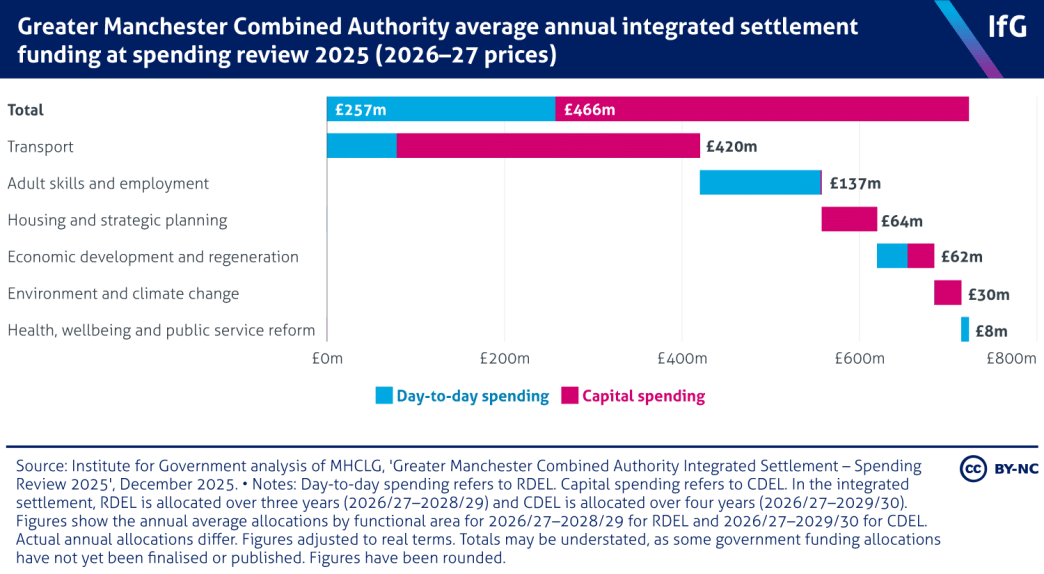
Some revenue also comes from local taxes. The mayor has the power to set a council tax precept to provide additional discretionary spending power. For 2026/27, this precept has been set at £153.95 per year for a Band D property. 64 GMCA, ‘Mayoral general budget and precept proposals’, 30 January 2026, https://democracy.greatermanchester-ca.gov.uk/documents/s42001/5A%20260128-Mayoral%20General%20Budget%20and%20Precept%20Proposals%2026-27%20-%20FINAL… There is a separate police precept, as in other parts of England, while some business rates revenue is also retained locally.
How does GMCA compare to the rest of the UK in terms of social and economic outcomes?
Based on data from 2017-2023, Greater Manchester underperforms the national average across several core economic indicators. Economic productivity and gross median weekly pay are both below the UK average, and while there is variation across the local areas, only Salford exceeds the UK average in terms of productivity and only Stockport and Trafford exceed the UK average in terms of gross median pay.
The region also underperforms on adult skills. Only, 58% of 16–64 olds have a level three qualification or above, compared to 61% across the UK. And while four areas outperform the national average (Bury, Manchester, Stockport and Trafford), most areas fall below the UK average. The lowest is Tameside with 49%.
Greater Manchester has a lower male healthy life expectancy than the UK average. Men in the region on average live almost 61 healthy years compared to the national figure of 63 years. In Oldham the figure is 57 years.
Public transport use to get to work is highest in Manchester (40%), but the region as a whole (25%) is below the national average (28%).
How does the GMCA area overlap with other administrative boundaries?
The GMCA area is well aligned with many other local administrative boundaries. This has made it simpler to integrate a wider set of public service functions into the devolution arrangements than in other combined authority areas. GMCA is coterminous with the Greater Manchester Police Force which allowed the mayor to take on police and crime commissioner functions. It is also coterminous with the Greater Manchester Health and Social Care Partnership and Transport for Greater Manchester, which operates as an executive arm of the combined authority. GMCA was coterminous with the Greater Manchester Local Enterprise Partnership, whose functions were fully integrated into GMCA.
- Topic
- Devolution
- Position
- Metro mayor
- English Regions
- North West
- Combined authorities
- Greater Manchester Combined Authority
- Publisher
- Institute for Government