Working to make government more effective

Explainer

Electoral systems across the UK

How do the electoral systems in the House of Commons and devolved legislatures work?

People walking out of a polling station
The devolved legislatures are elected using different voting systems to the first-past-the-post (FPTP) system used in UK general elections to elect MPs to Westminster.

Elections to the House of Commons, Senedd Cymru, Northern Ireland Assembly and Scottish Parliament each use a different electoral system. The UK government is also changing the system for mayoral elections. How do these different systems work?
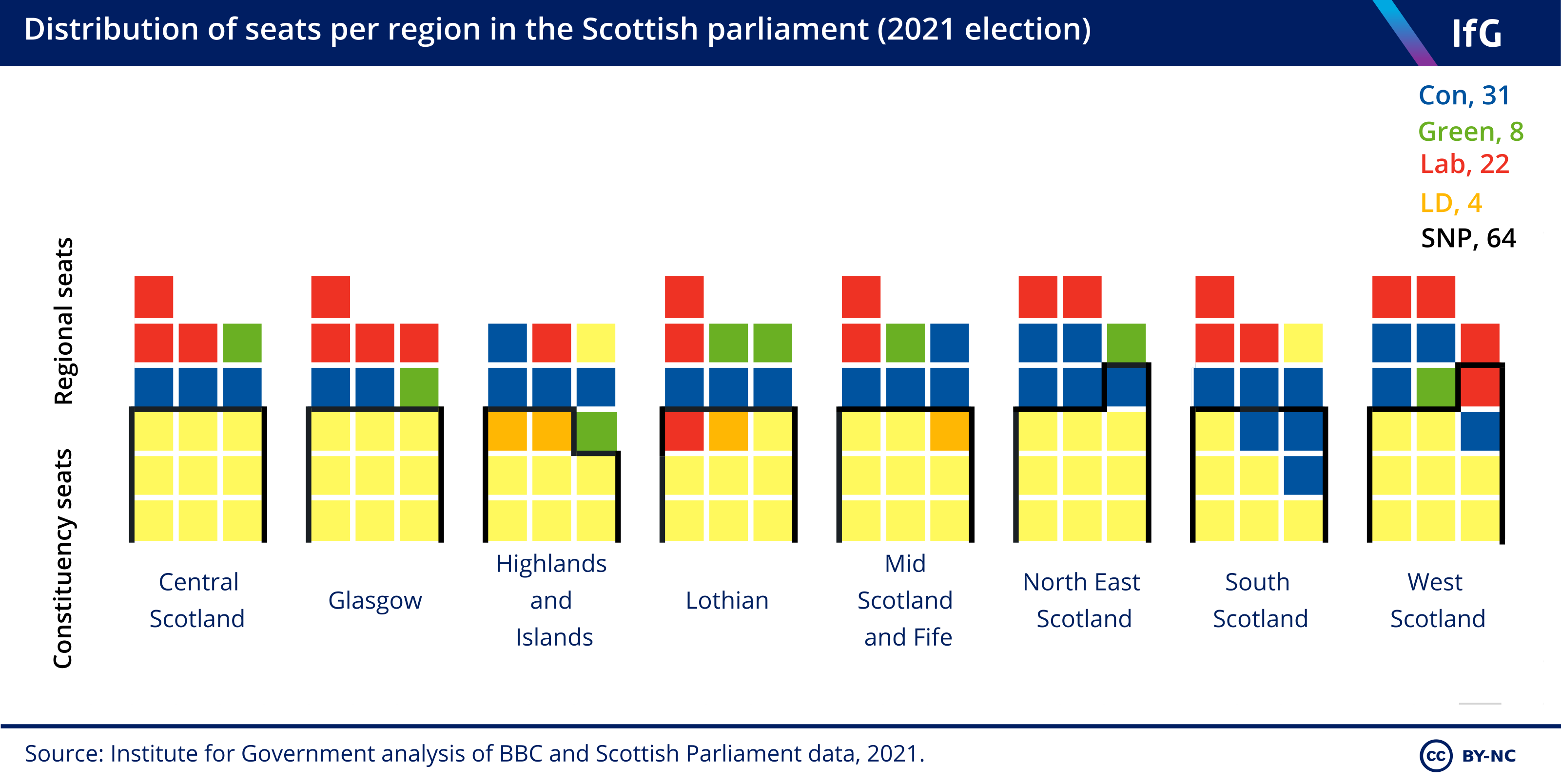
The devolved legislatures in Northern Ireland, Scotland and Wales are elected under voting systems that differ from the first-past-the-post (FPTP) system used in UK general elections.

All three use a type of proportional electoral system. The Scottish parliament is elected under a version of the 'additional member system' (AMS); the Northern Ireland assembly uses the 'single transferable vote' (STV); and the Senedd Cymru (Welsh parliament) uses a closed list proportional system.

Unlike the parliament in Westminster all three devolved legislatures are unicameral, with one legislative chamber. The UK parliament is bi-cameral but only the lower house, the House of Commons, is elected by public vote.

In 2016 and 2017, the power to reform the electoral system, electoral franchise and size of the devolved legislatures was devolved to Scotland and Wales, subject to support of two-thirds of members. The Northern Ireland assembly cannot reform its own electoral system.

The voting age for elections to the Scottish Parliament and Senedd Cymru was reduced from 18 to 16 from the 2016 and 2021 elections respectively. In February 2026, the Representation of the People bill was introduced to parliament which will reduce the voting age to 16 for UK general elections, elections to the Northern Ireland Assembly and local councils in England and Northern Ireland. The legislation is expected to be in place by the next general election.

British, Irish, or qualifying commonwealth citizens are eligible to vote in UK general elections. In Northern Ireland the qualification is expanded to include those who are legally resident in the country with EU citizenship. In Scotland and Wales this is expanded further to include anyone legally resident regardless of their nationality. 


Scotland

Scottish parliamentary elections use the additional member system (AMS). Voters in Scotland each have two votes; the first vote is for a constituency member, the second for a party, on a regional basis.

Votes for the constituency member are counted using the same first-past-the-post method that is used in UK parliament elections: the candidate with the most votes in that constituency wins the seat. There are 73 members elected in this way. 

The second vote acts as a top up vote providing 56 ‘additional members’ to the parliament. These members are elected to represent eight parliamentary regions with seven seats available in each. Voters cast their vote for a party (or independent) in their region. Any parties contesting a region publish a fixed list of candidates. 

Party seat entitlement for the regional members is determined through the d’Hondt formula. undefined Wilson H.J., 'The D’Hondt Method Explained', Mathematics Department, UCL, https://www.ucl.ac.uk/~ucahhwi/dhondt.pdf.  For the party that wins additional seats, the first name on their list is elected to the first additional seat, proceeding down the list if more seats are won.

This stage is described as ‘topping up’ because it allocates additional seats to parties or independent candidates according to the number of regional votes cast, while taking into account how many constituency seats the party won within the region. A party that wins a disproportionate share of constituency seats may therefore not win any additional regional seats, even if it wins the largest number of regional votes.

Wales

From 1999 until 2021, Senedd Cymru, like the Scottish Parliament, was elected using the Additional Member System, although using a form of the system that was less proportional than its Scottish equivalent.

Following the passage of the Senedd Cymru (Members and Elections) Act 2024, the 2026 election was held under a closed list proportional system. The number of Members of the Senedd (MSs) increased from 60 to 96 and the constituencies increased in size and decreased in number from 40 to 16, with six MSs representing each new constituency.

Under the new ‘closed list proportional’ electoral system, voters cast one vote, for a political party rather than an individual (with the exception of independent   candidates, who will be included on the ballot as individuals rather than parties). Political parties can list up to eight candidates for each constituency. Seats are allocated based on the share of votes each party (or independent candidate) receives in the constituency, using the D’Hondt formula.

Labour should introduce the alternative vote system for mayoral elections

The alternative vote would be fairer and more appropriate than the system the government favours.

Read the comment
Andy Burnham speaking at the Salford Lads Club during the launch of his campaign for re-election as Mayor of Greater Manchester Combined Authority

Mayoral elections in England

Since May 2023, mayoral (and police and crime commissioner) elections in England have used the first-past-the-post (FPTP) voting system. Prior to this, mayoral elections used the supplementary voting (SV) system. Following the passage of the English Devolution and Community Empowerment Act in 2026, mayoral elections will return to using the SV system.

Under SV, there are two columns on the ballot paper. Voters indicate their first-choice candidate in the first column and their second-choice candidate in the second column.  

If a candidate receives more than 50% of first preference votes, then they are elected. If no candidate receives more than 50% of the first preference votes, then all but the two candidates with the most first preference votes are eliminated. The second preference votes of the eliminated candidates are transferred to the two remaining candidates. The candidate with the most votes after this transfer is elected.  

The London Assembly – the body which scrutinises and holds the mayor of London to account – is elected using a version of AMS 

Northern Ireland

The Northern Ireland assembly in Stormont was established following the Belfast/Good Friday Agreement signed in 1998 and was designed to facilitate power-sharing between unionist and nationalist parties. The assembly comprises 90 members who are elected using the ‘single transferable vote’ (STV) system.

Under STV, all members are elected in the same way and are elected to represent multi member constituencies. The 18 constituencies are the same as those used in UK general elections with five members elected from each. Parties can put forward as many candidates as they like in a constituency – in 2022 a total of 239 candidates stood in the election.
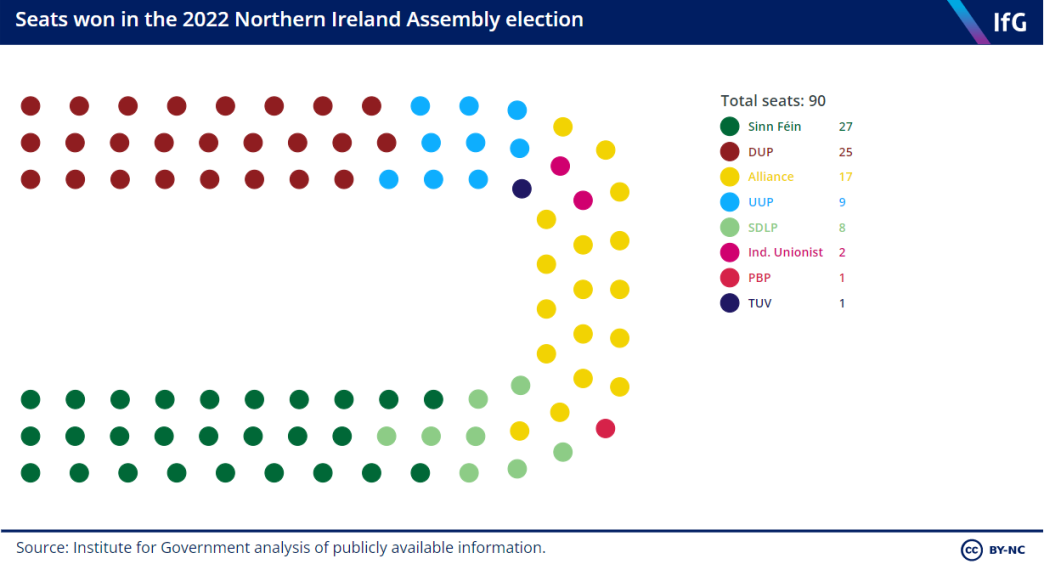
Seats won in the 2022 Northern Ireland Assembly election

Voters are presented with a list of candidates and rank their preferred candidates in order of preference. To gain a seat a candidate needs to receive a certain number of votes (the quota) which varies across constituencies. The 'droop quota’ is calculated by dividing total votes cast by 1 more than the number of available seats, then adding 1.  

When a candidate has exceeded the quota other votes for them are surplus votes. These are transferred to voters’ next preference candidate. Instead of transferring specific ballot papers, a representative transfer value is calculated (see box below). If no one reaches the quota, the candidate(s) with the fewest votes are eliminated and their votes redistributed. If a voter’s second preference is already eliminated their next available preference is used.

At each stage candidates who receive transferred votes and exceed the quota are elected, and further candidates are eliminated. Any surpluses, and the votes the eliminated candidates received, are then redistributed. The process continues in this way until all the seats are filled. 

How are the votes transferred to a second preference?

When there is a surplus of votes for a candidate (i.e. any above the droop quota), a representative transfer value is calculated. This is done by dividing the surplus by the total number of votes cast for that candidate that have a second choice marked. This fractional value is then transferred to the second preferences.

The candidate(s) with the fewest votes are also eliminated and their preferences redistributed. If the second preference is an eliminated candidate, the next available preference is used. The transfer value for these votes is one vote, as the first preference was not used.

If a surplus arises at a later stage (i.e. not the initial count of first preferences), then the representative transfer value is only calculated for the last batch of votes that got the candidate over the quota. undefined Trinity College Dublin, Election indices, www.tcd.ie/Political_Science/people/michael_gallagher/ElSystems/Docts/ElectionIndices.pdf

Example:

John Smith receives 1,000 first-preference votes.

The droop quota is worked out to be 800, so John Smith is elected immediately.

John Smith has 200 surplus votes. All of the ballot papers that have him as first choice also have a second preference marked (although this is unusual in real-life cases).

Representative transfer value: 200 / 1,000

Value: 0.2

600 of John Smith’s votes had Jane White as their second preference, so Jane receives 120 redistributed votes (600 x 0.2)

200 had Mark Green as their second preference, so Mark receives 40 votes (200 x 0.2)

200 had Maria Black as their second preference, so Maria also receives 40 votes (200 x 0.2). 

What are the effects of the different electoral systems across the UK?

The systems used in the devolved legislatures are designed to produce more proportional results; the number of seats each party wins more closely reflects its share of the vote. The result is that single-party majorities are rare.  

The Gallagher index is used to measure proportionality across different system, on a scale of 0 to 100 a score closer to 0 indicates more proportional outcomes.  

Comparing the devolved legislatures since devolution in 1999 the Northern Ireland assembly’s STV system is the most proportional, Scottish parliament and Senedd elections have been slightly less proportional (in that order). All are more proportional on average than UK general elections. 

Related content

29 MAY 2026 Explainer

Sewel convention

How the Sewel convention works in practice and what happens when devolved consent is withheld.